Chapter 1 — General Management and Marketing
1. Concept of Management
Likely Exam Question (5 marks)
"Define management. Explain the functions of management as given by Henri Fayol."
Definition
Management is the process of planning, organizing, leading, and controlling resources (human, financial, material, informational) to achieve organizational goals effectively and efficiently.
- Effectively — doing the right things (achieving goals)
- Efficiently — doing things right (minimum resource waste)
"Management is the art of getting things done through people." — Mary Parker Follett
"To manage is to forecast and to plan, to organize, to command, to coordinate and to control." — Henri Fayol
Functions of Management (Fayol's Five Functions)
| Function | Description | Key Activities |
|---|---|---|
| Planning | Deciding what to do in advance | Setting goals, strategies, policies, budgets |
| Organizing | Arranging resources and tasks | Departmentalization, delegation, authority structure |
| Commanding (Leading) | Directing people towards goals | Motivating, communicating, supervising |
| Coordinating | Harmonizing group efforts | Ensuring departments work in sync |
| Controlling | Measuring performance vs. standards | Corrective action, feedback loops |
Levels of Management
| Level | Role | Example |
|---|---|---|
| Top Management | Strategic decisions, vision, policy | CEO, MD, Board of Directors |
| Middle Management | Implement strategies, coordinate | Department Heads, Branch Managers |
| Lower/Supervisory | Day-to-day operations, supervision | Supervisors, Foremen, Team Leaders |
2. Modern Approaches to Management
Likely Exam Question (10 marks)
"Discuss the evolution of management thought with emphasis on modern approaches."
2.1 Classical Approach
(a) Scientific Management — Frederick W. Taylor (1911)
- Focus on efficiency at the shop-floor level
- Principles:
- Science, not rule of thumb
- Harmony, not discord
- Cooperation, not individualism
- Maximum output, not restricted output
- Development of each worker to greatest efficiency
(b) Administrative Theory — Henri Fayol (1916)
- Focused on management as a whole (top-down)
- 14 Principles of Management (selected key ones):
| Principle | Meaning |
|---|---|
| Division of Work | Specialization increases efficiency |
| Authority & Responsibility | Right to give orders with accountability |
| Unity of Command | One employee, one boss |
| Unity of Direction | One plan for a group of activities with same objective |
| Scalar Chain | Clear line of authority from top to bottom |
| Esprit de Corps | Team spirit and unity |
(c) Bureaucratic Theory — Max Weber
- Formal hierarchy, rules, impersonal relationships
- Division of labor, merit-based promotion
2.2 Behavioral/Human Relations Approach
- Elton Mayo (Hawthorne Studies, 1924–32): Social factors and attention affect productivity more than physical conditions
- Abraham Maslow: Need Hierarchy Theory
- Douglas McGregor: Theory X (authoritarian) vs. Theory Y (participative)
2.3 Modern Approaches
| Approach | Key Idea | Proponents |
|---|---|---|
| Systems Approach | Organization is an open system with interrelated subsystems (inputs → process → outputs → feedback) | Ludwig von Bertalanffy, Katz & Kahn |
| Contingency Approach | No single best way to manage; depends on situation (environment, technology, people) | Fred Fiedler, Joan Woodward |
| Quantitative Approach | Use of mathematical models, statistics, OR techniques for decision-making | Operations Research School |
| Total Quality Management | Continuous improvement, customer focus, employee involvement | W. Edwards Deming, Joseph Juran |
Key Exam Points — Modern Approaches
- Systems approach treats organization as open system interacting with environment
- Contingency approach says "it depends" — no universal best practice
- Know at least 3 approaches with one proponent each
3. Motivation
Likely Exam Question (10 marks)
"Explain Maslow's Need Hierarchy Theory and Herzberg's Two-Factor Theory of motivation."
Definition
Motivation is the internal drive that energizes, directs, and sustains behavior toward achieving goals.
3.1 Maslow's Need Hierarchy Theory (1943)
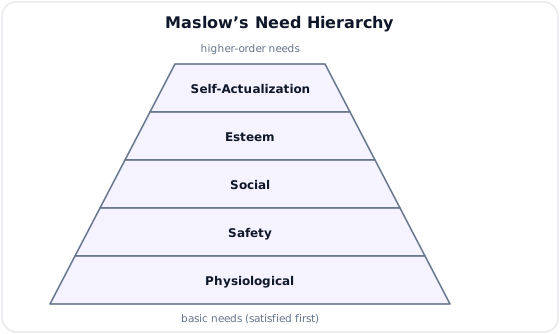
- Lower needs must be substantially satisfied before higher needs emerge
- A satisfied need no longer motivates
- Movement is generally upward, but regression possible
3.2 Herzberg's Two-Factor Theory (1959)
| Hygiene Factors (Dissatisfiers) | Motivators (Satisfiers) |
|---|---|
| Company policy | Achievement |
| Supervision | Recognition |
| Salary & working conditions | Work itself |
| Interpersonal relations | Responsibility |
| Job security | Growth & advancement |
- Hygiene factors prevent dissatisfaction but don't motivate
- Motivators drive job satisfaction and performance
- Implication: Enrich jobs, not just improve conditions
3.3 McGregor's Theory X and Theory Y
| Theory X (Pessimistic) | Theory Y (Optimistic) |
|---|---|
| Workers dislike work | Work is natural |
| Must be coerced/controlled | Self-directed when committed |
| Avoid responsibility | Seek responsibility |
| Need security above all | Capable of creativity |
3.4 Other Motivation Theories
| Theory | Key Concept |
|---|---|
| McClelland's Needs | Need for Achievement (nAch), Power (nPow), Affiliation (nAff) |
| Vroom's Expectancy | Motivation = Expectancy × Instrumentality × Valence |
| Adam's Equity Theory | People compare input/output ratios with others |
Key Exam Points — Motivation
- Maslow: 5 levels, hierarchy, lower first
- Herzberg: Two factors — hygiene prevents dissatisfaction, motivators create satisfaction
- Theory X = authoritarian; Theory Y = participative
4. Leadership
Likely Exam Question (5 marks)
"Differentiate between different styles of leadership."
Definition
Leadership is the ability to influence and guide individuals or groups toward achieving goals.
Leadership vs. Management
| Aspect | Leadership | Management |
|---|---|---|
| Focus | Vision, people, change | Systems, structure, control |
| Approach | Inspires and motivates | Plans and organizes |
| Orientation | Long-term, strategic | Short-term, operational |
| Authority | Personal influence | Formal position |
Leadership Styles
| Style | Description | When Best Used |
|---|---|---|
| Autocratic | Leader decides alone; tight control | Crisis, unskilled workforce |
| Democratic/Participative | Involves team in decisions | Skilled team, complex problems |
| Laissez-faire | Minimal intervention; freedom to team | Highly skilled, self-motivated team |
| Transformational | Inspires change, vision-driven | Innovation, organizational change |
| Transactional | Rewards/punishments for performance | Routine operations, clear tasks |
| Situational (Hersey-Blanchard) | Adapts style to maturity level of followers | Any situation |
Leadership Theories
| Theory | Key Idea |
|---|---|
| Trait Theory | Leaders are born with certain traits (intelligence, confidence, integrity) |
| Behavioral Theory | Leadership can be learned through specific behaviors |
| Contingency Theory (Fiedler) | Effectiveness depends on match between style and situation |
| Path-Goal Theory (House) | Leader clears obstacles and provides direction for subordinates |
5. Control and Coordination
Likely Exam Question (5 marks)
"What is controlling? Explain the steps in the control process."
5.1 Controlling
Controlling is the process of monitoring performance, comparing it with standards, and taking corrective action.
Steps in Control Process
- Establish Standards — Set measurable performance criteria
- Measure Actual Performance — Collect data through reports, observations
- Compare — Identify deviations (positive or negative)
- Take Corrective Action — Adjust plans, resources, or methods
Types of Control
| Type | Timing | Example |
|---|---|---|
| Feed-forward (Preventive) | Before activity | Quality inspection of raw materials |
| Concurrent | During activity | Supervisor monitoring work-in-progress |
| Feedback | After activity | Final product quality check |
5.2 Coordination
Coordination is the integration of activities of different departments to achieve organizational goals harmoniously.
| Principle | Description |
|---|---|
| Direct Contact | Managers communicate directly |
| Early Stage | Coordination starts at planning stage |
| Reciprocal Relationship | All factors are interdependent |
| Continuity | Ongoing process, not one-time |
Mary Parker Follett's principles of coordination emphasize that it must be a continuous, direct, and early process involving all parties.
6. Teamwork and Group Dynamics
Likely Exam Question (5 marks)
"What is group dynamics? Explain the stages of team development."
Group vs. Team
| Aspect | Group | Team |
|---|---|---|
| Goal | Individual goals | Common goal |
| Accountability | Individual | Mutual/shared |
| Synergy | Neutral or negative | Positive |
| Skills | Random | Complementary |
Tuckman's Stages of Team Development (1965)
| Stage | Characteristics |
|---|---|
| Forming | Orientation, testing boundaries, polite |
| Storming | Conflict, power struggles, competition |
| Norming | Cohesion develops, roles clarified, trust built |
| Performing | High performance, goal-focused, collaborative |
| Adjourning | Task complete, dissolution, reflection |
Factors Affecting Group Dynamics
- Group Size — Optimal 5–9 members for decision-making
- Group Cohesiveness — Shared values increase performance
- Groupthink — Excessive conformity leads to poor decisions (Irving Janis)
- Social Loafing — Individual effort decreases in larger groups
Key Exam Points — Teamwork
- Know all 5 stages of Tuckman's model
- Groupthink is negative — suppresses dissent
- Teams differ from groups in synergy and accountability
7. Management Information System (MIS)
Likely Exam Question (10 marks)
"What is MIS? Explain its components and role in decision-making."
Definition
Management Information System (MIS) is a computer-based system that provides managers with tools to organize, evaluate, and manage information for decision-making.
Components of MIS
| Component | Function |
|---|---|
| Hardware | Computers, servers, networking equipment |
| Software | Application programs, DBMS, OS |
| Data | Raw facts collected from internal/external sources |
| Procedures | Rules for data collection, processing, distribution |
| People | Users, IT staff, managers |
Levels of Information Systems
| Level | System Type | Users | Example |
|---|---|---|---|
| Operational | Transaction Processing System (TPS) | Supervisors | Billing, payroll |
| Tactical | Management Information System (MIS) | Middle managers | Sales reports, budget analysis |
| Strategic | Decision Support System (DSS) / Executive Information System (EIS) | Top management | Market trends, strategic planning |
Role of MIS in Decision-Making
- Data Collection — Gathers data from all departments
- Data Processing — Converts raw data into meaningful information
- Information Storage — Maintains database for retrieval
- Information Dissemination — Provides timely reports to managers
- Decision Support — Enables informed, data-driven decisions
Benefits of MIS
- Improved decision quality and speed
- Better coordination across departments
- Enhanced planning and forecasting
- Reduced information overload through filtering
- Improved competitive advantage
Key Exam Points — MIS
- MIS converts data → information → knowledge
- Three levels: TPS, MIS, DSS/EIS
- MIS supports all management levels, not just top management
8. Corporate and Strategic Planning
Likely Exam Question (10 marks)
"What is strategic planning? Explain the strategic planning process with SWOT analysis."
8.1 Corporate Planning
Corporate Planning is the process of defining the overall direction and objectives of an entire organization for the long term.
- Sets mission, vision, and values
- Determines resource allocation across business units
- Time horizon: typically 3–10 years
8.2 Strategic Planning
Strategic Planning is the systematic process of defining strategy, making decisions on resource allocation, and setting priorities.
Strategic Planning Process

- Define Mission & Vision — Why the organization exists and where it wants to go
- Environmental Analysis
- External (PESTLE): Political, Economic, Social, Technological, Legal, Environmental
- Internal: Resources, capabilities, core competencies
- SWOT Analysis
- Strategy Formulation — Corporate, business, and functional strategies
- Strategy Implementation — Resource allocation, structure, leadership
- Evaluation & Control — Performance metrics, corrective actions
SWOT Analysis
| Helpful | Harmful | |
|---|---|---|
| Internal | Strengths | Weaknesses |
| External | Opportunities | Threats |
Strategic Management Models
| Tool/Model | Purpose |
|---|---|
| Porter's Five Forces | Analyze industry competition |
| BCG Matrix | Portfolio analysis (Star, Cash Cow, Question Mark, Dog) |
| Ansoff Matrix | Growth strategies (Market Penetration, Development, Product Development, Diversification) |
| Balanced Scorecard | Measure performance across 4 perspectives (Financial, Customer, Internal Process, Learning) |
Porter's Five Forces
- Threat of New Entrants — Barriers to entry
- Bargaining Power of Suppliers — Supplier concentration
- Bargaining Power of Buyers — Customer negotiation power
- Threat of Substitutes — Alternative products/services
- Industry Rivalry — Competition intensity
Key Exam Points — Strategic Planning
- SWOT: Internal (S, W) vs. External (O, T)
- Porter's Five Forces analyzes industry competitiveness
- BCG Matrix classifies products/units by market share and growth rate
9. Corporate Social Responsibility (CSR)
Likely Exam Question (5 marks)
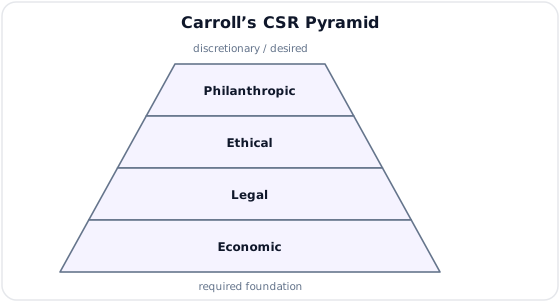
"What is Corporate Social Responsibility? Explain Carroll's CSR Pyramid."
Definition
Corporate Social Responsibility (CSR) is a business model in which companies integrate social and environmental concerns in their operations and interactions with stakeholders.
Carroll's CSR Pyramid (1991)
Triple Bottom Line (TBL) — John Elkington (1994)
- People — Social responsibility
- Planet — Environmental sustainability
- Profit — Economic viability
Benefits of CSR
| Benefit | Description |
|---|---|
| Brand Image | Positive public perception |
| Employee Retention | Attracts and retains talent |
| Risk Mitigation | Reduces regulatory and legal risks |
| Customer Loyalty | Consumers prefer socially responsible companies |
| Investor Confidence | ESG compliance attracts ethical investors |
CSR in Nepal Context
- Companies Act 2063 and NRB directives encourage CSR
- Banks required to spend portion of profits on social activities
- Telecom operators (NTC, Ncell) invest in rural connectivity, education
10. Ethics, Integrity, and Responsibility
Likely Exam Question (5 marks)
"What is business ethics? Discuss ethical issues in service-like institutions."
Definition
Business Ethics is the study of appropriate business policies and practices regarding potentially controversial subjects including corporate governance, insider trading, bribery, discrimination, and social responsibility.
Core Ethical Principles
| Principle | Meaning |
|---|---|
| Integrity | Adherence to moral and ethical standards; honesty |
| Transparency | Open communication and accountability |
| Fairness | Just treatment of all stakeholders |
| Accountability | Taking responsibility for actions and decisions |
| Respect | Dignity for individuals and communities |
Ethical Issues in Business/Service Institutions
- Conflict of Interest — Personal interest vs. organizational duty
- Corruption and Bribery — Unethical payments for favors
- Discrimination — Unfair treatment based on gender, caste, religion
- Environmental Degradation — Ignoring environmental impact for profit
- Data Privacy — Misuse of customer/employee data
- Whistleblower Protection — Supporting those who report wrongdoing
Code of Ethics in Telecom (Nepal)
- Nepal Telecommunications Authority (NTA) guidelines
- Fair pricing and transparency in service charges
- Quality of Service (QoS) standards
- Universal service obligation for rural areas
- Prevention of monopolistic practices
Key Exam Points — Ethics & CSR
- Carroll's Pyramid: Economic → Legal → Ethical → Philanthropic
- TBL: People, Planet, Profit
- Ethics in telecom: QoS, fair pricing, universal access
11. Business Strategic Planning
Likely Exam Question (5 marks)
"Differentiate between strategic planning and operational planning."
Strategic vs. Operational Planning
| Dimension | Strategic Planning | Operational Planning |
|---|---|---|
| Scope | Entire organization | Department/function |
| Time Horizon | Long-term (3–10 years) | Short-term (1 year or less) |
| Focus | Direction and vision | Day-to-day execution |
| Who | Top management | Middle/lower management |
| Risk | High uncertainty | Lower uncertainty |
| Flexibility | Broad, adaptable | Specific, detailed |
Business Strategy Levels
- Corporate Strategy — What businesses to be in? (diversification, mergers)
- Business/Competitive Strategy — How to compete? (cost leadership, differentiation)
- Functional Strategy — How to support business strategy? (marketing, HR, finance plans)
Porter's Generic Strategies
| Strategy | Description | Example |
|---|---|---|
| Cost Leadership | Lowest cost producer in the industry | Walmart, Ncell (competitive pricing) |
| Differentiation | Unique product/service, premium pricing | Apple, NTC (brand trust) |
| Focus/Niche | Serve a specific market segment | Luxury telecom, rural ISPs |
12. Marketing Process
Likely Exam Question (10 marks)
"Explain the marketing process. Describe the marketing mix (4Ps) with examples from the telecom industry."
Definition
Marketing is the process of identifying, anticipating, and satisfying customer needs profitably.
"Marketing is a social and managerial process by which individuals and groups obtain what they need and want through creating and exchanging products and value with others." — Philip Kotler
The Marketing Process

- Market Research — Understand customer needs, market size, competitors
- STP (Segmentation, Targeting, Positioning)
- Develop Marketing Mix (4Ps/7Ps)
- Implementation — Execute marketing plan
- Control & Evaluation — Measure ROI, adjust strategies
Market Segmentation
| Basis | Description | Example |
|---|---|---|
| Geographic | Region, urban/rural | NTC rural vs. urban plans |
| Demographic | Age, income, education | Student packs, business plans |
| Psychographic | Lifestyle, values | Premium vs. value users |
| Behavioral | Usage rate, loyalty | Heavy data users, prepaid vs. postpaid |
13. Product Planning
Likely Exam Question (5 marks)
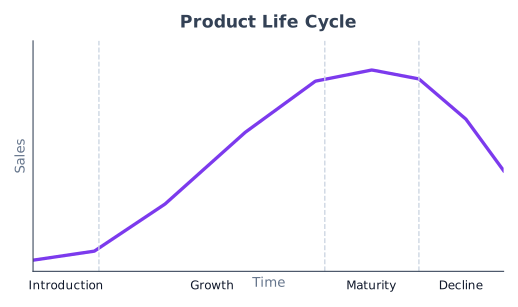
"Explain the Product Life Cycle with a diagram."
Product Levels (Kotler)
- Core Product — Basic benefit (e.g., communication)
- Actual Product — Features, quality, brand (e.g., NTC 4G SIM)
- Augmented Product — After-sales support, warranty, delivery
Product Life Cycle (PLC)
| Stage | Characteristics | Strategy |
|---|---|---|
| Introduction | Low sales, high cost, no profit | Awareness, heavy promotion |
| Growth | Rising sales, competitors enter | Differentiation, expand distribution |
| Maturity | Peak sales, saturated market | Defend market share, diversify |
| Decline | Falling sales, obsolescence | Harvest or divest |
New Product Development Process
- Idea Generation
- Idea Screening
- Concept Development & Testing
- Business Analysis
- Product Development
- Test Marketing
- Commercialization
14. Developing the Marketing Program (Marketing Mix)
Likely Exam Question (10 marks)
"Describe the 7Ps of marketing mix with examples from the telecom sector."
The 4Ps (Traditional Marketing Mix)
| P | Element | Description | Telecom Example |
|---|---|---|---|
| Product | Goods/services offered | Features, quality, brand | NTC 4G data packs |
| Price | Amount charged | Pricing strategy | Competitive pricing vs. Ncell |
| Place | Distribution channels | Availability, coverage | Recharge points, mobile app |
| Promotion | Communication to customers | Advertising, sales promotion | TV ads, SMS campaigns |
Extended 7Ps (Services Marketing)
| P | Element | Telecom Example |
|---|---|---|
| People | Employees delivering service | Customer care representatives |
| Process | Service delivery mechanism | SIM activation, complaint resolution |
| Physical Evidence | Tangible cues of service | Retail stores, bills, tower visibility |
Pricing Strategies
| Strategy | Description | Example |
|---|---|---|
| Penetration Pricing | Low initial price to gain market share | Ncell entry pricing in Nepal |
| Skimming Pricing | High initial price, lower later | New technology launch |
| Competitive Pricing | Match competitor prices | NTC vs. Ncell data rates |
| Bundle Pricing | Multiple services at discount | Voice + Data + SMS packs |
| Freemium | Basic free, premium paid | Free Facebook, paid data |
Promotion Mix
| Tool | Description | Example |
|---|---|---|
| Advertising | Paid, non-personal communication | TV, radio, newspaper ads |
| Sales Promotion | Short-term incentives | Bonus data, lucky draws |
| Personal Selling | Face-to-face interaction | Corporate account managers |
| Public Relations | Building public image | CSR events, sponsorships |
| Direct Marketing | Direct communication with customers | SMS marketing, email |
Key Exam Points — Marketing
- Know 4Ps and extended 7Ps with telecom examples
- PLC has 4 stages: Introduction → Growth → Maturity → Decline
- STP: Segmentation → Targeting → Positioning
- Telecom marketing: mix of competitive pricing, bundled services, digital promotion