Transmission Fundamentals
Possible Exam Questions
Exam Questions and Answer Map
Tags: [PYQ paper/year] = directly observed in a past paper · [likely] = pattern-predicted variant. Marks in [ ] show the typical split.
-
Explain the basic telecommunication network and its evolution. [5] — [likely]
-
Answer plan: Define a telecom network → list main elements (terminal, transmission, switching, signalling, NMS) → describe evolution stages from manual telephony to NGN → state the key trend toward packet/IP convergence.
-
Model answer: Basic Telecommunication Network and Its Evolution
-
Compare guided transmission media (twisted pair, coaxial, optical fiber). [5] — [likely]
-
Answer plan: Define guided media → compare bandwidth, typical use, advantages, and limitations for each medium → mention selection criteria.
-
Model answer: Guided Transmission Media Comparison
-
Define characteristic impedance and return loss of a transmission line. [5] — [likely]
-
Answer plan: State \(Z_0 = \sqrt{(R+j\omega L)/(G+j\omega C)}\) → explain matched condition \(Z_L = Z_0\) → derive reflection coefficient \(\Gamma\) → define return loss \(RL = -20\log_{10}|\Gamma|\) → state why high RL is desirable.
-
Model answer: Characteristic Impedance and Return Loss
-
Explain the hybrid (2-wire/4-wire) circuit and the transformer used in telephony. [5] — [likely]
-
Answer plan: Describe 2-wire subscriber loop vs 4-wire trunk → explain hybrid circuit function and balance network → state transformer uses (impedance matching, isolation, balanced/unbalanced) → give turns-ratio impedance formula \(Z_p = a^2 Z_s\).
-
Model answer: Two-Wire/Four-Wire Hybrid and Telephone Transformer
-
What are echo and singing in a telephone network and how are they controlled? [5–10] — [likely]
-
Answer plan: Define echo as delayed reflection due to mismatch → list causes → describe talker/listener/acoustic echo → define singing as sustained oscillation (Barkhausen criterion) → compare echo vs singing → list control methods (echo canceller, matching, gain reduction).
- Model answer: Echo and Singing in Telephone Networks
Scope of this Topic
This note covers the NTC syllabus items: evolution of telecommunication networks, transmission media and lines, characteristic impedance, return loss, transformers and hybrid circuits, signal and noise measurements, echo, and singing.
1. Evolution of Telecommunication Systems
Likely Exam Question (5 marks)
"Briefly explain the evolution of telecommunication networks from analog telephony to NGN."
Telecommunication evolved from simple point-to-point voice circuits into integrated, packet-based multimedia networks.
| Stage | Main Technology | Key Feature |
|---|---|---|
| Telegraph era | Wired telegraph | Text signalling using electrical pulses |
| Manual telephony | Magneto/manual exchange | Operator-assisted circuit connection |
| Automatic telephony | Strowger and crossbar switching | Dial-based automatic connection |
| Analog transmission | FDM, coaxial, microwave | Voice channels carried as analog signals |
| Digital transmission | PCM, TDM, PDH, SDH | Voice converted to bits and multiplexed |
| Data networks | Packet switching, X.25, Frame Relay, IP | Efficient bursty data transfer |
| Mobile networks | 1G to 5G | Cellular mobility and broadband access |
| NGN | IP/MPLS core, softswitch, IMS | Converged voice, data, and video over IP |
Key Trend
The main trend is from circuit-switched, service-specific networks toward packet-switched, service-independent networks.
| Old Network | Modern Network |
|---|---|
| Separate voice, data, and video networks | Converged IP network |
| Dedicated physical circuit for a call | Statistical sharing of packet resources |
| Hardware switching | Software-controlled switching and routing |
| Narrowband voice focus | Broadband multimedia focus |
| Static numbering and routing | Dynamic addressing, routing, mobility |
2. Basic Telecommunication Network
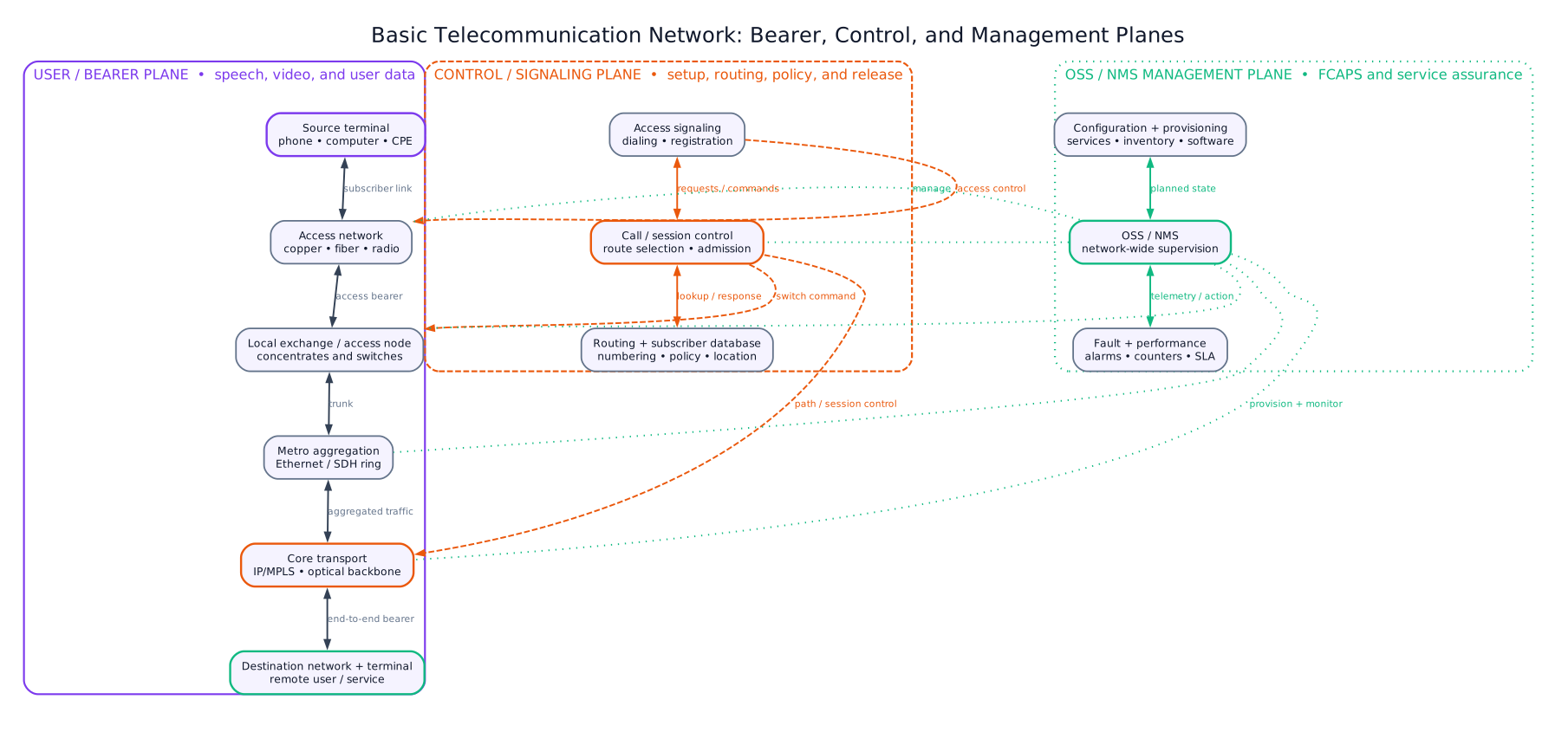
A telecommunication network is a collection of terminals, transmission links, switching nodes, and signalling systems used to transfer information from one point to another.
Main Network Elements
| Element | Function | Example |
|---|---|---|
| Terminal equipment | Converts user information into electrical/optical/radio signal | Telephone, router, mobile handset |
| Transmission medium | Carries signal between nodes | Copper, fiber, microwave, satellite |
| Switching node | Selects path and connects users | Local exchange, MSC, router |
| Signalling system | Controls call setup, routing, charging, release | SS7, SIP, ISUP |
| Network management | Supervises faults, configuration, accounting, performance, security | NMS/OSS |
Network Topologies
| Topology | Description | Advantage | Disadvantage |
|---|---|---|---|
| Point-to-point | Direct link between two nodes | Simple, high capacity | Not scalable |
| Bus | All nodes share a common medium | Low cost | Collision/fault affects many nodes |
| Star | All nodes connect to central node | Easy management | Central node failure is critical |
| Ring | Nodes form a closed loop | Protection possible | Break may disrupt service without protection |
| Mesh | Multiple interconnections | High reliability | Expensive and complex |
| Tree | Hierarchical structure | Scalable | Upper-level failure affects many users |
Access, Metro, and Core Network
| Network Part | Role | Examples |
|---|---|---|
| Access network | Connects subscriber to provider | Copper local loop, FTTH, radio access |
| Metro/aggregation network | Collects traffic from access areas | SDH rings, metro Ethernet |
| Core/backbone network | High-capacity national/international transport | Optical fiber, MPLS, IP backbone |
3. Transmission Media
Likely Exam Question (5 marks)
"Compare guided and unguided transmission media."
Transmission media are classified as guided and unguided.
Guided Media
Guided media confine signal energy within a physical path.
| Medium | Bandwidth | Typical Use | Advantages | Limitations |
|---|---|---|---|---|
| Twisted pair | Low to medium | Telephone loop, DSL, Ethernet | Cheap, easy to install | Noise, attenuation, crosstalk |
| Coaxial cable | Medium to high | Cable TV, RF feeders, legacy trunk | Better shielding than pair cable | Bulkier, costlier than pair cable |
| Optical fiber | Very high | Backbone, FTTH, submarine cable | Low loss, high bandwidth, EMI immune | Splicing and optical equipment cost |
Unguided Media
Unguided media use electromagnetic waves through free space.
| Medium | Frequency Range | Typical Use | Notes |
|---|---|---|---|
| Radio wave | kHz to GHz | Broadcasting, mobile, WiFi | Can support non-line-of-sight at lower frequencies |
| Microwave | GHz range | Point-to-point links, cellular backhaul | Usually line-of-sight |
| Satellite | Uplink/downlink microwave bands | TV, VSAT, remote connectivity | Wide coverage but high delay for GEO |
| Infrared | THz range | Short-range remote control | Cannot penetrate walls |
Selection Criteria
- Required bandwidth and data rate
- Distance and attenuation
- Noise and interference environment
- Cost of cable, towers, repeaters, and terminals
- Reliability and maintainability
- Security and regulatory constraints
4. Transmission Lines
A transmission line is a distributed electrical path used to carry high-frequency signals. At high frequency or long distance, resistance, inductance, capacitance, and conductance are distributed along the line and cannot be treated as lumped elements.
Primary Line Constants
| Constant | Symbol | Unit | Meaning |
|---|---|---|---|
| Series resistance | \(R\) | \(\Omega/\text{m}\) | Conductor loss |
| Series inductance | \(L\) | \(\text{H}/\text{m}\) | Magnetic energy storage |
| Shunt capacitance | \(C\) | \(\text{F}/\text{m}\) | Electric energy storage between conductors |
| Shunt conductance | \(G\) | \(\text{S}/\text{m}\) | Leakage through dielectric |
Secondary Line Constants
The propagation constant is:
where:
- \(\alpha\) = attenuation constant in nepers/m
- \(\beta\) = phase constant in rad/m
- \(\omega = 2\pi f\)
The characteristic impedance is:
For a lossless line where \(R = 0\) and \(G = 0\):
Wavelength and Phase Velocity
If the physical line length is comparable to wavelength, transmission-line effects become important. A common rule is to treat a conductor as a transmission line when:
5. Characteristic Impedance and Matching
Likely Exam Question (10 marks)
"Define characteristic impedance. Explain the importance of impedance matching in transmission systems."
Definition
Characteristic impedance \(Z_0\) is the input impedance of an infinitely long transmission line, or the impedance seen looking into a finite line terminated by its own characteristic impedance.
If a line is terminated by \(Z_L = Z_0\), all incident power is absorbed by the load and there is no reflection.
Reflection Coefficient
| Condition | Reflection Coefficient | Result |
|---|---|---|
| \(Z_L = Z_0\) | \(\Gamma = 0\) | Perfect match, no reflection |
| Open circuit | \(\Gamma = +1\) | Full reflection, same polarity voltage |
| Short circuit | \(\Gamma = -1\) | Full reflection, opposite polarity voltage |
VSWR
Voltage Standing Wave Ratio is:
For a perfect match, \(\Gamma = 0\) and VSWR = 1.
Importance of Matching
- Maximizes power transfer
- Reduces echo and standing waves
- Prevents transmitter damage due to reflected power
- Improves signal quality and bit error performance
- Reduces distortion in broadband systems
6. Return Loss
Likely Exam Question (5 marks)
"What is return loss? Why is high return loss desirable?"
Return loss measures how much power is reflected due to impedance mismatch. It is expressed in decibels.
or, in terms of incident and reflected power:
| Return Loss | Meaning |
|---|---|
| 0 dB | Total reflection, worst case |
| 10 dB | 10% power reflected |
| 20 dB | 1% power reflected |
| 30 dB | 0.1% power reflected |
High return loss means low reflected power and good impedance matching.
Relation with VSWR
Then:
7. Transformers in Telecommunication Circuits
Transformers are widely used in transmission systems for isolation, impedance matching, balancing, and coupling.
Main Uses
| Use | Explanation |
|---|---|
| Impedance matching | Matches line impedance to equipment impedance for maximum power transfer |
| Isolation | Provides DC isolation between circuits |
| Balanced-unbalanced conversion | Interfaces balanced lines with unbalanced equipment |
| Hybrid circuit | Separates transmit and receive paths in 2-wire/4-wire conversion |
| Common-mode rejection | Reduces noise induced equally on both conductors |
Ideal Transformer Relations
For turns ratio \(a = N_p/N_s\):
Impedance transformation:
Example: If a \(600\,\Omega\) line must be matched to a \(150\,\Omega\) load:
So a 2:1 turns ratio is required.
8. Hybrid Circuit
Likely Exam Question (10 marks)
"Explain the function of a hybrid circuit in telephony. What causes echo in a hybrid circuit?"
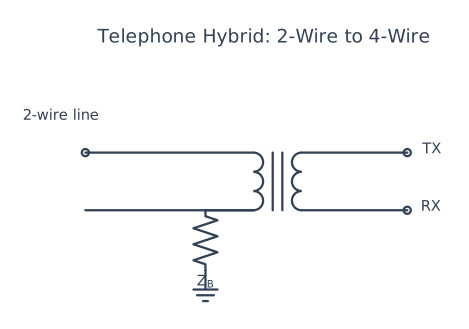
A hybrid circuit converts between a 2-wire subscriber loop and a 4-wire trunk circuit.
| Side | Function |
|---|---|
| 2-wire side | Transmit and receive share the same pair |
| 4-wire side | Separate transmit and receive paths |
Why Hybrid is Needed
Subscriber local loops are usually 2-wire for economy, but long-distance transmission and digital switching prefer 4-wire operation because transmit and receive signals can be amplified separately without feedback.
Hybrid Balance
The hybrid uses a balancing network that approximates the impedance of the 2-wire line. If the balance network exactly equals the line impedance, the transmit signal does not leak into the receive path.
If the balance is imperfect:
- Part of the transmitted signal returns as echo.
- Return loss becomes poor.
- Long-distance calls become annoying or unstable.
Hybrid Losses
| Loss | Meaning |
|---|---|
| Trans-hybrid loss | Isolation between transmit and receive ports |
| Return loss | Measure of line-balance quality |
| Insertion loss | Signal loss through the hybrid path |
High trans-hybrid loss and high return loss are desirable.
9. Signal Level and Noise Measurements
Likely Exam Question (5 marks)
"Define dB, dBm, SNR, noise figure, and noise temperature."
Decibel
Decibel is a logarithmic unit used to express ratios.
For power:
For voltage or current with the same impedance:
dBm
dBm is an absolute power level referenced to 1 mW.
| Power | dBm |
|---|---|
| 1 mW | 0 dBm |
| 10 mW | 10 dBm |
| 100 mW | 20 dBm |
| 1 W | 30 dBm |
dBW
dBW is referenced to 1 W.
Relation:
Signal-to-Noise Ratio
Higher SNR gives better voice quality, lower bit error rate, and higher possible channel capacity.
Thermal Noise
Thermal noise power is:
where:
- \(k = 1.38 \times 10^{-23}\,\text{J/K}\)
- \(T\) = absolute temperature in kelvin
- \(B\) = bandwidth in Hz
At room temperature, thermal noise density is approximately:
For bandwidth \(B\):
where \(NF\) is noise figure in dB.
Noise Figure
Noise figure shows degradation of SNR by a device:
Ideal noiseless device: \(F = 1\), \(NF = 0\,\text{dB}\).
10. Echo
Likely Exam Question (5 marks)
"What is echo in telephone circuits? How can it be reduced?"
Echo is the delayed return of a speaker's own voice due to impedance mismatch and signal reflection in a transmission path.
Causes of Echo
- Impedance mismatch at hybrid circuits
- Poor return loss in subscriber loops
- Long propagation delay in satellite or long-distance links
- Reflections at connectors, cable joints, or unmatched terminations
- Acoustic coupling between microphone and speaker
Types of Echo
| Type | Cause | Example |
|---|---|---|
| Talker echo | Speaker hears delayed version of own voice | Hybrid reflection in long-distance call |
| Listener echo | Listener hears repeated version of received voice | Double reflection in network |
| Acoustic echo | Loudspeaker sound enters microphone | Hands-free telephone |
Echo Control Methods
| Method | Working Principle |
|---|---|
| Impedance matching | Reduces reflection at line interfaces |
| Echo suppressor | Temporarily attenuates reverse path during speech |
| Echo canceller | Estimates echo and subtracts it from received signal |
| Hybrid balancing | Improves trans-hybrid loss |
| Delay reduction | Avoids long routing where possible |
Echo becomes objectionable when round-trip delay is large, typically above about 25 ms.
11. Singing
Likely Exam Question (5 marks)
"Differentiate between echo and singing in telephone circuits."
Singing is sustained oscillation in a telephone circuit caused by positive feedback around a 4-wire amplifier loop. It is similar to how an oscillator works.
Causes
- Excessive amplifier gain
- Poor hybrid balance
- Low return loss
- Feedback from receive path into transmit path
- Phase shift satisfying oscillation condition
Condition for Singing
Singing occurs when loop gain is equal to or greater than unity and total phase shift is a multiple of \(360^\circ\):
This is the Barkhausen criterion applied to the telephone transmission loop.
Echo vs Singing
| Feature | Echo | Singing |
|---|---|---|
| Nature | Delayed reflected speech | Continuous oscillation/howling tone |
| Main cause | Reflection due to mismatch | Positive feedback with high loop gain |
| Depends strongly on delay | Yes | Not mainly |
| Control | Echo cancellation, matching | Reduce gain, improve hybrid balance |
| Effect | Annoying repeated voice | Circuit instability |
12. Solved Examples
Example 1 - Return Loss
Q. A transmission line has \(Z_0 = 50\,\Omega\) and load \(Z_L = 75\,\Omega\). Find reflection coefficient, VSWR, and return loss.
Solution:
Example 2 - Thermal Noise
Q. Find thermal noise power in dBm for a receiver bandwidth of \(200\,\text{kHz}\) with noise figure \(5\,\text{dB}\).
Solution:
Noise power is approximately \(-116\,\text{dBm}\).
13. Short Notes for Revision
Characteristic Impedance
Characteristic impedance is the impedance seen looking into an infinitely long transmission line. Matching \(Z_L\) with \(Z_0\) prevents reflection and maximizes power transfer.
Return Loss
Return loss is the ratio of incident to reflected power expressed in dB. High return loss means good matching and low reflection.
Hybrid Circuit
Hybrid circuit converts 2-wire subscriber lines to 4-wire trunk circuits. Imperfect balancing causes echo.
Echo
Echo is delayed reflected speech due to impedance mismatch. It is reduced using impedance matching, hybrid balancing, echo suppressors, and echo cancellers.
Singing
Singing is self-sustained oscillation due to positive feedback in telephone circuits. It is prevented by reducing loop gain and improving hybrid balance.
Key Exam Points - Transmission Fundamentals
- \(Z_0 = \sqrt{(R+j\omega L)/(G+j\omega C)}\); for lossless line, \(Z_0 = \sqrt{L/C}\).
- Perfect matching occurs when \(Z_L = Z_0\), giving \(\Gamma = 0\), VSWR = 1, and no reflected power.
- Return loss is higher for better matching: \(RL = -20\log_{10}|\Gamma|\).
- Hybrid circuit performs 2-wire/4-wire conversion; poor hybrid balance causes echo.
- Echo is delayed reflection; singing is continuous oscillation due to positive feedback.
- Thermal noise: \(N = kTB\) and noise density at room temperature is about \(-174\,\text{dBm/Hz}\).
Model Answer - Basic Telecommunication Network and Its Evolution [5 marks]
Exam-ready answer
A telecommunication network is an organized set of terminals, access links, switching or routing nodes, transmission systems, signaling, and operations support used to convey voice, data, image, or video between users. Its bearer path is: source terminal converts information to an electrical, optical, or radio signal; the access network carries it to a local exchange/router; metro and core nodes select a route and aggregate traffic; the destination access network and terminal recover the information. A separate control plane performs address analysis, call/session setup and release through systems such as SS7 or SIP, while OSS/NMS performs fault, configuration, accounting, performance, and security management.
The evolution was telegraph -> manual telephone exchange -> automatic Strowger/crossbar exchange -> analog FDM coaxial/microwave trunks -> PCM/TDM digital exchanges and PDH/SDH fiber -> packet data, cellular systems, and NGN. Early calls occupied a dedicated analog circuit and required an operator; automatic dialing introduced electromechanical switching. PCM then sampled a nominal voice channel at \(8\,\text{kHz}\) with 8 bits/sample, producing \(64\,\text{kbit/s}\), and digital multiplexing improved quality and capacity. Modern NGN uses shared IP/MPLS transport, software session control, media gateways, and service platforms so voice, video, and data use one core.
Thus the architectural trend is from service-specific, hardware-controlled circuit networks to software-controlled, packet-switched convergence. Circuit switching still offers deterministic delay for traditional voice, whereas packet sharing is more efficient for bursty traffic but needs QoS, synchronization, security, and legacy interworking. Examples are PSTN local-loop-to-exchange calling and a VoIP call carried through broadband access and an IP core.
Practice target: 8 minutes; draw and label the three planes, then give the evolution stages and one circuit-versus-packet caveat.
Model Answer - Guided Transmission Media Comparison [5 marks]
Exam-ready answer
Guided media confine electromagnetic energy to a physical path. Twisted pair consists of two insulated copper conductors twisted to cancel induced noise. It is inexpensive, easy to terminate, and already reaches most subscribers; balanced telephone loops, Ethernet, and DSL are typical applications. Its resistance, dielectric loss, crosstalk, and external interference limit distance and bandwidth, although category and DSL technology determine the actual rate.
Coaxial cable has a central conductor, dielectric, and concentric shield, giving controlled characteristic impedance, commonly \(50\,\Omega\) for RF/data or \(75\,\Omega\) for video systems. Its shielding and bandwidth exceed ordinary pair cable, so it suits cable television, RF feeders, and legacy digital trunks, but it is bulkier and harder to install. Optical fiber guides light in a dielectric core and cladding by total internal reflection. Single-mode fiber offers extremely high bandwidth and long repeater spacing; multimode fiber is cheaper for shorter links. Fiber is light, secure, immune to EMI and has low attenuation, but lasers, receivers, connectors, and precision splicing add cost and bending must be controlled.
| Criterion | Twisted pair | Coaxial cable | Optical fiber |
|---|---|---|---|
| Signal | Balanced electrical | Shielded electrical/RF | Optical |
| Capacity/reach | Low-medium/short | Medium-high/medium | Very high/long |
| Noise immunity | Lowest | Good | Excellent |
| Main use | Loop, LAN, DSL | CATV, RF feeder | Backbone, FTTH, submarine |
Selection depends on required bit rate and distance, installed cost, attenuation, EMI, security, mechanical environment, and maintenance skill. For example, copper pair is economical for the final subscriber drop, while fiber is preferred for an aggregation or core link. Published bandwidth and reach are technology- and installation-dependent rather than universal values.
Practice target: 8 minutes; define guided media, compare all three under four common headings, and finish with one selection example and caveat.
Model Answer - Characteristic Impedance and Return Loss [5 marks]
Exam-ready answer
The characteristic impedance \(Z_0\) is the voltage-to-current ratio of one travelling wave on a uniform line; equivalently, it is the input impedance of an infinitely long line or of a finite line terminated in \(Z_0\). For distributed primary constants \(R,L,G,C\) per unit length,
At a load \(Z_L\), the incident wave is partly reflected unless \(Z_L=Z_0\). The voltage reflection coefficient and voltage standing-wave ratio are
Return loss measures the incident-to-reflected power ratio:
Therefore a high positive return loss means a small reflection and good matching; \(RL=20\,\text{dB}\) means \(P_r/P_i=10^{-2}\), so only 1% of incident power is reflected. For example, a \(50\,\Omega\) line terminated in \(75\,\Omega\) has \(\Gamma=(75-50)/(75+50)=0.2\), \(RL\approx13.98\,\text{dB}\), and VSWR \(=1.5\). Matching improves delivered power, suppresses standing waves and waveform distortion, and reduces hybrid echo or transmitter stress. An open or short has \(|\Gamma|=1\) and \(RL=0\,\text{dB}\); an ideal match has \(\Gamma=0\) and theoretically infinite return loss. In practice \(Z_0\) and return loss vary with frequency, connectors, and line tolerances, so they must be specified over the operating band.
Practice target: 8 minutes; write all three boxed relations and solve one numerical mismatch without confusing high return loss with high reflected power.
Model Answer - Two-Wire/Four-Wire Hybrid and Telephone Transformer [5 marks]
Exam-ready answer
A subscriber local loop is normally 2-wire: the same balanced pair carries speech in both directions. A trunk, repeater, codec, or digital switch uses 4-wire working, with separate transmit and receive pairs so each direction can be amplified without direct feedback. A hybrid is the bidirectional bridge that converts between these interfaces: speech from the 4-wire transmit port is delivered to the 2-wire line, incoming line speech is delivered to the 4-wire receive port, and ideally the local transmit signal is cancelled at that receive port.
The transformer windings and bridge arms divide the transmitted signal between the actual line impedance \(Z_L\) and a balance network \(Z_B\). When \(Z_B\) accurately models \(Z_L\) over the voice band, equal opposing voltages cancel at the receive arm, giving high trans-hybrid loss. If line length, handset, frequency, or weather makes \(Z_B\ne Z_L\), transmit energy leaks into receive and returns after network delay as echo; two imperfect hybrids plus trunk gain can also form a singing loop.
Telephone transformers provide galvanic isolation, DC blocking, balanced/unbalanced conversion, common-mode rejection, coupling, and impedance matching. For an ideal transformer with turns ratio \(a=N_p/N_s\),
Thus matching a \(150\,\Omega\) secondary load to a \(600\,\Omega\) primary line needs \(a=\sqrt{600/150}=2\). Real hybrids have insertion loss and finite bandwidth, and no fixed balance network exactly represents every subscriber loop; adaptive echo cancellation is therefore used on long-delay digital and packet paths.
Practice target: 8 minutes; label all four hybrid ports and the balance network, then state the transformer ratio and mismatch caveat.
Model Answer - Echo and Singing in Telephone Networks [5-10 marks]
5-mark answer and 10-mark extension
For 5 marks - write this
Echo is an intelligible delayed return of speech to the talker or listener. The usual electrical cause is impedance mismatch at a 2-wire/4-wire hybrid: part of the outgoing signal leaks into the opposite 4-wire path and returns after propagation delay. Acoustic coupling from a loudspeaker to a microphone causes acoustic echo. Singing is different: it is a sustained tone or howl produced when leakage through two hybrids and the gains and delays of the 4-wire path form positive feedback. At some frequency it satisfies the oscillation condition
Echo is controlled by accurate line termination and hybrid balance, high return/trans-hybrid loss, reduced delay, echo suppressors, or preferably an adaptive echo canceller. Singing is prevented by improving hybrid isolation and keeping loop gain below unity with a suitable stability margin. Echo is repeated speech and becomes more objectionable as delay rises; singing is regenerative oscillation and may persist without new speech.
Add for a 10-mark variant
In the signal path, near-end speech enters hybrid \(H_1\), travels on the four-wire send path through codecs, amplifiers or packet transport, and reaches hybrid \(H_2\). A fraction reflected by the mismatch at \(H_2\) returns on the receive path. The speaker hears talker echo after the round-trip delay; a second reflection may produce listener echo. Satellite, transcoder, and packet/jitter-buffer delays do not create the reflection, but they make an existing echo perceptually worse. The often-quoted delay at which control becomes important, about \(25\,\text{ms}\), is an engineering guideline and depends on echo level and the applicable standard.
An echo canceller models the echo path with an adaptive filter. If far-end/reference signal \(x(n)\) produces actual echo \(d(n)\), the filter forms \(\hat d(n)=\mathbf{w}^T(n)\mathbf{x}(n)\) and sends residual
An LMS-type update is \(\mathbf{w}(n+1)=\mathbf{w}(n)+\mu e(n)\mathbf{x}(n)\), with normalization and practical double-talk detection. Unlike an echo suppressor, which inserts loss in one direction and can clip simultaneous speech, cancellation permits full-duplex conversation; nonlinear loudspeakers, rapid path change, insufficient filter tail, and double talk limit cancellation.
For a two-hybrid singing loop, let the one-way gains be \(G_1,G_2\) and leakage factors \(k_1,k_2\). The loop magnitude is \(|G_1G_2k_1k_2|\); oscillation occurs only if magnitude and phase conditions coincide. Gain reduction, frequency shaping, improved balance networks, and stable automatic level control restore margin. As an example, a poorly balanced long VoIP/PSTN gateway call may have audible delayed self-speech but remain stable; raising trunk gain can turn the same feedback path into a continuous tone. Hence echo cancellation addresses delayed replicas, while singing control primarily addresses closed-loop stability.
Practice target: 9 minutes for the 5-mark core or 18 minutes for the full answer; distinguish reflection level, propagation delay, and closed-loop gain explicitly.