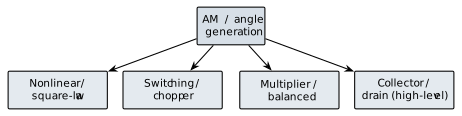
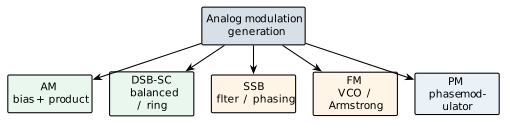
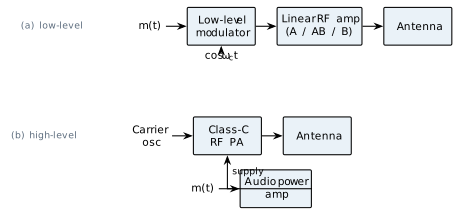
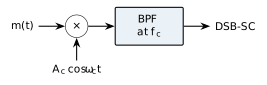
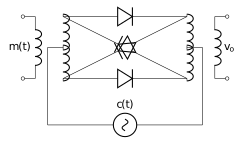
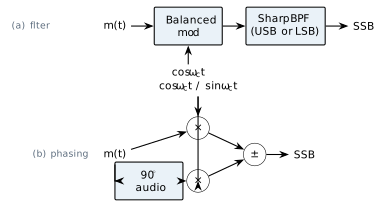
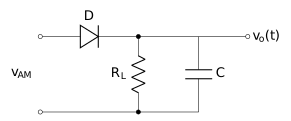
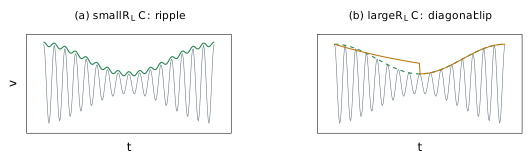
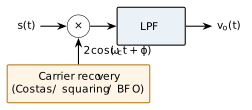
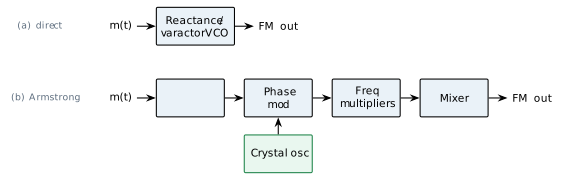
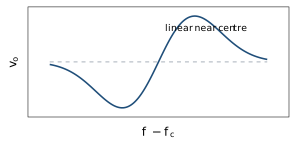
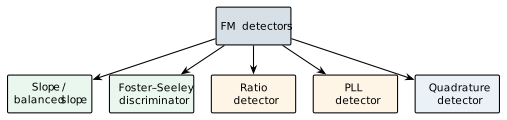
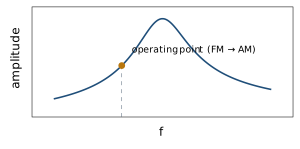
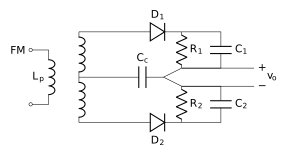
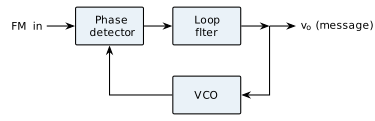
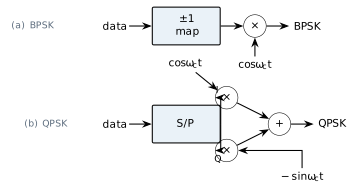
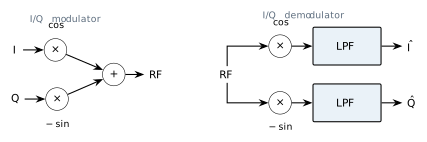
Fig: Standard families of AM/DSB generation circuits: nonlinear (square-law), switching, four-quadrant multiplier/balanced and high-level collector/drain modulationFig: Map of AM, DSB-SC, SSB, FM and PM generation methods. The exact transistor/op-amp implementation varies; the exam emphasises the signal operation and required transfer characteristicFig: (a) Low-level AM modulates before RF amplification, so every following stage must be linear. (b) High-level AM lets an efficient Class-C final stage run while the audio amplifier varies its collector/drain supplyFig: Balanced product modulator: matched branches cancel carrier feedthrough while the cross-products add; a bandpass filter selects the DSB-SC band. Device mismatch and offsets leave a residual carrier (finite suppression in dB)Fig: Diode-ring (lattice) modulator: two center-tapped transformers, four diodes and the carrier across the centre taps. Both carrier and message feedthrough cancel, giving DSB-SC after filteringFig: SSB generation. (a) Filter method: DSB-SC then a sharp crystal/mechanical filter selects one sideband. (b) Phasing method: quadrature message and carrier in two product modulators; adding/subtracting cancels one sidebandFig: Diode envelope detector: D charges C near positive carrier peaks; between peaks C discharges through R_L following the envelopeFig: Envelope detection. (a) Too-small R_LC leaves carrier ripple. (b) Too-large R_LC (orange) cannot follow the falling envelope (green dashed), cutting diagonally across itFig: Coherent product detector: multiply by a synchronised local carrier and low-pass filter. Used for DSB-SC and SSBFig: FM generation. (a) Direct: message varies an LC/VCO frequency, large deviation but poorer stability. (b) Indirect (Armstrong): integrate then phase-modulate a crystal carrier, and multiply/mix up-excellent stabilityFig: Discriminator S-curve: linear through the centre frequency, saturating away from itFig: Taxonomy of FM detectors, from the simple slope detector to IC-friendly PLL and quadrature detectorsFig: Slope detection: the tuned circuit is used off resonance so its skirt converts frequency deviation into amplitude. It has a narrow linear range and needs a preceding limiterFig: Simplified Foster-Seeley discriminator: a center-tapped double-tuned transformer turns frequency deviation into a phase difference; the two rectified diode voltages are equal at f_c and unequal off centre, and their difference is the audio. A ratio detector uses the same transformer with reversed diode/loading and a large capacitor holding the voltage sum constant, giving inherent AM rejectionFig: PLL FM demodulator: the VCO tracks the input frequency; within lock the loop-filter control voltage is the recovered messageFig: (a) BPSK: antipodal mapping into a balanced modulator. (b) QPSK: a serial-to-parallel mapper drives quadrature product modulators whose sum is the QPSK signalFig: Generic coherent I/Q modem: the transmitter sums quadrature-multiplied I and Q; the receiver down-converts with quadrature carriers and low-pass filters to recover I, Q for symbol decisions