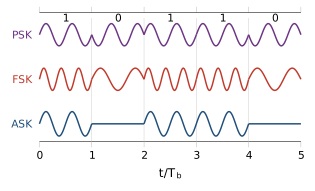
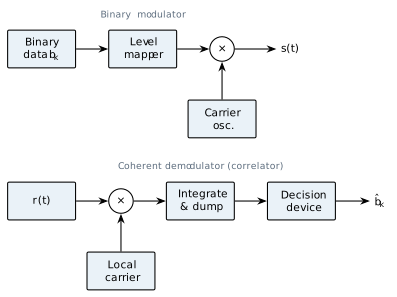
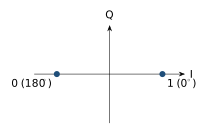
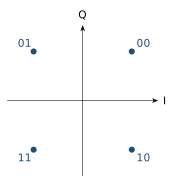
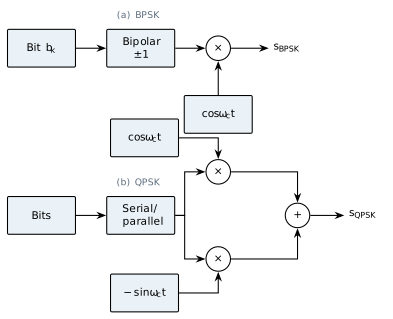
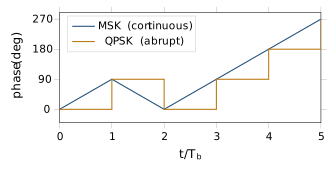
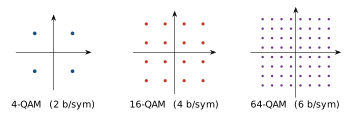
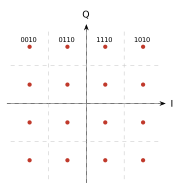
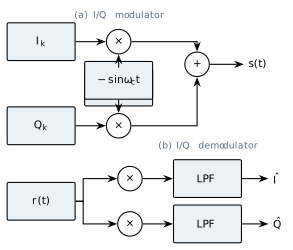
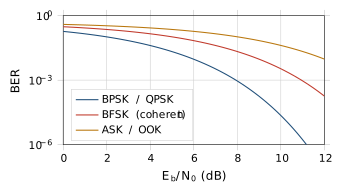
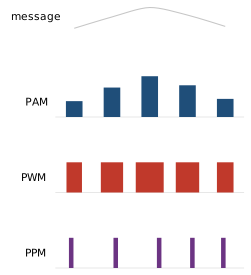
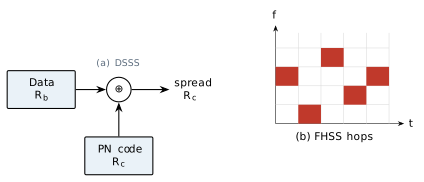
Fig: ASK, FSK and PSK carrier waveforms for the common data sequence 1\,0\,1\,1\,0: ASK gates the carrier on/off, FSK switches between two frequencies, and PSK flips the phase by 180^ on a 0 bitFig: Binary modulator (data mapper multiply by carrier) and coherent demodulator (multiply by local carrier integrate-and-dump decision)Fig: BPSK constellation: two antipodal points at 0^ and 180^ on the in-phase axis (E_b), giving maximum Euclidean distance for a fixed bit energyFig: Gray-coded QPSK constellation at 45^, 135^, 225^, 315^: adjacent points differ by one bit, so a nearest-neighbour symbol error usually causes only one bit errorFig: Generation: (a) BPSK maps a bit to 1 and multiplies by the carrier; (b) QPSK splits serial bits into I/Q streams driving two balanced modulators (cosine and -sine) whose outputs are summedFig: MSK phase evolves as a continuous piecewise-linear trellis (90^ per bit), whereas QPSK-type modulation makes abrupt phase steps at symbol boundariesFig: Square constellations of increasing order: as M rises the points crowd together at fixed average power, so a larger E_b/N_0 is neededFig: Gray-coded 16-QAM: four levels per axis (\-3,-1,+1,+3\), one-bit changes between horizontal/vertical neighbours, and rectangular decision boundariesFig: Generic I/Q modem: (a) modulator multiplies I by _c t and Q by -_c t and sums; (b) demodulator uses two mixers and low-pass filters to recover I and QFig: Qualitative coherent-AWGN BER versus E_b/N_0: BPSK/QPSK are most power-efficient, orthogonal BFSK needs 3 more, and ASK/OOK more stillFig: Analog pulse modulation of one message: PAM varies pulse amplitude, PWM varies pulse width, and PPM varies pulse position (all at the same sampling instants)Fig: (a) DSSS: data XORed with a fast PN chip sequence to spread the spectrum. (b) FHSS: the carrier hops among frequency channels over time under PN control