NTC Preparation Strategy
Target: Nepal Telecom — Level 7, Telecom Engineer (Electronics & Communication)
Based on: the official syllabus + analysis of past -c technical papers (2079, 2081, 2082) and Eng. Sewa 2082/83.
0. The one key insight
This exam is a theory exam, not a problem-solving exam.
Across every past paper analyzed, there was only one genuine numerical (NTC 2081 Q3 — root-locus breakaway point) plus a couple of tiny "calculate" sub-parts buried inside theory questions (skin depth, star↔delta formula). Everything else is:
explain · describe · differentiate · derive · draw diagram · classify · discuss
So the winning strategy is maximize written recall + clear explanations + labeled diagrams, and do NOT sink time into numerical drilling for Phase I.
1. What the exam actually is (scheme)
| Paper | Marks | Format | Nature |
|---|---|---|---|
| Paper I — GK, Management & Institutional | 100 | 50 MCQ (×1) + 6 short (×5) + 2 long (×10) | GK/current affairs + memorizable theory |
| Paper II — Technical Subject | 100 | 4 short (×5) + 8 long (×10) | 100% subjective theory/derivation |
Notes that shape strategy:
- MCQ negative marking: –20% per wrong answer. Only guess after eliminating options.
- No calculator in the MCQ exam.
- Paper II is entirely subjective — no MCQs, no pure calculation problems.
- Answer language: Nepali, English, or both.
2. Priority order (do these in sequence)
Rule you set: do not start Technical (Paper II) until Paper I is solid.
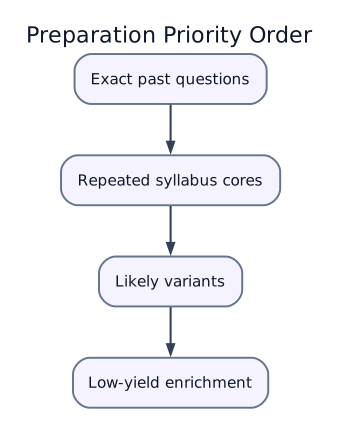
Why this order: Sections that are theory-heavy and repeat every year give the most marks per hour. Management/Institutional and GK are pure recall. Technical is large and last because it's the biggest surface area and you only reach it once the safe marks are secured.
3. What kind of questions to focus on
A. Highest-value question types (drill these first)
- "Differentiate / compare X and Y" — guaranteed, easy, high-yield. e.g. e-health vs telemedicine · OSI vs TCP/IP · MLS vs ILS · SMPS vs linear supply · scalar vs vector potential · DS-SS vs FH-SS · open-loop vs closed-loop.
- "Explain the working principle of … with neat diagram" — always draw the diagram. e.g. thyristor rectifier · full-wave bridge rectifier · successive-approximation ADC · DC generator · PLL · optical fiber (TIR). Diagram-heavy subparts in the observed papers carry 3–7 marks, but a diagram alone has no guaranteed score; label it and explain the flow in 3–5 points.
- "Define / explain the concept of …" — short, memorizable definitions. e.g. sampling theorem · cloud computing · NGN · satellite communication · cache memory.
- Standard derivations to memorize as blocks (reproduce, don't re-derive under pressure):
- DC generator EMF equation
- Radar range equation
- Closed-loop transfer function
- Magnetic boundary conditions
- Rectifier ripple/efficiency expressions
B. Recurring high-frequency topics (appeared in multiple papers — study first)
- Rectifiers (full-wave bridge, thyristor-controlled) — appeared repeatedly
- PCM (block diagram, sampling, companding A-law/μ-law, advantages)
- OSI model / TCP-IP / physical layer
- NGN (architecture, convergence, advantages)
- Optical fiber (total internal reflection, Snell's law, fiber types, tx/rx)
- Satellite communication (uplink/downlink, Kepler's laws, earth stations, atmospheric loss)
- Antennas (dipole, VHF, gain, polarization, impedance matching)
- Earthing, shielding & lightning protection of telecom equipment
- Flip-flops / counters / logic (JK from SR, 2-bit counter)
- Digital modulation (BPSK, QPSK, FSK, constellation diagrams)
- Control systems (root locus, transfer functions, stability, open vs closed loop)
- Transforms (Fourier/Laplace/z — mainly distinguish + properties, not heavy math)
C. What to de-prioritize
- Heavy engineering calculus / integration / Fourier-Laplace-Z computation (Paper I math) — low yield vs effort.
- Long numerical problem sets — the exam almost never asks them.
- Obscure topics not in the syllabus or past papers.
4. Study method (how to prepare, not just what)
Answer template for every technical topic
Prepare each topic once, in this fixed structure, so recall is automatic:
Definition → Labeled diagram → Working principle → Key formula/derivation → Application / comparison
Techniques
- Active recall over re-reading: after studying a topic, close the note and write the answer from memory.
- Diagram-from-memory drills: use the 15-item Paper II drill list; redraw each in 90 seconds with mandatory labels and direction arrows.
- Spaced repetition: revisit each topic at increasing intervals (use the Revision Tracker / note frontmatter
confidence,reviews,last_reviewed,due). - Compare-sheet: maintain a single "Differentiate X vs Y" cheat sheet — it covers a huge share of marks.
- Derivation-sheet: one page of the ~5 must-know derivations.
- Write full mock answers timed — subjective exams reward speed + structure + diagrams, not just knowing the content.
For Paper I MCQs
- Do current affairs / GK daily in small doses (news, telecom-sector developments, national/international events).
- Memorize institutional facts: NTC objectives/structure/tariff, NTA, ITU, project management (CPM/PERT/Gantt), finance terms (EIRR/FIRR, FOB/CIF/LC).
- Practice only light arithmetic & data interpretation for the math MCQs.
5. Suggested phase plan
| Phase | Focus | Goal |
|---|---|---|
| Phase 1 | Paper I — Management + Institutional theory | Lock in the easiest, most repeatable marks |
| Phase 2 | Paper I — GK + current affairs (daily) + light math MCQ | Clear the 40-mark MCQ pass bar safely |
| Phase 3 | Paper II — high-frequency technical topics (Section 3B list) | Cover the topics that repeat every year |
| Phase 4 | Paper II — remaining syllabus + memorize derivations | Fill gaps, secure the long-answer marks |
| Phase 5 | Timed mock answers + diagram drills + revision | Convert knowledge into exam-ready writing |
6. Exam-day tactics
- Always draw the diagram — most technical questions explicitly ask for one; it earns easy marks.
- Structure long answers with headings/points and end with an application or comparison.
- Attempt the compare/define parts first in each question — they're the safest marks.
- MCQs: skip if you can't eliminate at least two options (negative marking).
- Write MCQ answers in CAPITAL letters (A/B/C/D) — lowercase/symbols void the whole sheet.
- Manage time: don't over-invest in the one numerical if it appears — secure theory marks first.
Bottom line
Prepare to write and draw, not to calculate. Front-load Management/Institutional and GK (safe marks), then attack the recurring technical topics using the fixed answer template, memorize the handful of standard derivations, and practice diagrams and timed answers. Skip heavy numerical drilling — the papers simply don't reward it.