Skip to content

NTC Level 7 — Full-Time Study Plan (14 Weeks / ~100 Days)

Target: Nepal Telecom — Level 7, Telecom Engineer (Electronics & Communication) Profile: Full-time available (job left), undergrad completed → technical content is revision, not first-time learning. Approach: Both papers in parallel, every day — interleaved tracks (tech mornings ∥ Paper I middays) so nothing goes stale and nothing gets boring. Companion docs: prepstrategy.md (overall strategy) · prepstrategy-technical.md (Paper II tiers & tactics)


1. How much time to give

The answer: 14 weeks (~3.5 months), ~630 hours

Plan Duration Schedule Total hours When to pick
Aggressive 10 weeks 8 h × 6 days ~480 h Exam already announced & close
Recommended 14 weeks 8 h × 6 days ~670 h Full-time, exam not yet announced
Comfortable 16–18 weeks 6 h × 6 days ~620 h If you want extra mock cycles

Why 14 weeks: the technical track currently has 51 note files grouped into 42 morning study sessions; related short notes are paired within one session. Running both papers in parallel (§2), those 42 sessions fit in 7 weeks of mornings, Paper I rides the midday track over 8 weeks, then ~3 weeks of second-pass sweeps and 3 weeks of mocks. Less than 10 weeks forces skipping Tier-3 topics; more than 18 weeks causes forgetting faster than covering.

Weekly rhythm: 6 study days + Sunday rest (flashcards + news only).

If you start Monday 2026-07-06, the plan ends ~2026-10-11. Tentative week dates are shown below — shift everything if the exam date is announced (see §11).


2. How to use the 8 hours — block architecture (SOTA)

Not 4 + 4. Two 4-hour single-subject slabs fail for three reasons: sustained attention collapses after ~90 min, blocking one subject all morning is measurably worse for long-term retention than interleaving, and neither slab reserves a retrieval slot — you'd be covering, not learning.

Use 3 blocks + 1 drip: 3 h + 2.5 h + 1.5 h + 1 h = 8 h.

Block Length What Why (learning science)
A — Deep acquisition 3 h = 2 × ~85 min + break New technical chapter: read → condense into answer template → draw diagrams Hardest new material at the morning alertness peak; ~90-min chunks ride the ultradian attention cycle
B — Second track 2.5 h Paper I topic of the day (management / GK / math per §4 template) Interleaving a different modality (memorization vs derivation) cuts interference and boredom
C — Retrieval gym 1.5 h Closed book: reproduce the morning chapter + diagram from memory, then 1 timed written answer Retrieval practice (testing effect) — the single biggest retention booster known
D — Consolidation drip 1 h (evening) Flashcards (both papers) · current affairs · 1 diagram from memory Spaced repetition; reviewing near sleep aids consolidation

The rules that make it SOTA:

  • Active recall over rereading — re-reading a note is not studying; close it and reproduce.
  • Spaced repetition — make flashcards the same day you learn a topic; due reviews are never skipped, even Sundays.
  • Interleave across papers, block within a track — both papers touched daily (durable memory + no boredom), but each track stays on one subject per week so context stays coherent.
  • Dual coding — every concept gets a labeled diagram, not just text.
  • Desirable difficulty — attempt from memory before checking the note. Struggle is the encoding signal.
  • Testing effect at scale — Saturday weekly self-test + mock gates (§10).
  • Hygiene: 7–8 h sleep (consolidation happens there) · nap ≤ 20 min after lunch · ~30 min exercise · phone outside the room during Blocks A–C.

Per-chapter method (from prepstrategy.md):

Read once → rewrite into Definition → Labeled diagram → Working principle → Key formula/derivation → Application/comparison → close the note, reproduce from memory → tag confidence and schedule review.


3. Daily routine (clock template)

Time Block What exactly
08:00–09:25 A1 Read today's technical chapter; mark what's answer-worthy
09:25–09:45 break Walk / stretch — no feed-scrolling
09:45–11:15 A2 Condense into the answer template + draw the diagrams
11:15–12:15 lunch + optional ≤ 20 min nap
12:15–14:45 B Paper I track of the day (25/5 pomodoro rhythm inside the block)
14:45–15:15 break Outside if possible
15:15–16:45 C Closed book: reproduce morning chapter + diagram → self-check vs note → 1 timed answer (5-mark ≈ 8 min, 10-mark ≈ 18 min) → update confidence frontmatter
16:45–20:30 free Exercise, dinner, life
20:30–21:30 D 30 min flashcards (all due, both papers) · 20 min current affairs (national + telecom sector) · 10 min one drill-list diagram from memory

Shift the whole grid earlier/later to match your chronotype — keep the order: acquire → interleave → retrieve → consolidate.


4. Weekly template (the parallel mix)

Day Block A (3 h) — Technical Block B (2.5 h) — Paper I Block C (1.5 h) Block D (1 h)
Mon Tech chapter 1 Management / Institutional Retrieval of today Drip
Tue Tech chapter 2 GK / Contemporary Retrieval Drip
Wed Tech chapter 3 Management / Institutional Retrieval Drip
Thu Tech chapter 4 GK / Contemporary Retrieval Drip
Fri Tech chapter 5 Management / Institutional Retrieval Drip
Sat Tech chapter 6 Math / Stats MCQ drill (no calculator) Weekly self-test: 2 written answers + 20 MCQs from this week Drip (light)
Sun Rest 30–45 min flashcards + news only

Each week advances 6 technical study sessions + 3 management/institutional + 2 GK + 1 math/stats session — every subject stays warm, nothing gets boring.


5. Phase map

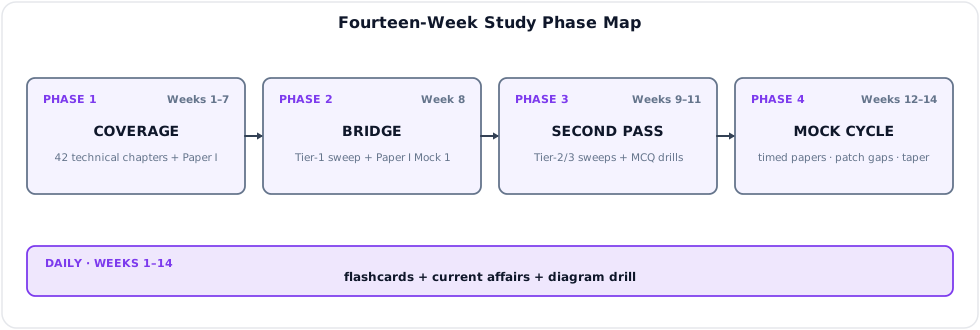
Fourteen-week study phase map: seven weeks of coverage, a bridge week, three weeks of second-pass study, three weeks of mock cycles, and daily flashcards, current affairs, and diagram drills throughout
Fig: Fourteen-week study phase map: seven weeks of coverage, a bridge week, three weeks of second-pass study, three weeks of mock cycles, and daily flashcards, current affairs, and diagram drills throughout

Changed from the earlier sequential plan per your call: both papers run side-by-side from Day 1. It's also the better learning design — interleaving beats blocking for retention, and current-affairs/institutional memory needs runway anyway.


6. Weeks 1–8 — parallel coverage curriculum

Mornings march through the technical notes in 42 scheduled sessions (Tier-1 subjects front-loaded); middays rotate Mon/Wed/Fri = Management–Institutional · Tue/Thu = GK · Sat = Math/Stats. Block C retrieves each morning's assigned notes the same day.

Week 1 (Jul 6–12) — Tech: EDC I ∥ Paper I: Management

Day Block A — Technical Block B — Paper I
Mon BJT Switching + MOSFET Switching + Logic Families — switching, TTL, NMOS/CMOS Management concept, modern approaches, motivation & leadership (note)
Tue Operational Amplifiers + Amplifiers — op-amp circuits, untuned, push-pull, tuned, feedback, Bode Physical geography of Nepal + world (note)
Wed Oscillators & Resonance — Wien bridge, LC, crystal, PLL Control, coordination, teamwork, group dynamics, MIS
Thu Combinational logic — adders, arithmetic, comparators, parity, MUX/DEMUX Socio-cultural & economic geography, demography of Nepal
Fri Sequential logic — flip-flops (JK from SR!), registers, counters Corporate/strategic planning, CSR, ethics + marketing process
Sat Thyristors & Rectifiers + Seven-Segment Displays Arithmetic reasoning, %, ratio, average (note)

Week 2 (Jul 13–19) — Tech: EDC II + Comm I ∥ Paper I: Project Management

Day Block A — Technical Block B — Paper I
Mon Memory + Filters + A/D Converters — RAM/DRAM/EPROM, Butterworth/Chebyshev, ADC Project life cycle, CPM & PERT, Gantt chart (note)
Tue 5.1 Communication Fundamentals — analog vs digital, signal & noise Natural resources, climatic conditions, livelihood & lifestyle
Wed 5.2 Analog Modulation + 5.3 Receivers — AM/DSB/SSB, FM/PM, superheterodyne Scheduling, resource leveling, cost control, TQM, negotiation, M&E
Thu 5.4 A/D Conversion + 5.7 PCM/ADPCM — 🔴 sampling, companding and PCM History of Nepal: ancient & medieval (no note yet — Loksewa GK book)
Fri 5.5 Baseband + 5.6 Error Control — NRZ/HDB3/AMI, parity/CRC/Hamming Accounting terminology, cost classification & analysis (note)
Sat 5.8 Digital Modulation + 5.9 Circuits + 5.10 RF Blocks — ASK/FSK/PSK/QAM, mixers and PLL Profit & loss, time & work, data interpretation

Week 3 (Jul 20–26) — Tech: Optical/Wireless + Protection ∥ Paper I: Financial Management

Day Block A — Technical Block B — Paper I
Mon 00_fiber_optics.md — 🔴 TIR, Snell's law, NA, dispersion, attenuation Interest & time value of money, engineering economics
Tue 01_optical_components.md — laser, LED, PIN/APD, splicing, OTDR History of Nepal: modern + major world events (GK book)
Wed 02_wireless_communication.md — 1G→5G, cellular, handover, frequency reuse CBA, risk analysis, investment decisions, forecasting, EIRR vs FIRR
Thu 03_satellite_communication.md — 🔴 orbits, Kepler, link budget, VSAT Customs, religions, ethnicity, languages, arts, heritage (GK book)
Fri 03_protection.md — 🔴 earthing, lightning protection, surge, breakers Trial balance, balance sheet, income statement, revenue/capital, depreciation
Sat Buffer / catch-up + 2 timed long answers from Weeks 1–3 Mean, median, mode, dispersion, variance (note)

Week 4 (Jul 27–Aug 2) — Tech: Telecom Advanced ∥ Paper I: Finance → Institutional

Day Block A — Technical Block B — Paper I
Mon 00_transmission_fundamentals.md — media, characteristic impedance, return loss, echo Procurement: FOB, CIF, LC, liquidated damages, bid security, performance bond, bidding
Tue 01_multiplexing_traffic.md — TDM/FDM/WDM, Erlang B, queuing Economic indicators: GDP, GNP, per-capita, remittance, FDI (note)
Wed 02_data_comm_networking.md — 🔴 OSI vs TCP/IP, switching types, X.25, frame relay NTC: objectives, structure, technologies, tariff, stakeholders (note)
Thu 03_switching_signaling.md — SPC, TS/ST/TST/STS, No. 5 & No. 7 Development infrastructure, planning & budgeting, current periodic plan
Fri 04_network_technologies.md — ISDN, ATM, PDH/SDH, DSL, numbering/routing NTA: establishment, goals, functions, role + telecom in periodic plan
Sat 05_advanced_technologies.md — 🔴 NGN, VoIP, GSM/CDMA, WiFi/WiMax Correlation, regression, probability

Week 5 (Aug 3–9) — Tech: Control + Signals I ∥ Paper I: Laws I

Day Block A — Technical Block B — Paper I
Mon 00_system_fundamentals.md — open vs closed loop, stability, sensitivity Telecommunications Act 2053 + Telecommunications Regulation 2054
Tue 01_transfer_functions.md — C/R = G/(1+GH), poles & zeros significance Constitution of Nepal; federal, provincial & local govt (note)
Wed 02_root_locus.mdthe one numerical: full procedure ×2–3 NT Employee Regulations 2078 — Ch 7, 9, 10, 11
Thu 03_frequency_response.md — Bode, gain & phase margins UNO, WTO, ITU, WB, ADB, AIIB, SAARC, BIMSTEC + public service charter
Fri 00_signals_classification.md — signal types, energy/power, elementary signals & impulse · 01_information_transmission.md — Shannon-Hartley, transmission NT Financial Regulations 2071 — Part 2, Part 3 Ch 1 & 3
Sat 02_lti_convolution.md — LTI, impulse response, convolution Random variables, probability distributions, sampling

Week 6 (Aug 10–16) — Tech: Signals II + EMT ∥ Paper I: Laws II

Day Block A — Technical Block B — Paper I
Mon 03_transforms.md — FT vs LT vs Z: distinguish + properties · 04_systems_filters.md — difference equations, FIR vs IIR Company Act 2063 — Ch 2, 3, 5
Tue 05_dsp.md — DFT/FFT, circular convolution, Parseval, autocorrelation Sustainable development, climate change, biodiversity, urbanization (note)
Wed 00_electrostatics.md — Coulomb, Gauss, Maxwell's 1st, Laplace/Poisson Telecom Policy 2060 + Digital Nepal Framework 2076 (19 points)
Thu 01_magnetostatics.md — Biot-Savart, Ampere, curl, boundary conditions Science & tech, telecom-sector advances, good governance
Fri 02_wave_propagation.md — free space/dielectric, skin effect, impedance matching ICT Policy 2072 + National Cyber Security Policy 2080
Sat 03_antennas_waveguides.md — dipole radiation, polarization, waveguides Calculus recognition: limits, maxima/minima, diff/integration + conics

Week 7 (Aug 17–23) — Tech: Electricity + ICT ∥ Paper I: consolidation

Day Block A — Technical Block B — Paper I
Mon 00_circuit_analysis.md — KCL/KVL, mesh/nodal, Thevenin/Norton, star↔delta Timed writing: 3 × 5-mark management answers
Tue 01_ac_fundamentals.md + 02_machines.md — 3-phase, resonance · transformers, DC generator EMF GK MCQ drill #1 (geography, history, culture)
Wed 00_computer_architecture.md — cache, buses, memory hierarchy, CPU Timed writing: 3 × 5-mark finance answers
Thu 01_programming.md + 03_cyber_security.md — algorithms/flowcharts · digital signature, virus/worm GK MCQ drill #2 (economy, governance, contemporary)
Fri 02_networking.md — DNS, IP, HTTP/FTP, routers, servers Timed writing: institutional/laws answers (NTC, NTA, DNF)
Sat All 42 technical sessions (51 notes) covered. Redo the weakest chapter Fourier/Laplace/Z/Taylor recognition MCQs

Week 8 (Aug 24–30) — BRIDGE: Tier-1 sweep ∥ Paper I Mock #1

Day Block A — Technical (closed book) Block B — Paper I
Mon Rectifiers & power electronics → full 10-mark answer from memory Weak-area patch (from weekly self-tests)
Tue PCM & digital conversion GK MCQ drill #3
Wed Optical fiber (TIR, types, tx/rx) Weak-area patch
Thu Satellite communication GK MCQ drill #4 (current affairs so far)
Fri OSI/NGN + earthing & lightning Mixed math/stats 20-MCQ timed
Sat PAPER I MOCK #1 — 50 MCQ / 45 min (capitals only; skip if < 2 options eliminated) + 6 short & 2 long / 90 min Grade + gap list. Gate: ≥ 60/100

7. Weeks 9–11 — second pass, sheets & first mocks

Week 9 (Aug 31–Sep 6) — Tier-2 sweep ∥ patching

Day Block A — Technical (closed book) Block B — Paper I
Mon Flip-flops & counters (JK from SR, 2-bit counter) Patch Mock #1 gaps
Tue Digital modulation + constellation diagrams Current-affairs consolidation (Jul–Aug)
Wed Control systems: root locus full run + transfer functions Patch Mock #1 gaps
Thu Antennas + impedance matching GK MCQ drill #5
Fri MOSFET/transistors + PLL Institutional recital: NTC/NTA/DNF facts from memory
Sat PAPER II MOCK #1 — full 3 h, 4 short + 8 long Self-grade vs notes; gap list

Week 10 (Sep 7–13) — Tier-3 sweep + the two sheets

Day Block A — Technical (closed book) Block B — Paper I
Mon Transforms: FT vs LT vs Z distinctions + properties Compare sheet: build the master "X vs Y" table
Tue EMT: boundary conditions, skin depth plug-in Compare sheet: finish + first recital
Wed Spread spectrum: DS-SS vs FH-SS Derivation sheet: assemble (list)
Thu Machines: star↔delta + DC generator EMF derivation Derivation sheet: memorize
Fri ICT: system bus, cache, cloud computing Diagram exam: all 15 drill diagrams from memory
Sat PAPER I MOCK #2 — full format Grade + patch list

Week 11 (Sep 14–20) — weak-topic rework

Day Block A — Technical Block B — Paper I
Mon Rework weakest tech topic #1 (closed-book output in Block C) Laws re-check: versions in force 3 months before exam
Tue Rework weakest tech topic #2 GK MCQ drill #6
Wed Rework weakest tech topic #3 Timed: 6 short + 2 long (Paper I Section B)
Thu Rework weakest tech topic #4 Current-affairs consolidation (Sep)
Fri Rework weakest tech topic #5 Mixed math/stats timed drill
Sat PAPER II MOCK #2 — full 3 h Grade + gap list

8. Weeks 12–14 — mock cycle & taper

Week 12 (Sep 21–27)

Day Block A — Technical Block B — Paper I
Mon Reproduce 2 Tier-1 topics as full answers MCQ blitz: 50-question mixed set in 45 min
Tue Reproduce 2 Tier-2 topics Institutional/laws rapid-fire recital
Wed Patch Paper II Mock #2 gaps GK / current-affairs MCQ set
Thu Reproduce 2 more Tier-1 topics Timed: 2 long Paper I answers
Fri Diagram exam #2 + derivation-sheet recital Flashcard mega-pass (all decks)
Sat PAPER II MOCK #3 — from the past-paper bank Grade + final gap list

Week 13 (Sep 28–Oct 4)

Day Block A — Technical Block B — Paper I
Mon Patch Mock #3 gaps Patch Paper I weak areas
Tue Tier-1 rapid recital (all 6 topics) DNF 19 points + act years/chapters final memorization
Wed Tier-2 rapid recital GK MCQ final drill
Thu Compare sheet + derivation sheet from memory Current affairs: full 6-month consolidation
Fri Skim all mindmaps + weakest 3 chapters Timed: 6 short + 2 long
Sat PAPER I MOCK #3 — full format Grade

Week 14 (Oct 5–11) — taper

Day Block A — Technical Block B — Paper I
Mon Light: derivation sheet + diagrams 1–8 Light: institutional facts
Tue Light: compare sheet + diagrams 9–15 Light: GK flashcards
Wed Skim Tier-1 notes only Current affairs final update
Thu Flashcards only — nothing new Exam logistics: admit card, route, stationery
Fri Full rest (or 1 h flashcards)
Sat Exam-ready. Sleep early.

9. Master coverage checklist

Coverage (Weeks 1–8, both papers in parallel)

  • [ ] Wk 1 — EDC I (6 ch) ∥ management + geography + arithmetic
  • [ ] Wk 2 — EDC II + Comm I (6 ch) ∥ project mgmt + history/resources + P&L/DI
  • [ ] Wk 3 — Optical/wireless + protection (5 ch) ∥ financial mgmt + history/culture + central tendency
  • [ ] Wk 4 — Telecom advanced (6 ch) ∥ procurement + NTC/NTA + economy + probability
  • [ ] Wk 5 — Control + signals I (6 ch) ∥ Telecom Act, Employee & Financial Regs + governance + distributions
  • [ ] Wk 6 — Signals II + EMT (6 ch) ∥ Company Act + policies + contemporary + calculus recognition
  • [ ] Wk 7 — Electricity + ICT (7 ch) ∥ timed-writing consolidation + GK drills
  • [ ] Wk 8 — Tier-1 closed-book sweep ∥ Paper I Mock #1 ≥ 60

Outputs

  • [ ] Derivation sheet (1 page) memorized
  • [ ] Compare sheet ("X vs Y" master table) memorized
  • [ ] 15 drill diagrams drawable from memory in ≤ 90 seconds each
  • [ ] 3× Paper II mocks + 3× Paper I mocks completed
  • [ ] Current-affairs log maintained daily from Day 1 (Block D)

10. Milestones (self-check gates)

End of Gate
Week 2 Routine locked: zero skipped blocks · 12 technical sessions done · flashcard decks growing daily
Week 4 23 technical sessions · management + finance + NTC/NTA solid
Week 7 All 42 technical sessions (51 note files) covered once
Week 8 Paper I Mock #1 ≥ 60/100 (pass bar is 40)
Week 9 Paper II Mock #1 ≥ 50 · every 🔴 Tier-1 topic reproducible closed-book
Week 11 Paper II Mock #2 ≥ 60
Week 13 Paper II Mock #3 ≥ 65 · Paper I Mock #3 ≥ 70 · both sheets + all diagrams from memory

If a gate fails → the next Sunday becomes a patch day for that gap only (keep Block D even then).


11. When the exam date is announced

  • > 14 weeks away: keep this plan; extend the mock cycle (repeat the Week 12 pattern).
  • 10–14 weeks: compress the second pass (Weeks 9–11 → 2 weeks: merge the Tier-3 sweep into the Tier-2 week). Keep every mock.
  • < 10 weeks: mornings cover Tier 1 + Tier 2 chapters only on the first pass; midday keeps the Management–Institutional track intact, halves GK, keeps Sat math. Never cut Block C, Block D, or the mocks — retrieval is worth more than coverage.
  • Re-check all laws/policies for amendments 3 months before the exam date (syllabus rule).

Bottom line

Run both papers in parallel every day: acquire technical in the morning (3 h), memorize Paper I midday (2.5 h), retrieve everything closed-book in the late afternoon (1.5 h), consolidate with flashcards at night (1 h). Each week advances 6 technical sessions + 3 management + 2 GK + 1 math session — full coverage in 8 weeks, then sweeps and 6 mocks convert it into marks. The 8 hours only count if Blocks C and D happen: retrieval and spacing are the engine; reading is just fuel.