Analog Receivers
Possible Exam Questions
Exam Questions and Answer Map
Evidence note: [PYQ paper/year] = exact question observed in that past paper; [likely] = pattern-predicted variant not confirmed as an exact PYQ.
- Draw the block diagram of a superheterodyne AM receiver and explain each block. Define intermediate frequency and image frequency. [10] — [likely]
- Answer plan: Draw antenna -> RF amplifier -> mixer + local oscillator -> IF amplifier -> detector -> AF amplifier -> speaker, with AGC feedback -> explain each block -> state \(f_{IF}=|f_{LO}-f_s|\) -> derive the image-frequency relation -> state common AM IF.
-
Model answer: Superheterodyne AM Receiver, IF and Image
-
Explain the tuned radio-frequency receiver. State its advantages and limitations. [5] — [likely]
- Answer plan: Draw cascaded tuned RF stages -> detector -> AF amplifier -> explain ganged tuning -> list simplicity and good sensitivity at a fixed frequency -> explain changing bandwidth, tracking difficulty and instability.
-
Model answer: Tuned Radio-Frequency Receiver
-
A receiver is tuned to \(1\,\text{MHz}\) and uses a \(455\,\text{kHz}\) IF with high-side injection. Find the local-oscillator and image frequencies. [5] — [likely]
- Answer plan: Use \(f_{LO}=f_s+f_{IF}\) -> obtain \(1.455\,\text{MHz}\) -> use \(f_{image}=f_s+2f_{IF}\) -> obtain \(1.910\,\text{MHz}\) -> verify both inputs give the same IF.
-
Model answer: Local-Oscillator and Image-Frequency Numerical
-
Draw and explain a superheterodyne FM receiver. Why are a limiter, discriminator, de-emphasis network and AFC used? [10] — [likely]
- Answer plan: Draw RF amplifier -> mixer/LO -> 10.7 MHz IF -> limiter -> discriminator -> de-emphasis -> AF amplifier -> explain amplitude-noise removal, frequency-to-voltage conversion, inverse pre-emphasis and oscillator-drift correction.
-
Model answer: Superheterodyne FM Receiver
-
Define sensitivity, selectivity and fidelity of a receiver and explain the trade-off among them. [5] — [likely]
- Answer plan: Define each term -> connect sensitivity to minimum usable input, selectivity to adjacent-channel rejection and fidelity to undistorted message bandwidth -> explain why very narrow IF bandwidth improves selectivity but can reduce fidelity.
- Model answer: Receiver Sensitivity, Selectivity and Fidelity
1. Receiver Purpose and Classification
A radio receiver selects a desired modulated signal from many signals present at its antenna, amplifies it, demodulates it and reproduces the original information with acceptable strength and fidelity.
Its essential tasks are:
- Selection of the wanted carrier frequency.
- Low-noise amplification of a weak received signal.
- Frequency conversion when a fixed intermediate frequency is used.
- Demodulation to recover the baseband message.
- Audio or data amplification to drive the destination.
- Automatic control of gain or tuning when signal level or oscillator frequency changes.
Main Receiver Types
| Receiver | Principle | Main merit | Main limitation |
|---|---|---|---|
| Crystal receiver | Tuned circuit and diode detector; no active gain | Simplest and needs no supply | Very low sensitivity and selectivity |
| TRF receiver | Amplifies the selected signal directly at RF | Simple signal path | Difficult tracking and nonuniform bandwidth |
| Superheterodyne receiver | Converts every selected RF signal to one fixed IF | High, uniform gain and selectivity | Mixer, local oscillator and image response add complexity |
| Direct-conversion receiver | Mixes selected RF directly to baseband or zero IF | Highly integrable | DC offset, \(1/f\) noise and LO leakage |
For conventional AM and FM broadcasting, the superheterodyne receiver is the standard exam answer.
2. Tuned Radio-Frequency (TRF) Receiver

In a TRF receiver, the selected station is amplified at its original radio frequency. There is no mixer, local oscillator or intermediate-frequency stage.
Working
- The antenna receives many stations simultaneously.
- Each RF amplifier contains a parallel resonant circuit tuned to the wanted carrier.
- All tuned circuits are varied together by a ganged capacitor so they track the same station.
- Cascaded RF stages provide gain and reject out-of-band signals.
- An envelope detector recovers the AM message.
- The AF amplifier raises the recovered audio power and drives the speaker.
For a tuned \(LC\) circuit:
Its approximate \(3\,\text{dB}\) bandwidth is:
where \(Q\) is the loaded quality factor. If \(Q\) remains nearly constant, the absolute bandwidth changes with tuning frequency. This is one reason a TRF receiver does not provide uniform selectivity over a wide band.
Advantages
- Simple architecture with no frequency converter.
- No internally generated image-frequency response.
- Good sensitivity and selectivity over a narrow tuning range.
- Low component count for fixed-frequency receivers.
Limitations
- Several tuned circuits must track accurately over the full tuning range.
- Bandwidth and selectivity vary with received frequency.
- High RF gain can cause instability because of stray feedback.
- Achieving both high gain and narrow bandwidth at high RF is difficult.
- It is unsuitable for wide-range, high-performance broadcast reception.
These limitations led to the superheterodyne architecture.
3. Superheterodyne Receiver
A superheterodyne receiver translates the selected RF carrier to a fixed intermediate frequency (IF). Most receiver gain and channel selectivity are then obtained at this one fixed frequency.
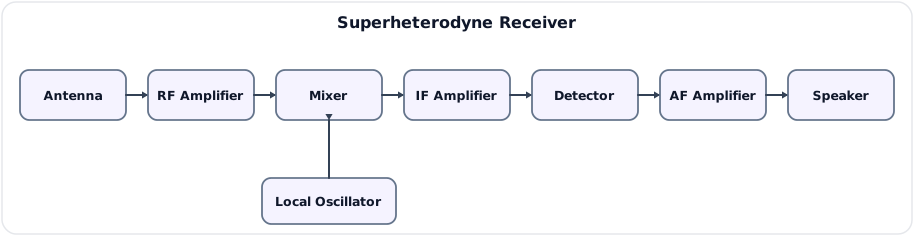
Block Functions
| Block | Function |
|---|---|
| Antenna and input network | Capture RF energy and provide initial band selection or impedance matching |
| RF amplifier / preselector | Select the wanted band, improve sensitivity and reject the image before mixing |
| Local oscillator (LO) | Generate a tunable sinusoid whose frequency tracks receiver tuning |
| Mixer | Multiply RF and LO signals to produce sum and difference frequencies |
| IF filter and amplifier | Supply most gain and adjacent-channel selectivity at a fixed frequency |
| Detector / demodulator | Recover the original AM or FM message |
| AGC | Vary RF/IF gain so output remains usable over a large input-level range |
| AF amplifier | Provide voltage and power gain for the loudspeaker |
Frequency Conversion
If the selected signal is \(f_s\) and the local oscillator is \(f_{LO}\), the mixer produces components at:
The IF filter selects the difference component:
Two tuning choices are possible:
| Injection | Local-oscillator relation |
|---|---|
| High-side injection | \(f_{LO}=f_s+f_{IF}\) |
| Low-side injection | \(f_{LO}=f_s-f_{IF}\) |
Common broadcast values are:
| Receiver | Typical IF |
|---|---|
| AM broadcast | \(455\,\text{kHz}\) |
| FM broadcast | \(10.7\,\text{MHz}\) |
These are common design values, not universal requirements.
Why a Fixed IF Is Useful
- Fixed-frequency filters can provide steep, repeatable selectivity.
- Stable high gain is easier at IF than over the complete RF tuning range.
- Only the RF preselector and LO need to track station tuning.
- The same detector can operate at one frequency for every selected station.
Image Frequency
An image frequency is an undesired RF frequency that produces the same IF as the desired signal when mixed with the same local oscillator. The IF filter therefore cannot distinguish it from the wanted signal after mixing; it must be rejected by the RF preselector.
For high-side injection:
The image lies one IF above the LO:
Therefore:
For low-side injection, the image is below the wanted station:
Image Rejection
Image response is reduced by:
- A tuned RF amplifier or preselector before the mixer.
- A higher first IF, which places the image farther from the wanted frequency.
- Multiple tuned RF circuits.
- A dual-conversion receiver: high first IF for image rejection, lower second IF for sharp selectivity.
This creates a design trade-off: high IF improves image rejection, while low IF makes narrow channel filtering easier.
Worked Image-Frequency Example
Given: \(f_s=1.000\,\text{MHz}\), \(f_{IF}=455\,\text{kHz}\) and high-side injection.
Local-oscillator frequency:
Image frequency:
Verification:
Both frequencies reach the IF amplifier as \(455\,\text{kHz}\), so front-end image rejection is essential.
Receiver Performance Terms
| Term | Meaning | Typical measure or consequence |
|---|---|---|
| Sensitivity | Ability to produce an acceptable output from a weak input | Minimum usable RF input for a specified SNR or output quality |
| Selectivity | Ability to accept the wanted channel and reject nearby channels | IF-filter bandwidth, shape factor and adjacent-channel rejection |
| Fidelity | Ability to reproduce the original message without amplitude or phase distortion | Flat message-band response and low distortion |
| Signal-to-noise ratio | Ratio of recovered signal power to unwanted noise power | Higher output SNR gives clearer reception |
| Image rejection | Ability to suppress the image-frequency input | Determined mainly by RF preselection and IF plan |
| Stability | Ability to remain tuned without frequency drift or oscillation | Depends on LO, AGC and circuit design |
There is an important trade-off: narrowing the IF filter improves adjacent-channel selectivity, but a filter narrower than the modulation bandwidth removes wanted sidebands and reduces fidelity.
4. AM Receiver
A practical AM broadcast receiver normally uses the superheterodyne chain in Section 3.
AM Signal Path
- The RF amplifier selects and amplifies the wanted AM station.
- The mixer converts it to the AM IF, commonly \(455\,\text{kHz}\).
- The IF filter passes the carrier and both sidebands needed for the audio bandwidth.
- The IF amplifier supplies most of the voltage gain.
- A diode envelope detector recovers the message and a DC control component.
- The AF voltage and power amplifiers drive the loudspeaker.
For a maximum audio frequency \(f_m\), a conventional AM receiver needs an IF passband of approximately:
Automatic Gain Control (AGC)
Received signal strength may change by many decibels because of distance, fading and antenna conditions. AGC derives a slowly varying DC voltage from the detected signal and uses it to reduce RF/IF gain for strong signals and increase gain for weak signals.
AGC provides:
- Nearly constant loudspeaker level over a wide input range.
- Prevention of overload and distortion on strong stations.
- Improved usable dynamic range.
The AGC time constant must be slow compared with the audio waveform so it follows average carrier level rather than removing the message modulation.
AM Receiver Limitations
- Amplitude noise is detected along with the wanted envelope.
- Adjacent-channel rejection depends strongly on IF filtering.
- A simple envelope detector cannot demodulate suppressed-carrier DSB-SC or SSB correctly.
- Fading directly changes recovered amplitude unless AGC compensates it.
5. FM Receiver
An FM receiver also uses superheterodyne frequency conversion, but its post-IF stages differ because the information is carried by instantaneous frequency rather than amplitude.

Block-by-Block Operation
- RF amplifier: selects the wanted FM channel and rejects the image.
- Mixer and LO: convert the station to a fixed IF, commonly \(10.7\,\text{MHz}\).
- IF amplifier/filter: provide gain and pass the complete FM channel bandwidth.
- Limiter: clip amplitude changes caused by noise or fading because amplitude carries no ideal FM information.
- Discriminator/detector: convert instantaneous-frequency deviation into a proportional voltage.
- De-emphasis network: apply the inverse of transmitter pre-emphasis and suppress high-frequency noise.
- AF amplifier: amplify recovered audio for the loudspeaker.
Limiter
The limiter drives the IF waveform toward constant amplitude before an amplitude-sensitive discriminator. It removes most unwanted AM variation without changing zero crossings and frequency deviation.
A separate limiter is needed before slope and Foster-Seeley detectors. Ratio and PLL detectors are substantially less sensitive to amplitude variation, although practical receivers may still limit earlier to improve robustness.
Discriminator
An FM discriminator has an approximately linear S-curve around the center frequency:
- \(v_o=0\) at \(f=f_c\).
- \(v_o>0\) on one side of \(f_c\).
- \(v_o<0\) on the other side.
- Within the linear range, \(v_o\propto f-f_c\).
Common implementations are the balanced slope detector, Foster-Seeley discriminator, ratio detector, quadrature detector and PLL detector.
De-Emphasis
FM noise power rises toward the upper end of the audio band. The transmitter therefore boosts high-frequency message components using pre-emphasis. The receiver uses a complementary first-order RC de-emphasis network:
Common broadcast time constants are \(50\,\mu\text{s}\) and \(75\,\mu\text{s}\), depending on the regional standard. De-emphasis restores the original audio response while attenuating high-frequency detector noise.
Automatic Frequency Control (AFC)
AFC uses a slowly varying component of the discriminator output to correct drift in the local oscillator. If the IF center frequency moves, the discriminator produces a DC error whose polarity indicates the tuning direction. Feeding this error to a varactor or controlled oscillator pulls the LO back toward correct tuning.
AGC controls gain; AFC controls frequency. They must not be confused.
FM Receiver Advantages
- Better rejection of amplitude noise after limiting.
- Capture effect suppresses the weaker of two co-channel FM signals.
- Better audio fidelity is possible with wider message bandwidth.
- Constant-envelope RF allows efficient transmitter power amplification.
FM Receiver Limitations
- Requires greater channel and IF bandwidth than AM.
- Receiver circuitry is more complex.
- Below the FM threshold, output SNR deteriorates rapidly.
- Accurate discriminator alignment and oscillator stability are required.
6. AM and FM Receiver Comparison
| Feature | AM superheterodyne receiver | FM superheterodyne receiver |
|---|---|---|
| Common broadcast IF | \(455\,\text{kHz}\) | \(10.7\,\text{MHz}\) |
| Information parameter | Carrier amplitude | Instantaneous frequency |
| Stage before detector | IF amplifier | IF amplifier followed by limiter |
| Detector | Envelope or synchronous detector | Discriminator, ratio detector, quadrature detector or PLL |
| Post-detector network | Usually audio coupling/filtering | De-emphasis network |
| Automatic control | AGC is important | AFC is common; gain limiting reduces AGC need in the detector path |
| Noise immunity | Lower because amplitude noise is detected | Better above threshold because amplitude noise is limited |
| Required bandwidth | Narrower | Wider |
| Complexity | Lower | Higher |
7. Key Exam Points
Key Exam Points - Analog Receivers
- A TRF receiver amplifies at the incoming RF; a superheterodyne receiver first converts the signal to a fixed IF.
- Mixer relation: \(f_{IF}=|f_{LO}-f_s|\).
- For high-side injection: \(f_{LO}=f_s+f_{IF}\) and \(f_{image}=f_s+2f_{IF}\).
- The RF preselector must reject the image before mixing; the IF filter cannot remove it afterward.
- High IF improves image rejection; low IF makes narrow selectivity easier.
- Typical broadcast IF values are \(455\,\text{kHz}\) for AM and \(10.7\,\text{MHz}\) for FM.
- AGC stabilizes output level; AFC corrects oscillator-frequency drift.
- An FM receiver adds a limiter, discriminator and de-emphasis network.
- Sensitivity concerns weak signals, selectivity concerns unwanted channels and fidelity concerns message reproduction.
Model Answer - Superheterodyne AM Receiver, IF and Image [10 marks]
Exam-ready answer
A superheterodyne receiver converts every selected RF station to one fixed intermediate frequency (IF), where most gain and selectivity are obtained. The fixed frequency permits stable high gain and sharp, repeatable filters over the complete tuning range.
The antenna/input network captures many RF signals. The tuned RF amplifier or preselector selects the wanted band, improves sensitivity with low added noise and rejects the image. The local oscillator (LO) tracks tuning. The nonlinear mixer produces sum and difference frequencies, and the IF filter selects
The fixed IF filter/amplifier supplies most voltage gain and adjacent-channel selectivity. For conventional AM broadcast, \(455\,\text{kHz}\) is common, though not universal. The envelope detector recovers audio and a slowly varying AGC component. The AF amplifier drives the loudspeaker. Automatic gain control (AGC) reduces RF/IF gain for strong stations and increases it for weak ones, keeping output usable and avoiding overload; its time constant is slow relative to audio so it follows average carrier strength rather than modulation.
For high-side injection, \(f_{LO}=f_s+f_{IF}\). An undesired input on the other side of the LO also gives the same IF:
For low-side injection, \(f_{LO}=f_s-f_{IF}\) and \(f_{image}=f_s-2f_{IF}\). Once desired and image signals reach the mixer, both become the same IF, so the IF filter cannot separate them; RF preselection must reject the image beforehand. A higher first IF separates the image farther and improves rejection, whereas a lower IF makes narrow channel filtering easier. Dual conversion uses a high first IF followed by a lower second IF to obtain both advantages.
For \(f_s=1.000\,\text{MHz}\), \(f_{IF}=455\,\text{kHz}\) and high-side injection, \(f_{LO}=1.455\,\text{MHz}\) and \(f_{image}=1.910\,\text{MHz}\). Both satisfy \(|f-f_{LO}|=455\,\text{kHz}\). The receiver's limitations are mixer spurs, LO leakage/drift, image response and greater complexity than TRF; its advantages are uniform bandwidth, high sensitivity, strong selectivity and easy multistage gain. The complete signal path preserves the AM carrier plus both sidebands through an IF bandwidth of at least about \(2f_{m(max)}\) before detection.
Practice target: 16-18 minutes; draw and label every block, derive both IF and image relations, and explain the high-IF/low-IF trade-off.
Model Answer - Tuned Radio-Frequency Receiver [5 marks]
Exam-ready answer
A tuned radio-frequency (TRF) receiver selects and amplifies the desired station directly at its incoming RF; it has no mixer, local oscillator or intermediate-frequency stage.
The antenna receives many stations. Two or more RF amplifier stages contain parallel resonant circuits tuned to the wanted carrier. Their capacitors are mechanically/electronically ganged so all resonances track together. After RF gain and selectivity, a diode envelope detector recovers the AM message, and an AF voltage/power amplifier drives the loudspeaker. For each tuned circuit,
where \(L\) is henry, \(C\) is farad, \(Q\) is loaded quality factor and \(B\) is \(3\,\text{dB}\) bandwidth in hertz.
Advantages are a simple signal path, low component count, no internally generated image frequency and useful performance over a narrow or fixed-frequency range. Limitations are difficult simultaneous tracking of several RF resonators, changing absolute bandwidth when \(Q\) is nearly constant, limited stable gain at high RF because of stray feedback, and nonuniform selectivity across a wide tuning band. For example, with \(Q=100\), bandwidth is \(5.5\,\text{kHz}\) at \(550\,\text{kHz}\) but \(16\,\text{kHz}\) at \(1.6\,\text{MHz}\), so one end may cut wanted sidebands while the other admits adjacent stations. A superheterodyne avoids this by converting every station to one fixed IF, but adds mixer/image complexity. TRF remains useful for simple fixed-frequency or narrow-range receivers.
Practice target: 7-8 minutes; draw the cascaded tuned stages and use \(B=f_0/Q\) to explain the central limitation.
Model Answer - Local-Oscillator and Image-Frequency Numerical [5 marks]
Exam-ready answer
In a superheterodyne receiver the mixer and IF filter use
Given desired signal \(f_s=1.000\,\text{MHz}\), IF \(f_{IF}=455\,\text{kHz}=0.455\,\text{MHz}\) and high-side injection, the LO lies above the wanted station:
The image lies the same IF distance on the opposite side of this LO. Therefore
or directly \(f_{image}=f_s+2f_{IF}=1.000+2(0.455)=1.910\,\text{MHz}\).
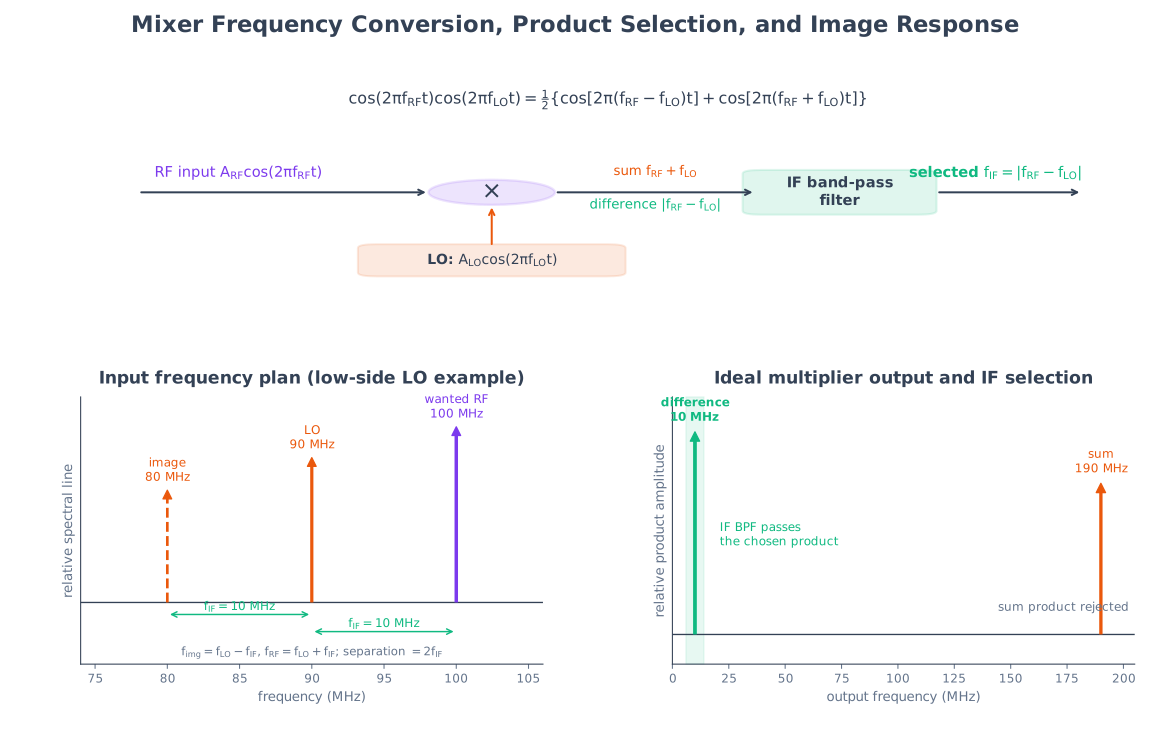
The essential numerical check is
Hence both the wanted station and image become \(455\,\text{kHz}\) after mixing. The IF filter cannot distinguish them; a tuned RF preselector before the mixer must attenuate \(1.910\,\text{MHz}\). Image separation from the desired station is \(2f_{IF}=910\,\text{kHz}\). A higher IF increases this separation and eases RF image rejection, while a lower IF permits a narrower fixed IF filter and better adjacent-channel selectivity. If low-side injection had instead been specified, the formulas would be \(f_{LO}=f_s-f_{IF}\) and \(f_{image}=f_s-2f_{IF}\), provided the resulting frequencies are positive and within the receiver plan.
Practice target: 7-8 minutes; write the injection relation first, retain common units, and verify both inputs produce the same IF.
Model Answer - Superheterodyne FM Receiver [10 marks]
Exam-ready answer
A superheterodyne FM receiver selects an FM station, converts it to a fixed IF and recovers the message from instantaneous-frequency deviation rather than amplitude.
The RF amplifier/preselector gives low-noise gain and rejects image/adjacent signals. The mixer and LO satisfy \(f_{IF}=|f_{LO}-f_s|\); \(10.7\,\text{MHz}\) is a common FM-broadcast IF. The IF filter/amplifier supplies most gain and passes the complete FM channel, approximately \(2(\Delta f+f_{m(max)})\) by Carson's rule. A filter too narrow removes significant sidebands and distorts audio.
The limiter clips amplitude variations caused by noise and fading while retaining zero crossings/frequency deviation, because ideal FM has constant envelope. It is particularly necessary before amplitude-sensitive slope and Foster-Seeley discriminators; ratio and PLL detectors have more inherent AM rejection. The discriminator has an S-curve: output is zero at center, positive on one side, negative on the other and approximately proportional to \(f_i-f_c\) in its linear region. Implementations include Foster-Seeley, ratio, quadrature and PLL detectors.
At the transmitter, pre-emphasis boosts high audio frequencies because post-detection FM noise rises strongly with frequency. The receiver de-emphasis network is a complementary first-order RC low-pass with
commonly \(50\,\mu\text{s}\) or \(75\,\mu\text{s}\) depending on the standard. It restores the original audio response and attenuates high-frequency noise. For \(R=75\,\text{k}\Omega\) and \(C=1\,\text{nF}\), \(RC=75\,\mu\text{s}\).
Automatic frequency control (AFC) uses the discriminator's slowly varying DC error to correct LO drift through a varactor or controlled oscillator. Its polarity pulls the IF back to center. AFC controls frequency, whereas AGC controls gain; they are not interchangeable. The recovered audio then passes through coupling/filtering and the AF amplifier to the speaker.
For broadcast \(\Delta f=75\,\text{kHz}\) and \(f_{m(max)}=15\,\text{kHz}\), Carson bandwidth is \(180\,\text{kHz}\), motivating an IF/channel near \(200\,\text{kHz}\). FM offers limiting, capture effect and high fidelity above threshold, but uses more bandwidth and circuitry than AM. Below the FM threshold, output SNR collapses rapidly; discriminator misalignment, oscillator drift and multipath also cause distortion. Proper RF preselection, IF bandwidth, limiting, de-emphasis and AFC are therefore all required for reliable reception.
Practice target: 16-18 minutes; draw the complete chain and explain limiter, discriminator, de-emphasis and AFC as four distinct functions.
Model Answer - Receiver Sensitivity, Selectivity and Fidelity [5 marks]
Exam-ready answer
Sensitivity is a receiver's ability to produce a specified usable output from a weak RF input. It is stated as minimum input power/voltage for a required output SNR, SINAD or BER. It depends mainly on antenna/interface loss, first-stage noise figure, gain and detector threshold; lower required input power means better sensitivity.
Selectivity is the ability to accept the wanted channel while rejecting adjacent or other unwanted frequencies. It is determined mainly by RF/IF filter bandwidth, skirt slope or shape factor, image rejection and dynamic range. Narrower, steeper filters generally improve adjacent-channel selectivity.
Fidelity is the ability to reproduce the original message without significant amplitude, phase or nonlinear distortion. It requires the receiver passband to include all wanted modulation components with approximately flat magnitude and sufficiently linear phase. For AM audio bandwidth \(f_m\), the IF must pass carrier and both sidebands, so \(B_{IF}\gtrsim2f_m\); FM must pass its significant Carson sidebands.
The main trade-off is that narrowing IF bandwidth reduces admitted noise \(N=kTB\) and adjacent-channel interference, improving sensitivity/selectivity, but a bandwidth narrower than the wanted spectrum cuts sidebands and reduces fidelity. Widening it improves waveform reproduction but admits more noise and neighboring channels. Likewise, very high front-end gain can improve weak-signal response yet cause compression/intermodulation in the presence of strong signals. For a \(455\,\text{kHz}\) AM IF carrying \(5\,\text{kHz}\) audio, about \(10\,\text{kHz}\) passband is required; an equivalent single-tuned \(Q\) is \(f_0/B\approx45.5\). A \(5\,\text{kHz}\) filter would sound muffled, while a much wider filter would admit unnecessary noise. Thus receiver design balances minimum usable signal, rejection and required message bandwidth rather than maximizing any one term alone.
Practice target: 7-8 minutes; define all three terms with a measurable criterion and explain the IF-bandwidth trade-off using one numerical example.