Advanced Communication Technologies
Possible Exam Questions
Exam Questions and Answer Map
Tags: [PYQ paper/year] = directly observed in a past paper · [likely] = pattern-predicted variant. Marks in [ ] show the typical split.
-
Explain the architecture and key components of NGN; state its advantages over traditional networks and give example services. [4+3+3=10] — [PYQ 2081]
-
Answer plan: Define NGN (packet-based, separated control/transport/service) → draw layered architecture (access, transport, control, service, management) → list components (softswitch, MGW, SBC, application server) → state 7 advantages → give service examples (VoIP, IPTV, conferencing).
-
Model answer: NGN Architecture, Components, Advantages and Services
-
Discuss IP-based convergence in NGN; how does NGN converge voice, video and data? What are the interoperability challenges? [3+3+4=10] — [PYQ 2082]
-
Answer plan: Explain convergence concept (one IP/MPLS transport for all services) → describe separation of layers enabling multi-service delivery → state QoS, SIP/IMS session control, media gateway interworking → list challenges (legacy PSTN interworking, QoS end-to-end, numbering portability, security, regulatory).
-
Model answer: IP-Based Convergence in NGN
-
Explain the GSM architecture and a basic call flow. [10] — [likely]
-
Answer plan: Define GSM (2G, TDMA/FDMA) → draw architecture (MS, BSS, NSS, OSS) → list key elements (BTS, BSC, MSC, HLR, VLR, AuC, EIR) → describe radio access (200 kHz, 8 TS, GMSK) → outline basic MO call flow (off-hook, RACH, SDCCH, authentication, TCH assignment, ringing, answer).
-
Model answer: GSM Architecture and Mobile-Originated Call Flow
-
Explain VoIP and the Real-time Transport Protocol (RTP). [5] — [likely]
-
Answer plan: Define VoIP → list main steps (speech coding, packetisation, signalling, transport, jitter buffering) → list protocols (SIP, RTP, RTCP, SDP) → describe RTP header fields (payload type, sequence, timestamp, SSRC) → compare VoIP vs PSTN.
-
Model answer: VoIP Operation and RTP Header
-
Differentiate WiFi and WiMAX. [5] — [likely]
-
Answer plan: State standards (802.11 vs 802.16) → compare coverage (LAN/hotspot vs MAN) → compare QoS support → compare mobility → compare typical deployment.
-
Model answer: WiFi and WiMAX Comparison
-
Compare DS-SS and FH-SS (performance and applications). [4] — [PYQ 2082]
-
Answer plan: Define DS-SS (spreading with PN code, entire bandwidth used continuously) → define FH-SS (carrier hops across frequencies per PN sequence) → compare bandwidth usage, interference resistance, near-far sensitivity, complexity → give applications (CDMA cellular for DS-SS; Bluetooth, military for FH-SS).
-
Model answer: Direct-Sequence and Frequency-Hopping Spread Spectrum
-
Describe how synchronization is achieved in a DS-CDMA system; why is DS-CDMA important? [4+2] — [PYQ 2082]
-
Answer plan: State two-stage sync (acquisition + tracking) → explain acquisition (sliding correlator or matched filter finds coarse code phase) → explain tracking (delay-lock loop maintains alignment) → state importance of DS-CDMA (frequency reuse = 1, soft handover, multipath via Rake, capacity through processing gain).
- Model answer: DS-CDMA Synchronization and Importance
Scope of this Topic
This note covers UMTS, IMT-2000, NGN, VoIP, Real-time Transport Protocol, DECT, GSM, CDMA2000-1x, WiFi, and WiMAX.
1. Mobile Communication Evolution
Likely Exam Question (5 marks)
"Briefly explain the evolution of mobile communication from 1G to 5G."
| Generation | Main Technology | Services | Key Feature |
|---|---|---|---|
| 1G | Analog cellular | Voice | Analog FM, low security |
| 2G | GSM, IS-95 CDMA | Digital voice, SMS | Digital encryption and better capacity |
| 2.5G | GPRS, EDGE | Packet data | Always-on low-speed data |
| 3G | UMTS, CDMA2000 | Voice, video call, mobile internet | Higher data rate and multimedia |
| 4G | LTE, LTE-A | All-IP broadband | OFDMA, MIMO, low latency |
| 5G | 5G NR | eMBB, URLLC, mMTC | Massive MIMO, network slicing, ultra-low latency |
Key Direction of Evolution
Mobile networks evolved from analog voice to digital voice, then to packet data, and finally to all-IP broadband and low-latency services.
2. UMTS
Likely Exam Question (10 marks)
"Explain UMTS architecture and its main features."
Universal Mobile Telecommunications System (UMTS) is a 3G mobile communication system standardized by 3GPP. It evolved from GSM/GPRS and uses WCDMA radio access.
Main Features
- 3G mobile system for voice, data, and multimedia
- WCDMA air interface
- Higher data rate than GSM/GPRS
- Supports circuit-switched voice and packet-switched data
- Global roaming through SIM/USIM-based authentication
- Better spectrum efficiency and soft handover
UMTS Architecture
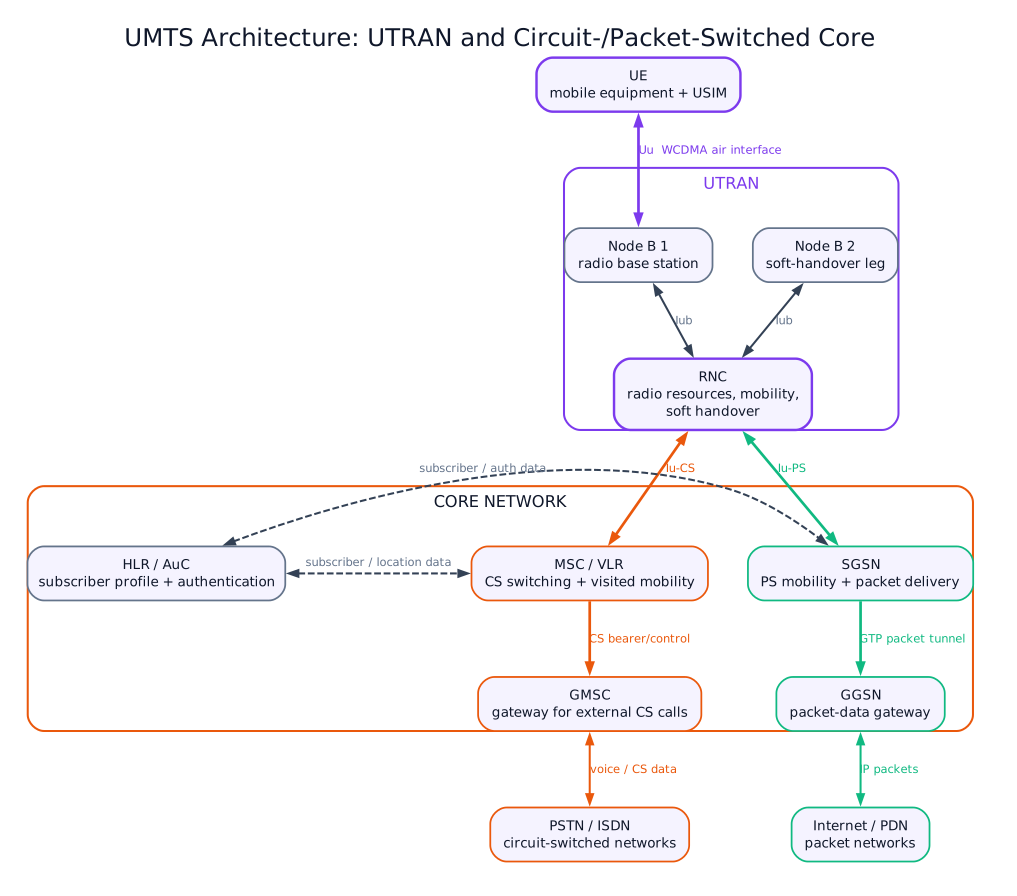
| Part | Components | Function |
|---|---|---|
| User Equipment (UE) | Mobile Equipment + USIM | User access, authentication, radio communication |
| UTRAN | Node B + RNC | Radio transmission, handover, power control |
| Core Network | MSC/VLR, HLR, SGSN, GGSN | Switching, mobility, packet data, subscriber database |
Important UMTS Elements
| Element | Full Form | Function |
|---|---|---|
| Node B | Base station | Radio transmission/reception |
| RNC | Radio Network Controller | Controls Node B, radio resource management |
| MSC | Mobile Switching Center | Circuit-switched voice switching |
| HLR | Home Location Register | Permanent subscriber database |
| VLR | Visitor Location Register | Temporary subscriber data in visited area |
| SGSN | Serving GPRS Support Node | Packet mobility and session management |
| GGSN | Gateway GPRS Support Node | Gateway to external packet networks |
WCDMA Features
| Feature | Explanation |
|---|---|
| Wideband carrier | 5 MHz carrier bandwidth |
| Code separation | Users separated by spreading codes |
| Soft handover | UE may connect to multiple cells during handover |
| Power control | Reduces near-far problem and interference |
| Rake receiver | Combines multipath components |
UMTS vs GSM
| Feature | GSM | UMTS |
|---|---|---|
| Generation | 2G | 3G |
| Access method | TDMA/FDMA | WCDMA |
| Main service | Voice and SMS | Voice, data, multimedia |
| Carrier bandwidth | 200 kHz | 5 MHz |
| Handover | Hard handover | Soft handover supported |
| Data rate | Lower | Higher |
3. IMT-2000
Likely Exam Question (5 marks)
"What is IMT-2000? State its objectives and radio interfaces."
IMT-2000 (International Mobile Telecommunications-2000) is the ITU framework for 3G mobile systems. It defines requirements for global mobile communication around the year 2000 and beyond.
Objectives
- Global roaming capability
- High-quality mobile voice and data
- Support for multimedia services
- Efficient spectrum use
- Compatibility with fixed and mobile networks
- Flexible service delivery across different environments
Target Data Rates
| Environment | Target Rate |
|---|---|
| High mobility | Around 144 kbps |
| Pedestrian/urban | Around 384 kbps |
| Indoor/low mobility | Up to about 2 Mbps |
IMT-2000 Radio Interfaces
| Interface | Associated System |
|---|---|
| IMT-DS | Direct Spread WCDMA/UMTS |
| IMT-MC | Multi-carrier CDMA/CDMA2000 |
| IMT-TC | Time Code, TD-SCDMA |
| IMT-SC | Single Carrier, UWC-136/EDGE evolution |
| IMT-FT | Frequency Time, DECT-based option |
Importance
IMT-2000 provided a global framework under which different 3G technologies such as UMTS and CDMA2000 could interoperate at the service and roaming level.
4. Next Generation Network (NGN)
Likely Exam Question (10 marks)
"Define NGN. Explain its architecture and advantages."
Next Generation Network (NGN) is a packet-based network that separates service control from transport and supports multiple services such as voice, data, and video over a common IP-based infrastructure.
ITU-T Concept
NGN provides telecommunication services using packet-based transport with QoS support, generalized mobility, and independent service-related functions.
Main Features
- Packet-based transport, usually IP/MPLS
- Separation of control, service, and transport layers
- Convergence of voice, data, and video
- Support for QoS and security
- Open interfaces for new services
- Fixed-mobile convergence
- Legacy PSTN interworking through media gateways
NGN Layered Architecture
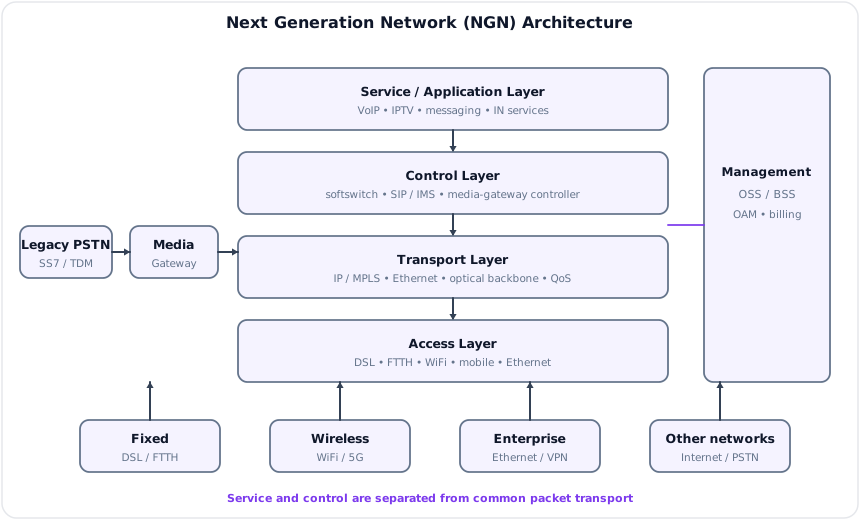
| Layer | Function | Examples |
|---|---|---|
| Access layer | Connects users through different access technologies | DSL, FTTH, WiFi, mobile, Ethernet |
| Transport layer | Packet forwarding and bearer transport | IP/MPLS, Ethernet, optical backbone |
| Control layer | Call/session control and resource control | Softswitch, SIP server, IMS control |
| Service layer | Application and value-added services | VoIP, IPTV, messaging, IN services |
| Management layer | Operation, administration, maintenance, billing | OSS/BSS, NMS |
NGN Components
| Component | Function |
|---|---|
| Softswitch | Software-based call control |
| Media Gateway (MGW) | Converts media between circuit and packet networks |
| Signaling Gateway | Converts SS7 signaling to IP signaling |
| Media Gateway Controller | Controls media gateways |
| Application Server | Hosts services such as voicemail, conferencing, IPTV |
| Session Border Controller | Secures and controls VoIP sessions at network borders |
Advantages of NGN
- One network for many services
- Lower operation and maintenance cost
- Faster service creation
- Better scalability
- Efficient bandwidth use
- Supports multimedia and mobility
- Interworks with legacy networks
5. VoIP
Likely Exam Question (10 marks)
"Explain VoIP operation and compare it with traditional PSTN."
Voice over Internet Protocol (VoIP) is the transmission of voice calls over IP packet networks.
VoIP Operation
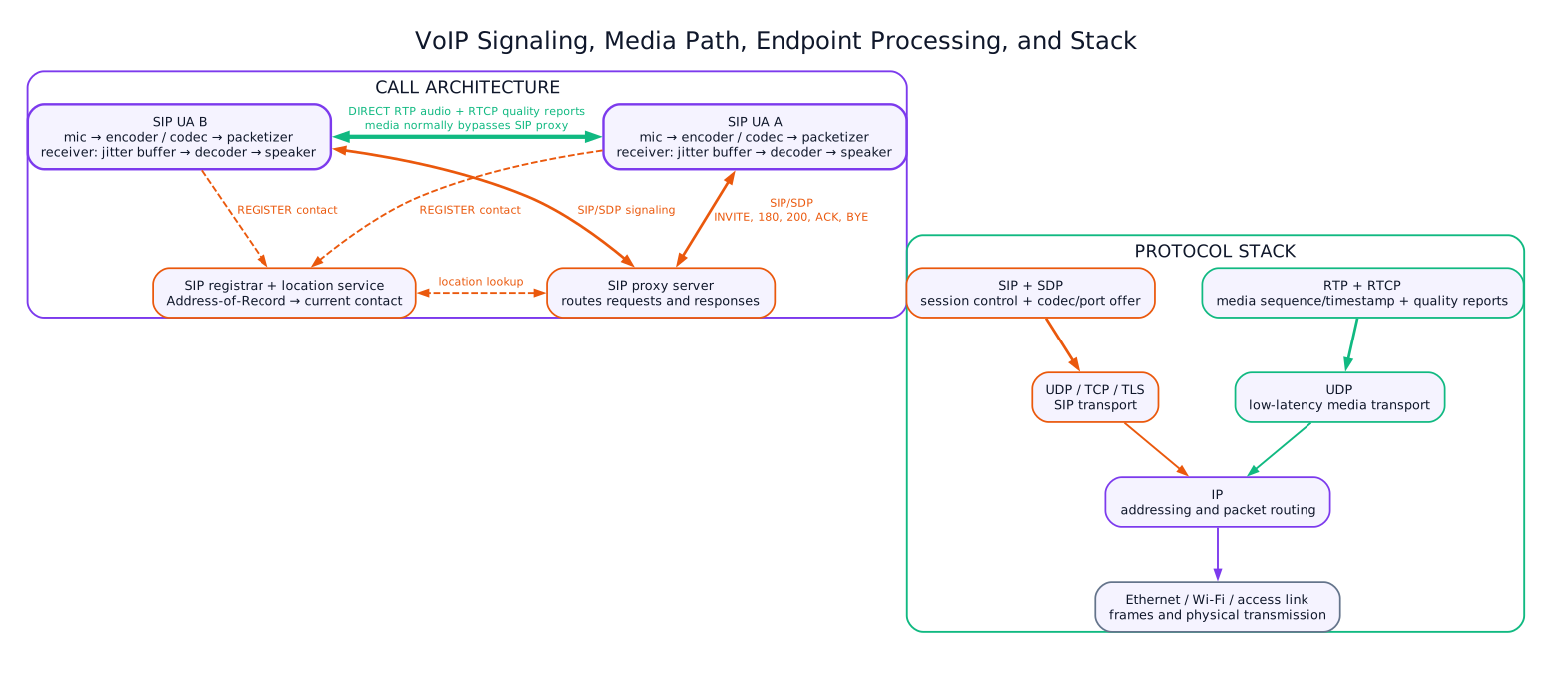
Main Steps
| Step | Function |
|---|---|
| Speech coding | Converts analog speech to compressed digital stream |
| Packetization | Groups encoded speech into RTP/UDP/IP packets |
| Signaling | Establishes, modifies, and releases sessions |
| Transport | Carries voice packets through IP network |
| Jitter buffering | Smooths packet delay variation |
| Playout | Converts digital stream back to audio |
VoIP Protocols
| Protocol | Function |
|---|---|
| SIP | Session setup, modification, and release |
| H.323 | Older multimedia communication suite |
| RTP | Carries real-time audio/video payload |
| RTCP | Reports quality and synchronization information |
| UDP | Low-latency transport for RTP |
| SDP | Describes media type, codec, IP, and port |
Common Voice Codecs
| Codec | Bit Rate | Notes |
|---|---|---|
| G.711 | 64 kbps | PCM, high quality, high bandwidth |
| G.729 | 8 kbps | Compressed voice, common in VoIP |
| G.723.1 | 5.3/6.3 kbps | Low bit rate |
| AMR | Variable | Used in mobile networks |
VoIP Quality Factors
| Factor | Effect |
|---|---|
| Delay | Causes conversational difficulty |
| Jitter | Causes uneven audio unless buffered |
| Packet loss | Causes gaps/distortion |
| Codec | Affects quality and bandwidth |
| Echo | Becomes annoying with delay |
| QoS | Prioritizes voice over best-effort data |
PSTN vs VoIP
| Feature | PSTN | VoIP |
|---|---|---|
| Switching | Circuit switching | Packet switching |
| Resource use | Dedicated circuit per call | Shared IP bandwidth |
| Signaling | SS7/CAS | SIP/H.323 plus RTP media |
| Voice format | Usually 64 kbps PCM in core | Codec-compressed packets |
| Service integration | Limited | Easy integration with data/video |
| Dependence on power/IP | Low at basic phone line | Needs IP equipment and power |
6. Real-time Transport Protocol (RTP)
Likely Exam Question (5 marks)
"What is RTP? Why is it used in VoIP?"
Real-time Transport Protocol (RTP) carries real-time audio and video over IP networks. It usually runs over UDP.
RTP Functions
- Payload type identification
- Sequence numbering
- Timestamping
- Source identification
- Support for jitter calculation and media synchronization
RTP Header Fields
| Field | Function |
|---|---|
| Version | RTP version number |
| Payload Type | Identifies codec/media format |
| Sequence Number | Detects packet loss and reorders packets |
| Timestamp | Supports playout timing and synchronization |
| SSRC | Synchronization source identifier |
| CSRC | Contributing source identifiers for mixers |
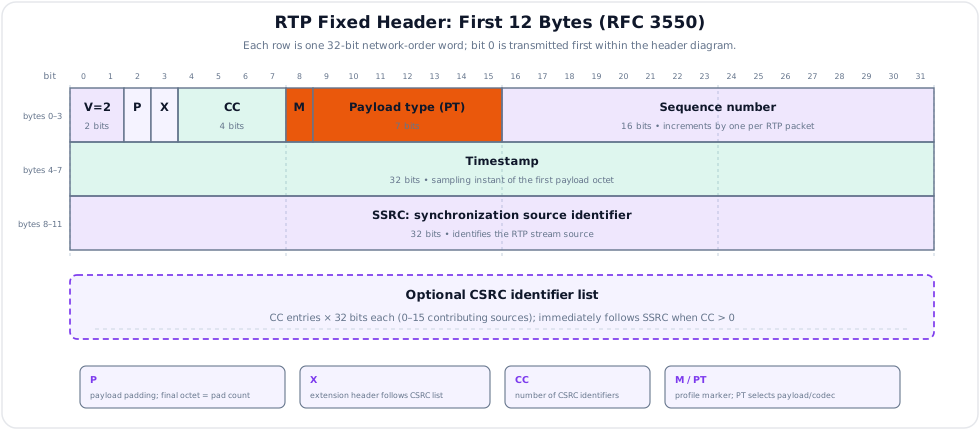
RTCP
Real-time Transport Control Protocol (RTCP) works with RTP and provides quality feedback.
| RTCP Function | Explanation |
|---|---|
| Sender/receiver reports | Packet loss, jitter, delay statistics |
| Source description | Identifies participants |
| Quality monitoring | Helps applications adapt transmission |
| Synchronization | Audio/video synchronization support |
RTP Does Not Provide
- Guaranteed delivery
- Retransmission by itself
- Congestion control by itself
- Resource reservation by itself
These are handled by other protocols or application mechanisms.
7. DECT
Digital Enhanced Cordless Telecommunications (DECT) is a digital cordless telephone technology mainly used for short-range wireless voice communication.
Features
| Feature | DECT |
|---|---|
| Main use | Cordless phones, wireless PBX |
| Coverage | Short-range indoor/outdoor |
| Access method | TDMA/TDD |
| Service | Mainly voice, limited data |
| Mobility | Low mobility, cordless roaming within coverage |
Advantages
- Good voice quality
- Low power portable handsets
- Secure digital communication
- Easy cordless PBX deployment
- Supports handover within DECT coverage
8. GSM
Likely Exam Question (10 marks)
"Explain GSM architecture and the functions of its main subsystems."
Global System for Mobile Communications (GSM) is a 2G digital cellular system based on TDMA/FDMA.
GSM Architecture
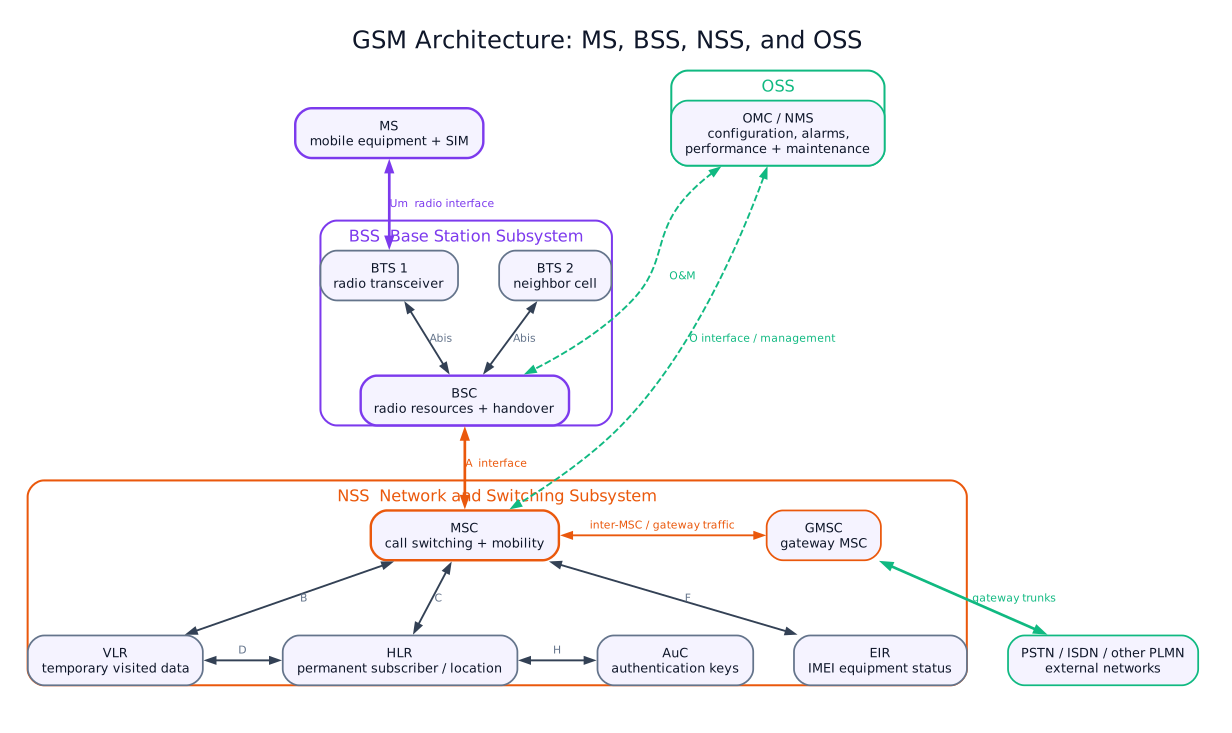
Main Subsystems
| Subsystem | Components | Function |
|---|---|---|
| MS | Mobile equipment + SIM | User access and subscriber identity |
| BSS | BTS + BSC | Radio access and radio resource control |
| NSS | MSC, HLR, VLR, AuC, EIR | Switching, mobility, authentication, subscriber data |
| OSS | OMC/NMS | Operation and maintenance |
Important GSM Elements
| Element | Full Form | Function |
|---|---|---|
| BTS | Base Transceiver Station | Radio transmission with mobiles |
| BSC | Base Station Controller | Controls multiple BTSs, handover, frequency management |
| MSC | Mobile Switching Center | Call switching and mobility management |
| HLR | Home Location Register | Permanent subscriber database |
| VLR | Visitor Location Register | Temporary data for roaming users |
| AuC | Authentication Center | Authentication and ciphering keys |
| EIR | Equipment Identity Register | IMEI-based equipment status database |
GSM Radio Access
| Parameter | Typical Value/Meaning |
|---|---|
| Carrier spacing | 200 kHz |
| Access method | FDMA + TDMA |
| Time slots per carrier | 8 |
| Modulation | GMSK |
| Duplexing | FDD |
GSM Channels
| Channel Type | Function |
|---|---|
| Traffic Channel (TCH) | Carries voice/data |
| Broadcast Channel (BCH) | Broadcasts system information |
| Common Control Channel (CCCH) | Paging and random access |
| Dedicated Control Channel (DCCH) | Call setup, handover, signaling |
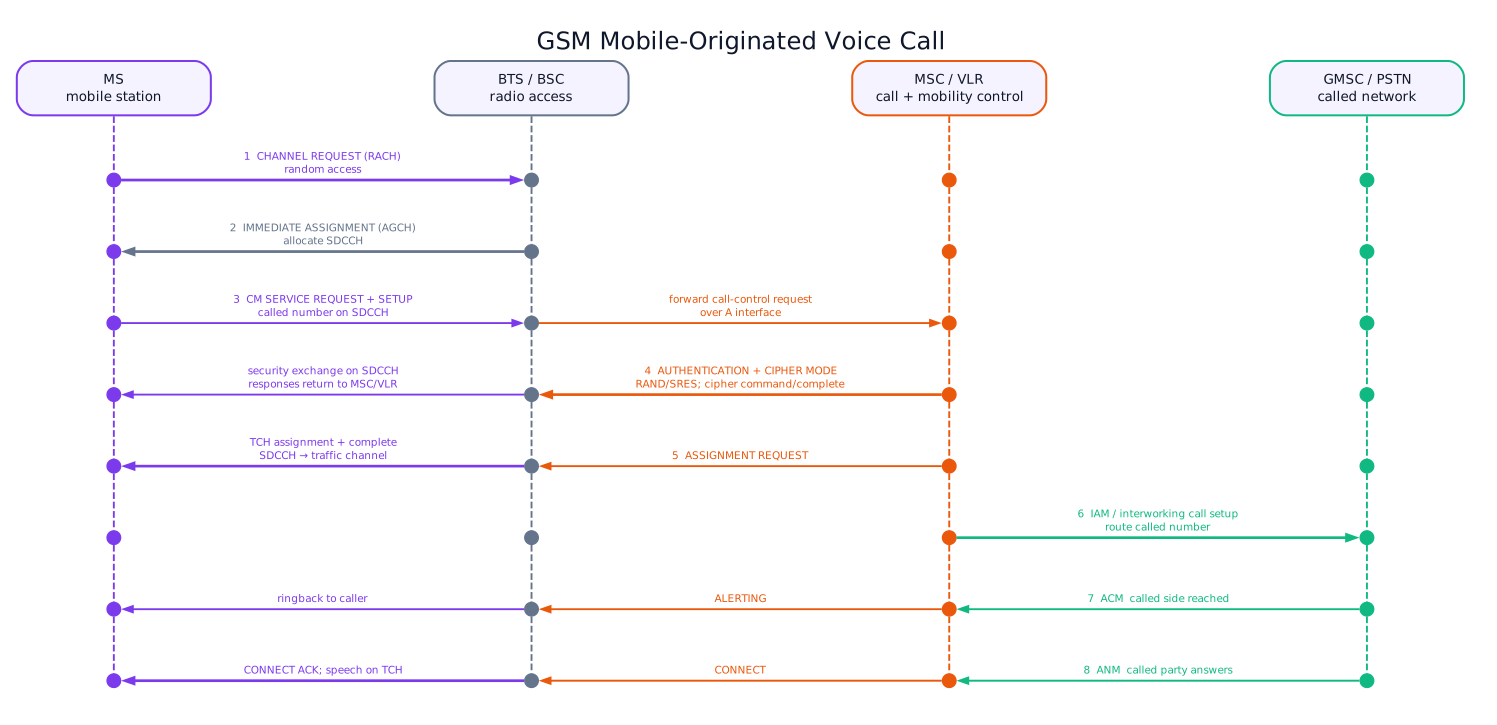
GSM Mobile-Originated Call Flow
A mobile-originated call first obtains an SDCCH for signaling, completes authentication and ciphering, and only then receives a traffic channel before the MSC interworks with the called network.
GSM Services
- Telephony
- Emergency call
- SMS
- Circuit-switched data
- Supplementary services such as call forwarding and call waiting
- Packet data through GPRS/EDGE evolution
9. CDMA2000-1x
CDMA2000-1x is a 3G mobile technology evolved from IS-95 CDMA. It uses code division multiple access and a 1.25 MHz carrier.
Main Features
| Feature | CDMA2000-1x |
|---|---|
| Generation | 3G family |
| Carrier bandwidth | 1.25 MHz |
| Access method | CDMA |
| Services | Voice, SMS, packet data |
| Handover | Soft handoff supported |
| Capacity | Improved over IS-95 |
CDMA Principle
In CDMA, all users may share the same frequency band at the same time, but each user is assigned a different spreading code.
Processing Gain
Processing gain is the ratio of spread bandwidth to original data bandwidth:
In dB:
Higher processing gain improves interference resistance.
Advantages and Limitations
| Advantages | Limitations |
|---|---|
| Efficient frequency reuse | Power control is critical |
| Soft handoff improves call continuity | Near-far problem |
| Good voice capacity | More complex receiver |
| Better privacy due to spreading codes | Capacity interference-limited |
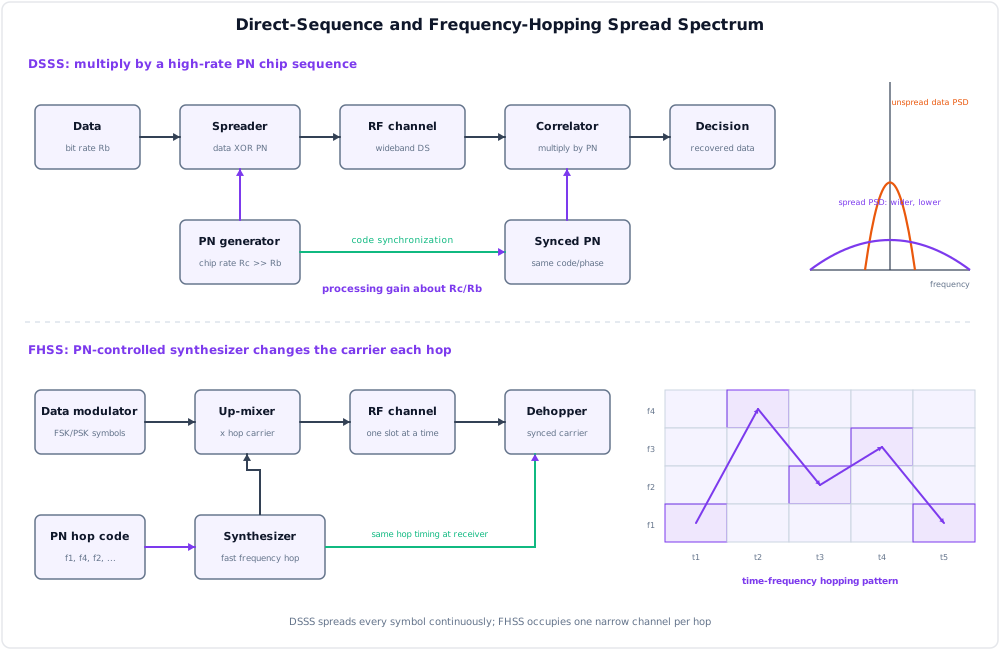
DS-SS vs FH-SS
| Feature | DS-SS (Direct Sequence) | FH-SS (Frequency Hopping) |
|---|---|---|
| Spreading method | Multiplies data by high-rate PN code; entire bandwidth used continuously | Carrier frequency hops across a set of frequencies per PN sequence |
| Bandwidth usage | Continuous wideband transmission | Narrowband at any instant, wideband over time |
| Interference resistance | High processing gain; resists narrowband interference | Avoids interference by hopping away from jammed frequencies |
| Near-far sensitivity | Sensitive; requires tight power control | Less sensitive; each hop is independent |
| Multipath handling | Rake receiver can combine multipath | Less multipath combining capability |
| Complexity | Wideband receiver, power control | Fast frequency synthesizer |
| Applications | CDMA cellular (IS-95, CDMA2000, UMTS), GPS | Bluetooth, military radios, GSM slow FH |
DS-CDMA Synchronization
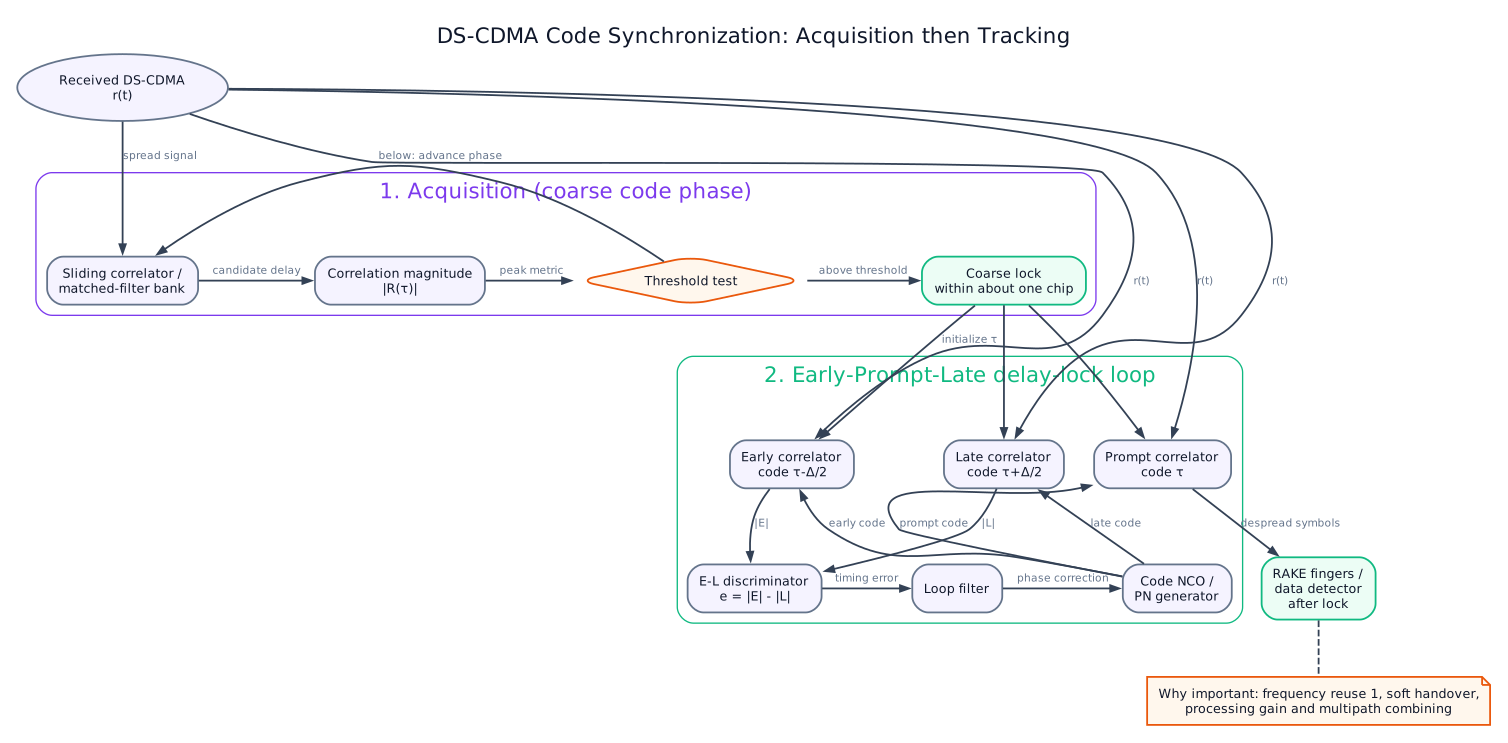
DS-CDMA requires precise alignment of the receiver's local PN code with the incoming spread signal. Synchronization has two stages:
| Stage | Function | Method |
|---|---|---|
| Acquisition | Coarse alignment of code phase | Sliding correlator or matched filter searches for correlation peak |
| Tracking | Fine maintenance of code phase | Delay-Lock Loop (DLL) or Tau-Dither Loop adjusts timing continuously |
Why DS-CDMA is important:
- Frequency reuse factor of 1 — all cells use the same carrier
- Soft handover improves call reliability at cell edges
- Rake receiver exploits multipath diversity
- Processing gain provides interference margin and capacity
- Graceful degradation under overload
10. WiFi
Likely Exam Question (5 marks)
"Write short notes on WiFi and its standards."
WiFi is a wireless local area network technology based on IEEE 802.11 standards.
Features
| Feature | WiFi |
|---|---|
| Standard family | IEEE 802.11 |
| Network type | Wireless LAN |
| Coverage | Short range, indoor/outdoor hotspot |
| Spectrum | 2.4 GHz, 5 GHz, 6 GHz bands depending on standard |
| Access method | CSMA/CA, OFDM/OFDMA in newer standards |
Common Standards
| Standard | Band | Key Feature |
|---|---|---|
| 802.11b | 2.4 GHz | Up to 11 Mbps |
| 802.11a | 5 GHz | OFDM, up to 54 Mbps |
| 802.11g | 2.4 GHz | Up to 54 Mbps |
| 802.11n | 2.4/5 GHz | MIMO, higher throughput |
| 802.11ac | 5 GHz | Wider channels, MU-MIMO |
| 802.11ax | 2.4/5/6 GHz | WiFi 6/6E, OFDMA, efficient dense networks |
WiFi Modes
| Mode | Description |
|---|---|
| Infrastructure mode | Devices connect through access point |
| Ad hoc mode | Devices communicate directly |
| Mesh mode | APs relay traffic wirelessly |
WiFi Security
| Security | Notes |
|---|---|
| WEP | Old and insecure |
| WPA | Improvement over WEP |
| WPA2 | Stronger security using AES |
| WPA3 | Improved authentication and security |
11. WiMAX
Likely Exam Question (5 marks)
"Compare WiFi and WiMAX."
WiMAX (Worldwide Interoperability for Microwave Access) is a broadband wireless access technology based on IEEE 802.16 standards.
Features
| Feature | WiMAX |
|---|---|
| Standard | IEEE 802.16 |
| Network type | Metropolitan area broadband wireless access |
| Coverage | Larger than WiFi |
| Access method | OFDM/OFDMA |
| Services | Broadband internet, backhaul, fixed/mobile wireless |
| QoS | Built-in QoS support |
Fixed and Mobile WiMAX
| Type | Standard | Feature |
|---|---|---|
| Fixed WiMAX | 802.16d | Fixed broadband wireless access |
| Mobile WiMAX | 802.16e | Mobility and handover support |
WiFi vs WiMAX
| Feature | WiFi | WiMAX |
|---|---|---|
| Standard | IEEE 802.11 | IEEE 802.16 |
| Coverage | LAN/hotspot | MAN/metropolitan access |
| Main use | Local wireless networking | Broadband wireless access/backhaul |
| QoS | Limited/basic in older versions | Stronger built-in QoS |
| Mobility | Local mobility | Fixed and mobile versions |
| Deployment | Homes, offices, campuses | ISP access networks, rural broadband |
12. Technology Comparison
| Technology | Generation/Type | Access Method | Main Use |
|---|---|---|---|
| DECT | Cordless | TDMA/TDD | Cordless telephony |
| GSM | 2G cellular | FDMA/TDMA | Digital voice, SMS |
| UMTS | 3G cellular | WCDMA | Mobile multimedia |
| CDMA2000-1x | 3G cellular | CDMA | Voice and packet data |
| WiFi | WLAN | CSMA/CA, OFDM/OFDMA | Local wireless internet |
| WiMAX | WMAN | OFDM/OFDMA | Broadband wireless access |
| NGN | Core network concept | IP/MPLS packet transport | Converged services |
| VoIP | Service/application | RTP over IP | Voice over packet network |
13. Solved Examples
Example 1 - GSM Carrier Capacity
Q. How many full-rate time slots are available in one GSM carrier?
Solution:
GSM uses TDMA with 8 time slots per carrier. Therefore one carrier has 8 time slots. In practice, some slots may be used for control channels depending on cell configuration.
Example 2 - CDMA Processing Gain
Q. A CDMA system spreads a \(9.6\,\text{kbps}\) signal over \(1.2288\,\text{MHz}\). Find processing gain in dB.
Solution:
Processing gain is approximately 21 dB.
Example 3 - VoIP Packet Rate
Q. A VoIP system sends one RTP packet every \(20\,\text{ms}\). How many packets are sent per second?
Solution:
So the packet rate is 50 packets/s.
14. Short Notes for Revision
UMTS
3G system using WCDMA. Main parts are UE, UTRAN, and core network. Supports voice, data, multimedia, soft handover, and higher data rates than GSM.
IMT-2000
ITU framework for 3G systems. Objectives include global roaming, multimedia services, and data rates up to about 2 Mbps in low-mobility environments.
NGN
Packet-based converged network separating service, control, and transport. Uses IP/MPLS, softswitches, media gateways, and application servers.
VoIP
Voice over IP packet network. Uses codecs, RTP/UDP/IP for media, and SIP/H.323 for signaling. Delay, jitter, packet loss, and echo affect quality.
RTP
Protocol for real-time audio/video transport. Provides sequence number, timestamp, payload type, and source identification, but not guaranteed delivery.
GSM
2G cellular system using FDMA/TDMA. Architecture includes MS, BSS, NSS, and OSS.
CDMA2000-1x
3G CDMA technology using 1.25 MHz carrier. Supports soft handoff and packet data; capacity is interference-limited.
WiFi and WiMAX
WiFi is IEEE 802.11 WLAN for local access. WiMAX is IEEE 802.16 broadband wireless access with larger coverage and QoS support.
Key Exam Points - Advanced Technologies
- UMTS is a 3G WCDMA system; main blocks are UE, UTRAN, and core network.
- IMT-2000 is the ITU 3G framework; target rates include 144 kbps, 384 kbps, and up to about 2 Mbps.
- NGN separates service/control from packet transport and supports converged services.
- VoIP uses IP packets for voice; SIP handles signaling, RTP carries media.
- RTP provides payload type, sequence number, timestamp, and source identification but does not guarantee delivery.
- GSM uses FDMA/TDMA with 8 time slots per carrier; CDMA2000-1x uses CDMA over 1.25 MHz.
- WiFi is IEEE 802.11 WLAN; WiMAX is IEEE 802.16 broadband wireless access.
Model Answer - NGN Architecture, Components, Advantages and Services [10 marks, PYQ 2081]
Exam-ready answer
Part A - Definition and architecture [4 marks]
A Next Generation Network (NGN) is a packet-based telecom network that supports multiple services over common broadband transport, provides QoS and mobility, and separates service/session control from bearer transport. Unlike a traditional service-specific PSTN, it allows access technology and application logic to evolve independently through standardized interfaces.
The access layer terminates DSL, FTTH, Ethernet, WiFi, cellular and legacy lines. The transport layer forwards media/data over Ethernet, IP/MPLS and optical capacity. The control layer performs SIP/IMS session control, admission, addressing, routing and resource policy. The service layer hosts applications such as telephony, messaging, IPTV and presence. OSS/BSS/NMS management spans all layers for configuration, faults, performance, security, accounting and billing. A voice call follows access -> session control and policy -> packet bearer through transport -> destination access; control messages and RTP media need not follow the same logical path.
Part B - Key components [3 marks]
A softswitch/media-gateway controller applies call logic and controls bearer resources. A media gateway (MGW) converts TDM PCM trunks and packetized RTP media, including framing/codec adaptation where required; a signaling gateway interworks SS7 signaling with IP-based control. SIP proxy/registrar or IMS functions locate users and manage sessions. An application server supplies voicemail, conferencing, IN and IPTV logic. A session border controller (SBC) enforces topology hiding, policy, NAT traversal, admission and media/signaling security at an administrative border. Routers/MPLS nodes provide transport, while policy/QoS controllers and OSS/BSS supervise resources and charging. These roles may be combined or virtualized, so product boundaries are implementation-dependent.
Part C - Advantages and services [3 marks]
NGN converges voice, video and data on one scalable infrastructure, statistically shares bandwidth, reduces duplicate networks and O&M, enables rapid software-based service creation, supports fixed-mobile access and user mobility, exposes open interfaces, centralizes policy/management, and can protect real-time traffic through QoS. Typical services are VoIP and IP-PBX, IPTV/video-on-demand, multimedia conferencing, unified messaging, presence, VPNs, hosted contact centers, and converged mobile/fixed services.
For example, an analog PSTN caller can enter through a TDM media gateway, be controlled by a softswitch, cross an MPLS core as RTP, and terminate at a SIP phone. Benefits are not automatic: availability, emergency calling, lawful/regulatory functions, end-to-end QoS, timing, power backup, security and legacy codec/signaling interworking must be engineered. Packet convergence replaces dedicated circuits with managed shared resources; it does not remove carrier-grade requirements.
Practice target: 18 minutes; allocate about 7 minutes to the five-layer diagram, 5 minutes to component functions, and 6 minutes to advantages, services, example, and caveats.
Model Answer - IP-Based Convergence in NGN [10 marks, PYQ 2082]
Exam-ready answer
Part A - Meaning of IP convergence [3 marks]
IP-based convergence means voice, video and data are represented as packets and carried through a shared IP/Ethernet/MPLS transport instead of separate PSTN, broadcast-video and data backbones. Access remains heterogeneous, but a common network layer provides addressing, routing and statistical multiplexing. NGN separates access, bearer transport, session/resource control and applications, allowing one service to reach fixed, wireless or mobile users without duplicating the core.
Part B - How the services converge [3 marks]
For voice, SIP/IMS plus SDP establishes and negotiates a session while RTP/UDP carries coded media. Video uses RTP or streaming protocols, often aided by multicast/CDN functions. Data applications use TCP, UDP or newer transports over the same routed core. DiffServ marking, priority scheduling, traffic engineering/MPLS paths, policing, admission control and capacity planning protect delay-sensitive flows; best-effort data uses residual capacity. A softswitch or IMS function applies call/session and policy logic independently of routers. MGWs convert TDM speech to RTP and signaling gateways map SS7 toward IP control, so legacy and packet users can share a service.
Part C - Interoperability challenges [4 marks]
- Legacy interworking: SS7/ISUP causes, circuit identities, tones, fax/modem behavior, PCM framing and supplementary services must map correctly to SIP/SDP/RTP; transcoding reduces quality and adds delay.
- QoS across domains: DiffServ labels, admission and MPLS policy may not survive another operator or the public Internet. Congestion causes loss, jitter and delay, so an edge-to-edge SLA and measurement are needed.
- Addressing and mobility: E.164 numbers, SIP URIs, DNS/ENUM-like lookup, number portability, roaming and emergency location must remain consistent while IP addresses change.
- Protocol/vendor variation: optional SIP extensions, codec sets, IPv4/IPv6, NAT/firewalls and incompatible management models require profiles, SBCs and conformance testing.
- Security and resilience: registration fraud, spoofing, denial of service, media interception and attacks on centralized control demand authentication, encryption, screening, redundancy and overload control.
- Operations/regulation: synchronized charging records, lawful interception, privacy, emergency priority, power backup and carrier-grade availability must work across fixed/mobile and old/new domains.
Example: a GSM/PSTN call entering an MGW may be signaled as ISUP on one side and SIP on the other, transcoded from G.711 to a negotiated codec, and transported as RTP. The call succeeds only if number mapping, cause/answer supervision, DTMF, QoS and charging remain semantically consistent. Thus convergence reduces duplicated infrastructure and accelerates services, but moves complexity into policy, software, gateways and inter-provider agreements.
Practice target: 18 minutes; spend 5 minutes defining convergence, 5 minutes on the three service paths/QoS, and 8 minutes on at least five explained interoperability challenges plus an example.
Model Answer - GSM Architecture and Mobile-Originated Call Flow [10 marks]
Exam-ready answer
Global System for Mobile Communications (GSM) is a 2G digital cellular system using FDMA carriers and TDMA slots, normally with GMSK. A nominal carrier is \(200\,\text{kHz}\) wide and each TDMA frame has 8 slots; channel combination, control-slot use and usable traffic capacity depend on cell configuration.
The mobile station (MS) is mobile equipment plus SIM identity/security data. The base-station subsystem (BSS) has BTS radio equipment and a BSC that manages channels, power/frequency resources and many handovers; a TRAU may transcode speech. The network and switching subsystem (NSS) contains MSC for call/mobility control, GMSC toward PSTN/other networks, HLR permanent subscription/location data, VLR temporary visited-area data, AuC authentication/ciphering material, and EIR IMEI status. OSS/OMC performs configuration, fault and performance management. The Um air interface joins MS-BTS, Abis joins BTS-BSC, and A joins BSC-MSC; database signaling commonly uses SS7/MAP, with detailed interface realization depending on release/vendor.
A mobile-originated call proceeds as follows:
- After cell selection/location registration, the MS sends CHANNEL REQUEST on RACH; BTS/BSC returns immediate assignment on AGCH to a dedicated SDCCH.
- The MS sends a service request and identity. MSC/VLR checks subscription; AuC-based challenge/response authenticates the SIM, ciphering is enabled, and equipment identity may be checked through EIR.
- The MS sends call setup with the called number. MSC analyzes it, selects a route, and for a PSTN/inter-MSC call sends an ISUP IAM toward the called network.
- BSC allocates a traffic channel (TCH) and commands assignment; call proceeding/alerting indicates progress and ringback. Exact TCH-assignment position relative to external alerting is implementation and resource-policy dependent.
- On called-party answer, connect/acknowledgment completes the speech path and charging begins according to tariff policy. Handover may move the radio leg while the MSC anchors the call.
- Disconnect/release signaling clears the radio channel, A-interface circuit and external trunk and closes call records.
GSM mainly routes circuit-switched voice through MSCs; GPRS/EDGE later added a packet domain. Its 3G evolution, UMTS, retains separate CS and PS core paths around a WCDMA radio access network:
UE reaches Node B over Uu, Node B reaches RNC over Iub, and RNC controls radio resources/soft handover. Iu-CS connects RNC to MSC/VLR and GMSC for circuit voice/PSTN; Iu-PS connects to SGSN for packet mobility/session handling and GGSN for external packet-data access. HLR/AuC supports subscriber/security data. UMTS uses a nominal \(5\,\text{MHz}\) WCDMA carrier and code separation rather than GSM's \(200\,\text{kHz}\) FDMA/TDMA structure. This shows the transition from GSM's voice-centered NSS to parallel UMTS CS/PS service domains; later all-IP systems converge them further.
GSM offers mature roaming, digital voice, SIM security and mobility, but radio capacity, codec quality and data rate are limited relative to later generations. Authentication protects subscriber access, yet original GSM security scope/algorithms and signaling exposure are release-dependent; nominal radio values do not guarantee eight simultaneous full-rate calls because control channels and reuse planning consume resources.
Practice target: 18 minutes; draw GSM interfaces in 6 minutes, trace RACH-to-release in 8 minutes, and reserve 4 minutes for radio values, UMTS CS/PS evolution, and caveats.
Model Answer - VoIP Operation and RTP Header [5 marks]
Exam-ready answer
Voice over IP (VoIP) converts speech to coded digital samples, packetizes them, and transports them over a shared IP network. SIP is signaling, not speech transport: a typical call uses INVITE with SDP offer, 100 Trying, 180 Ringing, 200 OK with SDP answer, and ACK; BYE/200 OK releases it. SDP negotiates codec, media IP and UDP port. Once established, endpoints normally exchange RTP over UDP/IP media independently of the SIP proxy path; a codec, packetizer, jitter buffer, decoder and playout device form each direction.
The RTP version-2 fixed header is at least 12 bytes. Its first 32 bits are: V 2 bits, P 1, X 1, CC 4, M 1, payload type 7, and sequence number 16. They are followed by timestamp 32 bits and SSRC 32 bits. CC gives 0-15 following CSRC identifiers, each 32 bits; X announces an extension and P announces trailing padding.
The sequence number increments per RTP packet to reveal loss and restore order. Timestamp advances by media sampling instants, not wall-clock milliseconds; for G.711 at \(8\,\text{kHz}\) with \(20\,\text{ms}\) packets it normally advances 160 per packet. Payload type identifies the negotiated/profile-defined codec, marker meaning is payload-profile dependent, SSRC identifies one synchronization source, and CSRCs identify sources mixed into a packet. RTCP reports loss, jitter, timing and source descriptions and helps synchronize streams.
Compared with PSTN's reserved circuit and usually \(64\,\text{kbit/s}\) PCM bearer, VoIP statistically shares bandwidth and integrates services but incurs IP/UDP/RTP headers, variable delay, jitter, loss, NAT/security and power dependence. RTP itself provides no guaranteed delivery, reservation, encryption or retransmission; QoS, buffering, concealment, RTCP feedback and SRTP/other security must supply the required behavior.
Practice target: 9 minutes; separate SIP/SDP signaling from RTP media, draw the 12-byte header with every width, and give the 160-sample timestamp example.
Model Answer - WiFi and WiMAX Comparison [5 marks]
Exam-ready answer
WiFi is IEEE 802.11 wireless LAN technology for homes, offices, campuses and hotspots. Stations normally associate with an access point, contend for the medium using CSMA/CA, and use 2.4, 5 or 6 GHz spectrum according to amendment and regulation. OFDM is common and newer systems add OFDMA, MIMO and scheduled features. Security is provided by WPA2/WPA3 rather than the obsolete WEP.
WiMAX is IEEE 802.16 broadband wireless access for metropolitan/last-mile or backhaul service. A provider base station schedules subscriber stations over OFDM/OFDMA radio resources. Fixed WiMAX is associated with 802.16d/802.16-2004, while 802.16e added mobile operation and handover. Its connection-oriented scheduler and service flows were designed for explicit QoS across voice, video and data.
| Criterion | WiFi | WiMAX |
|---|---|---|
| Standard/focus | 802.11 WLAN | 802.16 WMAN/access |
| Control | Mainly contention plus newer scheduling | Base-station scheduling |
| Coverage | Room/building/hotspot | Wider access cell/metropolitan area |
| QoS | 802.11e/WMM and newer mechanisms | Built-in service-flow classes |
| Mobility | Local roaming among APs | Fixed and mobile profiles |
| Deployment | User/enterprise AP, unlicensed bands common | Operator base station, licensed/unlicensed profiles |
| Application | Local Internet/LAN | Rural broadband, last mile, backhaul |
Operationally, a WiFi client scans/authenticates/associates and obtains LAN/IP service; a WiMAX subscriber performs network entry, ranging, authentication, service-flow setup and scheduled transmission. WiFi equipment is inexpensive and ubiquitous but contention, interference and small-cell coverage constrain deterministic wide-area service. WiMAX offers controlled QoS and range but needs operator spectrum/site infrastructure and was overtaken in many markets by LTE. Coverage and throughput are not fixed: band, channel width, power, terrain, antenna, standard revision, load and national regulation determine them.
Practice target: 8 minutes; define both standards, compare seven common criteria, and finish with one deployment example and the range/rate caveat.
Model Answer - Direct-Sequence and Frequency-Hopping Spread Spectrum [4 marks, PYQ 2082]
Exam-ready answer
Direct-sequence spread spectrum (DSSS) multiplies each low-rate data symbol by a much faster pseudonoise chip sequence. The resulting wideband signal continuously occupies the spread band; a synchronized receiver correlates with the same code, despreading the wanted signal while spreading narrowband interference. Its processing gain is approximately
where \(R_c\) is chip rate and \(R_b\) data rate. Code acquisition/tracking, RAKE combining and tight power control are important; otherwise the near-far problem lets a strong user mask a weak one.
Frequency-hopping spread spectrum (FHSS) transmits a narrowband waveform at any instant but changes carrier among many frequency slots according to a shared PN hop sequence. The receiver's synthesizer must be time- and sequence-aligned to dehop it. Slow/fast hopping classification depends on hop rate relative to symbol rate. A narrowband interferer damages only hops that land on it, but a fast agile synthesizer and hop synchronization are required.
| Point | DSSS | FHSS |
|---|---|---|
| Instantaneous signal | Wideband | Narrowband on one hop |
| Rejection mechanism | Correlation/processing gain | Avoidance and coding across hops |
| Multipath | RAKE can resolve/combine paths | Frequency diversity; less direct RAKE use |
| Main sensitivity | Near-far and code timing | Hop timing/synthesizer speed |
| Applications | CDMA cellular, GPS, 802.11b | Classic Bluetooth/AFH, military/industrial links |
DSSS suits code-division multiple access; FHSS is robust against partial-band interference and interception without the hop pattern. Neither guarantees secrecy, and performance depends on code family, processing gain, jammer occupancy, coding, power control and synchronization.
Practice target: 7 minutes; define both signal paths, write processing gain, compare five criteria, and give one application and limitation for each.
Model Answer - DS-CDMA Synchronization and Importance [6 marks, PYQ 2082]
Exam-ready answer
Part A - Synchronization [4 marks]
In DS-CDMA, users share time and carrier frequency but are separated by high-rate spreading codes. The receiver can despread a user only when its locally generated PN code has nearly the same phase and rate as the arriving chips. Synchronization therefore has two stages.
Acquisition performs a coarse search over possible code delays and, where necessary, carrier-frequency/Doppler hypotheses. A serial/sliding correlator tests one phase at a time, while a matched-filter or parallel search tests many phases faster. The receiver integrates correlation energy, compares it with a threshold, and declares acquisition near the correlation peak; thresholds trade missed detection against false lock.
After acquisition, a delay-lock loop (DLL) tracks small delay drift. Early, prompt and late correlators use local codes at \(\hat\tau-\Delta\), \(\hat\tau\), and \(\hat\tau+\Delta\). A noncoherent timing discriminator may be
If early energy exceeds late, the estimate moves one way; if late exceeds early, it moves the other. A loop filter drives the code NCO until early and late energies are equal; the prompt arm then despreads data. Carrier/phase and frame synchronization are separate coupled tasks. RAKE searchers acquire significant multipath delays and assign tracking fingers, which are phase/weight combined.
Part B - Importance of DS-CDMA [2 marks]
DS-CDMA lets many users share the same time and carrier with distinct codes and supports frequency reuse close to one. Processing gain \(G_p\approx R_c/R_b\) supplies narrowband-interference margin; RAKE reception exploits resolvable multipath, and soft handover can combine links from multiple cells. Capacity degrades gradually rather than at a hard channel count.
However, code orthogonality is imperfect under delay/multipath and a strong nearby mobile can bury a weak user. Accurate synchronization and rapid closed-loop power control are therefore essential, and capacity is interference-limited. Code acquisition also becomes harder at low SNR or high Doppler; practical search windows, early-late spacing, coherent/noncoherent metrics and thresholds are waveform- and implementation-dependent.
Practice target: 10 minutes; spend 6 minutes on acquisition plus the E-P-L loop and 4 minutes on processing gain, reuse, RAKE/soft handover, near-far, and conventions.