Chapter 4 — Institutional Knowledge and Related Laws
Scope of this Chapter
This chapter covers Section B, Topic 5 of NTC Paper I — Institutional Knowledge and Related Laws. It carries high weight in the subjective section (5 & 10 mark questions). Focus areas: Nepal Telecom, NTA, Telecommunications Act 2053, and the major Acts, Regulations & Policies.
⚠️ Per the syllabus, laws/acts/policies refer to those in effect 3 months before the exam date. Always verify the latest amendments.
1. Nepal Telecom (Nepal Doorsanchar Company Limited)
Likely Exam Question (10 marks)
"Describe the objectives, organizational structure and scope of Nepal Telecom. What technologies has it adopted in service delivery?"
1.1 Introduction & Background
Nepal Doorsanchar Company Limited (NDCL), widely known as Nepal Telecom (NT / NTC), is the state-owned (majority government-owned) telecommunications service provider of Nepal.
- Registered under the Company Act and converted into a public limited company on Baisakh 1, 2061 BS (13 April 2004).
- Central office: Bhadrakali Plaza, Kathmandu.
- It is the sole provider of fixed-line (PSTN), ISDN, and leased-line services in Nepal.
- Government of Nepal holds the majority stake (~85%), with the remaining shares held by the general public and staff.
Historical Evolution
| Year (AD) | Year (BS) | Milestone |
|---|---|---|
| 1913 | 1970 | First telephone lines installed in Kathmandu |
| 1914 | 1971 | Open-wire trunk line: Kathmandu–Raxaul (India) |
| 1959 | 2016 | Telecommunication Department established |
| 1969 | 2026 | Telecommunication Development Board |
| 1975 | 2032 | Nepal Telecommunications Corporation (NTC) established |
| 2004 | 2061 | Converted to Nepal Doorsanchar Company Ltd. (NDCL) |
1.2 Vision, Mission & Goal
| Element | Statement |
|---|---|
| Vision | To remain a dominant, market-leading telecom service provider in the region |
| Mission | To provide nationwide reliable, affordable telecommunication services and become a customer-responsive entity |
| Goal | To provide cost-effective telecommunication services to every nook and corner of the country |
1.3 Objectives of Nepal Telecom
- Provide reliable, affordable, and quality telecom services throughout Nepal (urban & rural).
- Expand telecom infrastructure to achieve universal access.
- Adopt modern technologies to enhance service quality and capacity.
- Contribute to the national economy (a major taxpayer & dividend provider to GoN).
- Operate commercially and competitively while serving social obligations.
- Bridge the digital divide between rural and urban areas.
1.4 Organizational Structure
Nepal Telecom follows a hierarchical (line & staff) structure:
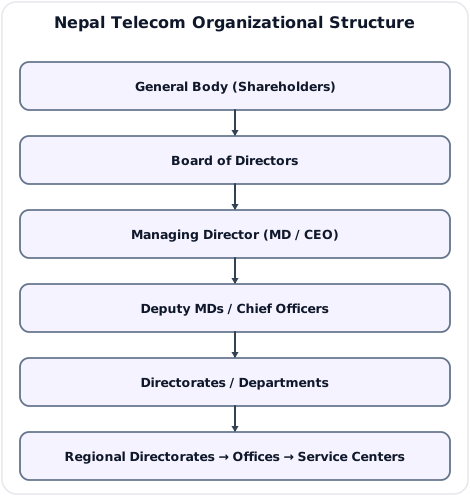
- General Body — Supreme authority; shareholders, chaired by a representative of the Government.
- Board of Directors — Policy-making body; chaired by a Chairperson nominated by GoN.
- Managing Director — Chief Executive responsible for day-to-day operations.
1.5 Scope of Nepal Telecom
| Domain | Services |
|---|---|
| Fixed (Wireline) | PSTN, ISDN, leased lines, FTTH broadband |
| Mobile | GSM (Namaste), CDMA (Sky), 3G, 4G/LTE, VoLTE |
| Internet/Data | ADSL, FTTH, leased internet, IP-VPN, cloud services |
| Wholesale/Transit | International gateway, national backbone, interconnection |
| Value-added | IPTV, SMS, IN services, mobile money |
1.6 Technologies Adopted in Service Delivery
| Technology | Application |
|---|---|
| PSTN / Switching | Fixed-line voice (digital exchanges) |
| GSM (2G/3G/4G) | Namaste mobile service |
| CDMA | Sky/CDMA fixed & mobile wireless |
| Optical Fiber (FTTH/Backbone) | High-speed broadband, national transmission backbone |
| MPLS / IP Core | Data & enterprise networking |
| Satellite | Remote/rural connectivity, international links |
| Microwave Radio | Transmission to remote terrain |
| 4G/LTE → 5G (planned) | Mobile broadband evolution |
1.7 Tariff (Rate) Determination Provisions
- Nepal Telecom, as a licensee, must get its service charges (tariff) approved by the NTA (per Section 42 of the Telecommunications Act 2053).
- The tariff list, with the date of enforcement, must be submitted to NTA at least 3 months in advance.
- Tariff rates must be fair, reasonable, and non-discriminatory.
- NTA issues tariff guidelines; rates are based on cost + reasonable return principles.
1.8 Relationship with Government & Stakeholders
| Stakeholder | Relationship |
|---|---|
| Government of Nepal (GoN) | Majority shareholder (~85%); receives dividends, taxes, royalty |
| NTA (Regulator) | Issues license, approves tariff, sets QoS standards, allocates frequency |
| MoCIT | Parent ministry — policy guidance |
| Customers | Service recipients; protected by NTA consumer provisions |
| Competitors (Ncell, etc.) | Interconnection & healthy competition under NTA |
| Vendors/Contractors | Procurement under Financial Regulations & PPA |
Key Exam Points — Nepal Telecom
- NDCL converted to a public company on Baisakh 1, 2061 BS (2004)
- Predecessor: Nepal Telecommunications Corporation (2032 BS / 1975)
- Government owns ~85%; sole provider of fixed-line/PSTN/ISDN
- Mobile brand = Namaste (GSM), Sky (CDMA)
- Tariff must be approved by NTA, submitted 3 months in advance
2. Nepal Telecommunications Authority (NTA)
Likely Exam Question (10 marks)
"Explain the establishment, objectives, and functions of the Nepal Telecommunications Authority as per the Telecommunications Act, 2053."
2.1 Establishment
- Established under Section 3 of the Telecommunications Act, 2053 (1997) in 2055 BS (1998 AD).
- An autonomous and corporate body with perpetual succession, its own seal, and the power to acquire property, sue, and be sued.
- Central office located in the Kathmandu Valley.
- Functions as the independent regulator of the telecom sector.
2.2 Constitution of the Authority
| Provision | Detail |
|---|---|
| Members | 5 members including the Chairman |
| Qualification | Experts in financial, technical, market management, accounts/audit, or legal fields |
| Appointment | By GoN on recommendation of an expert committee |
| Tenure | 5 years (renewable if performance satisfactory) |
| Chairman | Full-time Chief Executive Officer of the Authority |
| Quorum | More than 50% members present |
| Liaison | With GoN through the Ministry of Communication & Information Technology |
2.3 Goals & Objectives
- Make telecom services reliable and easily available to the public.
- Ensure basic telecom services reach all rural and urban areas.
- Promote healthy competition and private-sector participation.
- Protect consumer rights and interests.
- Develop Nepal as an international transit for telecommunications.
2.4 Functions and Duties (Section 13 of the Act)
The Act lists 15 functions (clauses a–o):
| # | Function |
|---|---|
| (a) | Provide suggestions to GoN on policy, plans & programmes for telecom development |
| (b) | Make telecom service reliable and easily available to the public |
| (c) | Arrange basic telecom service in all rural & urban areas |
| (d) | Involve national & foreign private investors in telecom operation |
| (e) | Ensure coordination and healthy competition among service providers |
| (f) | Prescribe, fix & approve standards and quality of equipment & service |
| (g) | Regularize and systematize telecom service |
| (h) | Grant licenses to operate telecom service in the private sector |
| (i) | Approve & regularize the fees (tariff) collected by licensees |
| (j) | Perform frequency-related functions (per Radio Frequency Policy Committee) |
| (k) | Carry out research on new telecom technology |
| (l) | Develop skilled manpower for the sector |
| (m) | Develop/extend service protecting consumer rights |
| (n) | Develop Nepal as an international transit for telecom |
| (o) | Carry out other functions for telecom development & promotion |
2.5 Other Powers of NTA
- Issue orders/directives to licensees (Sec. 15)
- Settle disputes between licensees, or licensee & customer (Sec. 16)
- Inspect and investigate licensee activities (Sec. 17)
- Cancel licenses for violations (Sec. 28)
- Impose penalties (fine up to Rs. 50,000) (Sec. 47)
- Operate the Rural Telecommunications Development Fund (RTDF)
Key Exam Points — NTA
- Established under Section 3, Telecommunications Act 2053 (1998 AD / 2055 BS)
- 5 members including Chairman; tenure 5 years
- Chairman = full-time CEO
- 15 functions under Section 13
- Liaises with GoN via MoCIT
3. Telecom Services in the Government's Periodic Plan
Likely Exam Question (5 marks)
"Briefly describe the place of telecommunication services in Nepal's current periodic plan."
Key Thrusts (Sixteenth Plan & related targets)
- Broadband for all — expand fiber & broadband to all local levels (Gaupalika/Nagarpalika).
- Digital Nepal — implement the Digital Nepal Framework to digitize governance, agriculture, health, education, etc.
- Rural connectivity — use the RTDF to extend service to remote areas.
- e-Governance — digital public service delivery.
- IT industry promotion — IT parks, startups, IT-BPO export.
- 5G readiness & spectrum management.
- Telecom infrastructure treated as a key enabler of economic growth and the SDGs.
Exam Tip
Quote concrete targets such as "broadband access to all local levels" and "increasing internet penetration" — and link them to the Digital Nepal Framework and SDGs.
4. Telecommunications Act, 2053 & Regulation, 2054
Likely Exam Question (10 marks)
"Discuss the salient features of the Telecommunications Act, 2053, including licensing, royalty, and penalties."
4.1 Overview
| Item | Detail |
|---|---|
| Royal Seal & Publication | 2053-9-17 BS (1 January 1997) |
| Repealed | Telecommunications Act, 2019 (1962) |
| Preamble | Make telecom service reliable & available; involve the private sector; regularize service |
| Chapters | 11 chapters, 63 sections |
| Regulator created | Nepal Telecommunications Authority (NTA) |
4.2 Salient Features
(a) Licensing (Chapter 5)
- No telecom service may be operated without a license (Sec. 21).
- License issued under Section 24, within 90 days of application.
- Maximum license period: 25 years (not more than 10 years at a time).
- Renewal: for a period not exceeding 5 years at a time.
- If multiple applicants qualify → competitive bidding on license fee, renewal fee & royalty.
- Sale/transfer of license needs NTA approval (Sec. 27).
- License may be cancelled for failure to operate or for violations (Sec. 28).
(b) Royalty (Section 32)
- Licensees must pay royalty to the Government as prescribed or as promised (in bidding).
(c) Rural Telecommunications Development Fund — RTDF (Section 30)
- Licensees deposit a percentage of annual income into a fund.
- Used for developing & extending telecom service in rural areas.
(d) Radio Frequency Policy Determination Committee (Section 49)
- Chaired by the Minister/Minister of State for Information & Communications.
- Determines frequency policy, allocation, and pricing.
- Members include Secretaries of Home, Defence, Tourism & Civil Aviation, Information & Communications, and the Chairman of NTA.
(e) Special Powers of Government (Chapter 4)
- During emergency/national security, the Government may take over telecom lines, tap, trace, or stop transmission.
(f) Punishment & Appeal (Chapter 10)
| Offence | Penalty |
|---|---|
| Contravening Act/orders | Fine up to Rs. 50,000 |
| Operating without license | Fine up to Rs. 50,000 + stoppage |
| Harassment via telecom | Fine up to Rs. 25,000 + stoppage |
| Damaging telecom lines/systems | Fine = loss/damage or imprisonment up to 5 years, or both |
| Appeal | Within 35 days to the prescribed committee |
4.3 Telecommunications Regulation, 2054 (1997)
- The subordinate legislation (rules) framed under the Act.
- Details the procedures for: license application format, fees, renewal, royalty, frequency distribution, QoS standards, and consumer service terms.
Key Exam Points — Telecom Act 2053
- Came into force 1 Jan 1997; repealed Act 2019
- License max 25 years (≤ 10 yrs at a time); renewal ≤ 5 yrs
- Created NTA, RTDF, and Radio Frequency Policy Committee
- Damaging telecom lines → up to 5 years imprisonment
- Appeal window: 35 days
5. Memorandum & Articles of Association of Nepal Telecom
Likely Exam Question (5 marks)
"Differentiate between the Memorandum of Association and Articles of Association."
| Aspect | Memorandum of Association (MoA) | Articles of Association (AoA) |
|---|---|---|
| Definition | Charter document defining the company's constitution & scope | Document defining internal rules & management |
| Contains | Name, registered office, objectives, capital, liability | Rules for meetings, directors, shares, voting, dividends |
| Relationship | Defines relationship with outside world | Defines relationship within the company |
| Supremacy | Supreme document | Subordinate to MoA |
| Alteration | Difficult (special resolution + conditions) | Easier (special resolution) |
Key Contents of NT's MoA
- Name: Nepal Doorsanchar Company Limited
- Objective: Provide telecommunications services across Nepal
- Authorized & paid-up capital
- Liability: Limited by shares
- Government shareholding (~85%)
Mnemonic
MoA = what the company can do (scope) · AoA = how the company does it (rules)
6. Nepal Telecom Employee Regulations, 2078
Likely Exam Question (5 or 10 marks)
"Explain the provisions of leave, conduct & discipline, and retirement benefits under the Nepal Telecom Employee Regulations, 2078."
The syllabus specifies Chapters 7, 9, 10, and 11.
6.1 Chapter 7 — Leave (बिदा)
Common categories of leave for employees:
| Leave Type | Purpose / Typical Provision |
|---|---|
| Home/Annual Leave | Earned leave, accumulable, encashable on retirement |
| Sick Leave | For illness (with medical certificate for long leave) |
| Casual/Festival Leave | Short personal/festival needs |
| Maternity Leave | For female employees (childbirth) |
| Paternity Leave | For male employees (spouse's childbirth) |
| Mourning (Kriya) Leave | Death rites of close family |
| Study Leave | Higher study / capacity development |
| Extraordinary Leave | Special circumstances (often unpaid) |
- Leave is a facility, not a right — it may be refused/cancelled if work demands.
- Unused accumulated leave is generally encashed at retirement (subject to ceiling).
6.2 Chapter 9 — Conduct & Discipline (आचरण)
Employees must:
- Maintain discipline, honesty, and integrity.
- Not engage in political activities, strikes, or unauthorized organizations.
- Not disclose confidential official information.
- Not accept gifts/bribes or have a conflict of interest.
- Not engage in other business/employment without approval.
- Devote full attention to official duties and follow the chain of command.
6.3 Chapter 10 — Punishment & Appeal (सजाय र पुनरावेदन)
Punishments are typically classified as:
| Category | Examples |
|---|---|
| Ordinary (Light) Punishment | Warning/censure, withholding of grade/promotion, stopping salary increment |
| Severe (Heavy) Punishment | Demotion, removal from service (eligible for some benefits), dismissal (without benefits) |
- Employee must be given a reasonable opportunity to defend (natural justice).
- Appeal can be filed to the prescribed authority within the stipulated time.
6.4 Chapter 11 — Retirement, Gratuity, Pension & Other Benefits
| Benefit | Description |
|---|---|
| Retirement | On reaching age limit or completing service tenure; voluntary retirement after qualifying years |
| Pension | Periodic payment after qualifying service (e.g., based on years × last salary formula) |
| Gratuity | Lump-sum for those not eligible for pension |
| Provident Fund (PF) | Employee + employer contribution |
| Leave Encashment | Payment for unused accumulated leave |
| Medical & Insurance | Health coverage / treatment expenses |
Key Exam Points — Employee Regulations 2078
- Syllabus chapters: 7 (Leave), 9 (Conduct), 10 (Punishment & Appeal), 11 (Retirement/Benefits)
- Punishment = Ordinary vs Severe; dismissal = no service benefits
- Always provide opportunity to defend before punishment
- Retirement benefits: Pension, Gratuity, PF, Leave Encashment
7. Nepal Telecom Financial Regulations, 2071
Likely Exam Question (5 marks)
"Describe the procurement and budgeting provisions under the Nepal Telecom Financial Regulations, 2071."
The syllabus specifies Part 2 (Procurement) and Part 3 (Ch 1: Plan & Budget; Ch 3: Custody & Property).
7.1 Part 2 — Procurement (खरिद)
- Procurement of goods, works & services must be transparent, competitive, and economical.
- Methods: open/sealed bidding, sealed quotations, direct purchase (within thresholds).
- Aligned with principles of the Public Procurement Act/Rules.
- Requires technical specification, cost estimate, bid evaluation, and approval by the competent authority.
- Provisions for bid security, performance bond, and liquidated damages.
7.2 Part 3, Chapter 1 — Plan & Budget (योजना र बजेट)
- Annual budget prepared in line with the company's business plan & strategy.
- Classified into operating (revenue) and capital expenditure.
- Budget must be approved by the Board and monitored via variance analysis.
7.3 Part 3, Chapter 3 — Custody & Property (जिन्सी र सम्पत्ति)
- Proper recording, custody, and protection of company assets (inventory/jinsi).
- Periodic physical verification of property and stores.
- Rules for handover, write-off, auction/disposal of obsolete/unusable assets.
- Fixing accountability for loss, damage, or misuse of company property.
Key Exam Points — Financial Regulations 2071
- Part 2 = Procurement (competitive, transparent)
- Part 3 Ch 1 = Plan & Budget (operating vs capital)
- Part 3 Ch 3 = Custody & Property (jinsi management, verification, disposal)
8. Company Act, 2063 (2006)
Likely Exam Question (10 marks)
"Explain the provisions relating to incorporation of a company, memorandum & articles, and general meetings under the Company Act, 2063."
The syllabus specifies Chapters 2, 3, and 5.
8.1 Chapter 2 — Incorporation of a Company
- A company is incorporated by registering with the Office of the Company Registrar (OCR).
- Required documents: MoA, AoA, application, and prescribed fee.
- On registration, a certificate of incorporation is issued.
- The company becomes a separate legal entity (perpetual succession, common seal, limited liability).
| Type of Company | Key Feature |
|---|---|
| Private Company | 1–101 shareholders; cannot offer shares to public |
| Public Company | Minimum 7 shareholders; can issue shares publicly |
| Single Shareholder Co. | One person company |
| Not-for-profit Co. | Profit not distributed to members |
8.2 Chapter 3 — Memorandum, Articles & Prospectus
- MoA — name, objectives, registered office, capital, liability.
- AoA — internal rules for governance, meetings, shares, directors.
- Prospectus — public document inviting the public to buy shares (public companies); must be approved by OCR and not misleading.
- MoA/AoA may be amended by special resolution in the general meeting.
8.3 Chapter 5 — Meetings of the Company
| Meeting | Provision |
|---|---|
| Annual General Meeting (AGM) | First AGM within 1 year of commencement; thereafter every year (within 6 months of fiscal year-end) |
| Extra-Ordinary General Meeting (EGM) | Held as needed for urgent matters |
| Notice | AGM: 21 days, EGM: 15 days prior notice (public company) |
| Quorum | Generally 3 shareholders representing required shares (public co.) |
| Resolutions | Ordinary (simple majority) & Special (75% majority) |
Key Exam Points — Company Act 2063
- Incorporation via OCR → certificate of incorporation
- Public company: min 7 shareholders; Private: max 101
- AGM within 1 year of commencement, then annually
- Special resolution = 75% majority; needed for MoA/AoA amendment
9. Telecommunications Policy, 2060 (2004)
Likely Exam Question (5 marks)
"State the main objectives of the Telecommunications Policy, 2060."
Main Objective
To create a favourable environment to make telecom service reliable, affordable, and universally accessible to all inhabitants of Nepal, supporting overall social and economic development.
Key Objectives & Features
- Universal access to telecom services across the country.
- Encourage private-sector participation and investment.
- Promote fair competition in a liberalized market.
- Establish a Rural Telecommunications Development Fund (RTDF) for rural expansion.
- Strengthen the regulator (NTA) for effective regulation.
- Improve quality of service and adopt modern technology.
- Make telecom a tool for socio-economic upliftment and bridging the digital divide.
Connection
Policy 2060 operationalizes the goals of the Telecommunications Act 2053 — especially universal service and the RTDF.
10. Digital Nepal Framework, 2076 (2019)
Likely Exam Question (10 marks)
"What is the Digital Nepal Framework? Describe its sectors and significance."
Concept
A national digital roadmap by the Ministry of Communication & Information Technology (MoCIT) to unlock economic growth and solve societal problems through digital technology.
"One Nation, 8 Sectors, 80 Digital Initiatives."
The 8 Sectors
| # | Sector | Example Initiatives |
|---|---|---|
| 1 | Digital Foundation (Connectivity) | Broadband, data centers, digital ID, payments |
| 2 | Agriculture | e-market, smart farming, crop data |
| 3 | Health | Telemedicine, e-health records |
| 4 | Education | e-learning, digital classrooms |
| 5 | Energy | Smart grid, smart metering |
| 6 | Tourism | Digital tourism, e-visa, smart destinations |
| 7 | Finance | Digital payments, fintech, financial inclusion |
| 8 | Urban Infrastructure | Smart cities, e-governance, smart transport |
Significance
- Drives socio-economic transformation & job creation.
- Improves governance efficiency and public service delivery.
- Supports e-commerce, IT-BPO, and fintech growth.
- Aligns with SDGs and the vision of a "Digital Nepal."
Key Exam Points — Digital Nepal Framework 2076
- 1 Nation, 8 Sectors, 80 Initiatives
- 8 sectors: Digital Foundation, Agriculture, Health, Education, Energy, Tourism, Finance, Urban Infrastructure
- Prepared by MoCIT (2019)
11. Information & Communication Technology (ICT) Policy, 2072 (2015)
Likely Exam Question (5 marks)
"State the vision and major targets of the ICT Policy, 2072."
Vision
To transform Nepal into an information- and knowledge-based society and economy.
Mission
To create conditions for the intensified development and growth of the ICT sector as a key driver of socio-economic development.
Major Targets
| Target | Goal |
|---|---|
| Digital literacy | At least 75% of the population |
| Broadband access | Reach 90% of the population |
| ICT contribution to GDP | At least 7.5% |
| e-Governance | Digital public service delivery |
| Employment | Generate ICT-sector jobs |
Significance
- Led to the renaming of the ministry to MoCIT (2017).
- Provided the policy basis for e-governance, broadband expansion, and IT industry development.
Key Exam Points — ICT Policy 2072
- Vision: information- & knowledge-based society
- Targets: 75% digital literacy, 90% broadband, 7.5% GDP contribution
12. National Cyber Security Policy, 2080 (2023)
Likely Exam Question (5 marks)
"What are the main objectives of the National Cyber Security Policy, 2080?"
Purpose
To establish legal and institutional arrangements for a safe, secure, and resilient cyberspace in Nepal, protecting critical national infrastructure from cyber threats.
Key Objectives
- Maintain secure cyberspace through legal & institutional frameworks.
- Protect National Critical Information Infrastructure (CII).
- Establish the National Cyber Security Centre (NCSC).
- Build human resources & capacity in cyber security.
- Make digital service delivery reliable and secure.
- Coordinate at bilateral, regional & international levels to reduce cyber risks.
Institutional Mechanism
- National Cyber Security Centre (NCSC) — operational lead.
- National Cyber Security Implementation Committee — coordinated by the Joint Secretary (IT Division, MoCIT); includes representatives from NTA, Nepal Rastra Bank, Nepal Army, Nepal Police, and IT experts.
Key Exam Points — Cyber Security Policy 2080
- Aims for secure & resilient cyberspace
- Protects Critical Information Infrastructure (CII)
- Establishes the National Cyber Security Centre (NCSC)
13. Quick Revision Summary
| Law / Body | Year (BS / AD) | Key Point |
|---|---|---|
| Nepal Telecom (NDCL) | 2061 / 2004 | State-owned; sole fixed-line provider |
| NTA | 2055 / 1998 | Regulator; 5 members; Sec. 13 = 15 functions |
| Telecommunications Act | 2053 / 1997 | Created NTA; license ≤ 25 yrs; RTDF |
| Telecom Regulation | 2054 / 1997 | Rules under the Act |
| Company Act | 2063 / 2006 | Incorporation, MoA/AoA, AGM |
| Telecom Policy | 2060 / 2004 | Universal access; RTDF; competition |
| ICT Policy | 2072 / 2015 | 75% literacy, 90% broadband, 7.5% GDP |
| Digital Nepal Framework | 2076 / 2019 | 8 sectors, 80 initiatives |
| Employee Regulations | 2078 / 2021 | Leave, conduct, punishment, retirement |
| Financial Regulations | 2071 / 2014 | Procurement, budget, property |
| Cyber Security Policy | 2080 / 2023 | Secure cyberspace; NCSC; CII |
Final Exam Strategy
- Memorize years (BS & AD) of each act/policy — frequently asked in MCQs.
- For 10-mark questions, structure as: Introduction → Objectives → Provisions/Functions → Significance.
- Always connect Act 2053 → Policy 2060 → Digital Nepal 2076 as a chain of telecom development.