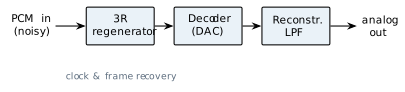
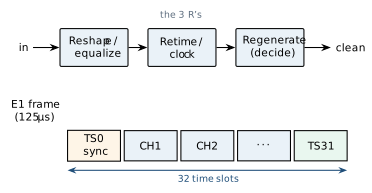
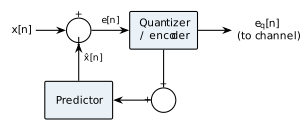
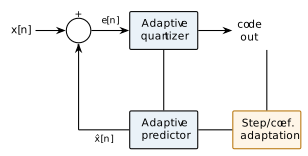
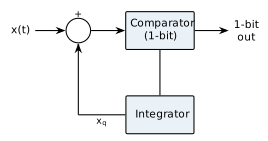
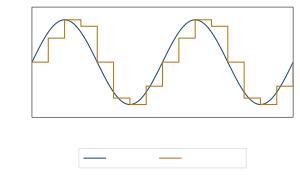
Fig: PCM transmitter: the message is band-limited, sampled and held, quantized to 2^n levels, then encoded into an n-bit serial line signalFig: PCM receiver: line symbols are reshaped, retimed and re-amplified, each codeword is decoded to a level (DAC), and a reconstruction LPF smooths the staircase back to analogFig: Regenerative repeater performs the three R's (reshape/equalize, retime/clock, regenerate); framing (E1: TS0 sync word + 31 channel slots) identifies the logical TDM positionsFig: DPCM transmitter: the predicted value x(n) is subtracted from the input, the error e(n) is quantized/encoded, and the local reconstruction feeds a predictor identical to the decoder'sFig: ADPCM codec: a DPCM loop in which both the quantizer step and the predictor coefficients are adapted from reconstructed history (ITU-T G.726)Fig: Delta-modulation encoder: a comparator emits one bit per sample and a feedback integrator builds the staircase estimate used for the next comparisonFig: DM staircase versus input: too small lags a steep input (slope overload); too large hunts about a flat input (granular noise). ADM adapts (increase on runs of equal bits, decrease on alternating bits) to reduce both