Skip to content

Communication Fundamentals - TikZ Figures

Communication classification by signal type, direction, channel and frequency placement
Fig: Communication classification by signal type, direction, channel and frequency placement
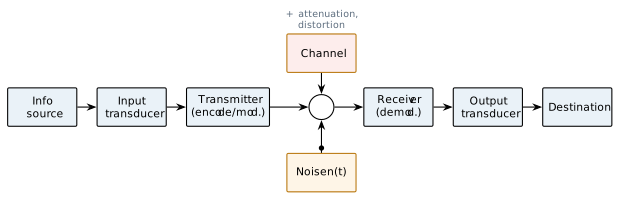
General communication system: the transmitter conditions the message for the channel, an additive-noise node injects n(t), and the receiver recovers the message for the destination
Fig: General communication system: the transmitter conditions the message for the channel, an additive-noise node injects n(t), and the receiver recovers the message for the destination
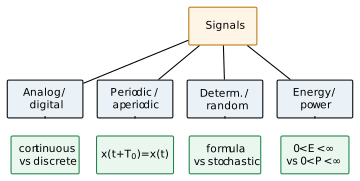
Signal classification by amplitude/time, repetition, predictability and energy measure
Fig: Signal classification by amplitude/time, repetition, predictability and energy measure
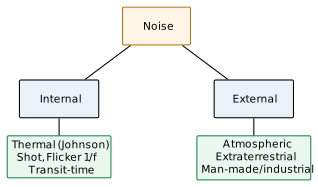
Noise classification into internal (device) and external (environmental) sources
Fig: Noise classification into internal (device) and external (environmental) sources
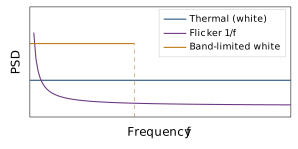
One-sided noise PSD: flat thermal (white) noise, low-frequency 1/f flicker noise, and a band-limited white spectrum of bandwidth B
Fig: One-sided noise PSD: flat thermal (white) noise, low-frequency 1/f flicker noise, and a band-limited white spectrum of bandwidth B
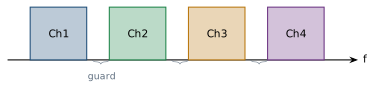
FDM spectrum: baseband channels placed in adjacent frequency bands separated by guard bands
Fig: FDM spectrum: baseband channels placed in adjacent frequency bands separated by guard bands
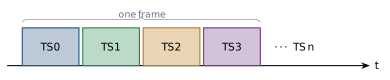
TDM frame: user time slots TS0\,-\,TSn repeating within each frame
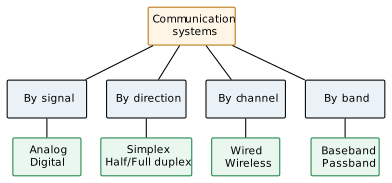
Fig: TDM frame: user time slots TS0\,-\,TSn repeating within each frame