Analog Modulation
Possible Exam Questions
Exam Questions and Answer Map
Evidence note: [PYQ paper/year] = exact question observed in that past paper; [likely] = pattern-predicted variant not confirmed as an exact PYQ.
- Why is modulation necessary in communication systems? [5] — [likely]
- Answer plan: Define modulation -> practical antenna length using \(\lambda=c/f\) -> frequency allocation and multiplexing -> channel matching/efficient radiation -> selective tuning and interference management -> qualify propagation dependence.
-
Model answer: Need for Modulation
-
Explain amplitude modulation. Derive the AM equation, frequency spectrum, bandwidth and power relations. [10] — [likely]
- Answer plan: Define AM -> write single-tone message and carrier -> expand \(A_c(1+\mu\cos\omega_mt)\cos\omega_ct\) -> identify carrier/USB/LSB -> state \(B=2f_m\) -> derive sideband/total power and maximum efficiency.
-
Model answer: Standard AM Derivation, Spectrum and Power
-
An AM transmitter has carrier power \(500\,\text{W}\) and modulation index \(0.8\). Find sideband powers, total power and efficiency. [5] — [likely]
- Answer plan: Use \(P_{each}=\mu^2P_c/4\), \(P_T=P_c(1+\mu^2/2)\) and \(\eta=\mu^2/(2+\mu^2)\) -> obtain \(80\,\text{W}\) each, \(660\,\text{W}\) total and \(24.24\%\).
-
Model answer: AM Sideband Power and Efficiency Numerical
-
Compare standard AM, DSB-SC, SSB-SC and VSB in bandwidth, transmitted components, power, detection and applications. [10] — [likely]
- Answer plan: Draw spectra -> tabulate carrier/sideband occupancy -> compare \(2f_m\), \(f_m\), and slightly above \(f_m\) -> explain envelope versus coherent detection -> give broadcast, HF voice and television uses.
-
Model answer: Standard AM, DSB-SC, SSB-SC and VSB
-
Explain DSB-SC generation and coherent detection. Why does an envelope detector fail? [5] — [likely]
- Answer plan: Define product modulation -> expand sidebands -> show carrier absent -> balanced/ring generation -> multiply by synchronized carrier and LPF -> explain envelope \(|m(t)|\) loses sign/phase reversals.
-
Model answer: DSB-SC Generation and Coherent Detection
-
Explain SSB-SC, its generation methods, advantages, limitations and detection. [10] — [likely]
- Answer plan: Define one-sideband transmission -> derive bandwidth/power saving -> explain filter and phase-shift generation -> product detector/BFO -> discuss frequency-error effect, HF voice and complexity.
-
Model answer: SSB-SC Generation, Detection and Performance
-
Explain frequency modulation and phase modulation. Derive their mathematical expressions and compare FM with PM. [10] — [likely]
- Answer plan: Start from instantaneous phase/frequency -> derive general FM integral and PM direct-phase forms -> specialize to a sinusoid -> define \(\beta=\Delta f/f_m\) and \(\beta_p=k_pA_m\) -> explain FM/PM integration-differentiation relationship.
-
Model answer: Frequency and Phase Modulation
-
Explain narrowband and wideband FM, the FM spectrum and Carson's rule. [10] — [likely]
- Answer plan: Define \(\beta\) -> use Bessel expansion with lines at \(f_c\pm nf_m\) -> explain infinitely many theoretical sidebands and constant total power -> distinguish NBFM/WBFM -> state \(B\approx2(\Delta f+f_m)\).
-
Model answer: Narrowband/Wideband FM, Spectrum and Carson's Rule
-
Explain direct and Armstrong FM generation and compare slope, Foster-Seeley, ratio and PLL detection. [10] — [likely]
- Answer plan: Draw direct VCO and indirect crystal/phase-modulator paths -> explain discriminator S-curve -> compare amplitude sensitivity, limiter requirement and linearity -> identify PLL control voltage as output.
-
Model answer: FM Generation and Detector Comparison
-
Compare AM and FM. [5] — [likely]
-
Answer plan: Compare varied parameter, bandwidth, noise immunity, transmitted power, PA linearity, receiver complexity, threshold/capture effects and applications.
- Model answer: AM and FM Comparison
1. Need for Modulation
Modulation is the controlled variation of a high-frequency carrier parameter by a lower-frequency message signal.
Carrier:
| Carrier parameter varied | Modulation |
|---|---|
| Amplitude | AM |
| Frequency | FM |
| Phase | PM |
Reasons
- Practical antenna dimensions
For free-space wavelength:
A resonant antenna dimension is often a fraction such as \(\lambda/4\). At \(3\,\text{kHz}\):
A quarter-wave antenna would be about \(25\,\text{km}\), so the message is translated to radio frequency.
- Match the signal to a bandpass channel
Antennas, microwave links, satellite transponders and AC-coupled circuits operate over allocated nonzero frequency bands.
- Frequency allocation and station separation
Different stations use different carriers, allowing a tuned receiver to select one.
- Multiplexing
Frequency-division multiplexing places several messages on separate carriers in one medium.
- Radiation and propagation choice
Frequency translation permits a band with suitable antenna gain, available spectrum and propagation for the intended link. Higher frequency does not universally mean greater range.
- Noise/interference strategy
The designer can choose a modulation and band with suitable immunity and filtering. Modulation does not by itself remove noise.
2. Standard Amplitude Modulation (AM)
In standard full-carrier AM, the carrier amplitude varies linearly with the message while carrier frequency and phase remain constant.
Single-Tone Derivation
Let:
The AM signal is:
where \(\mu\) is the modulation index.
For a normalized modulator sensitivity, \(\mu=A_m/A_c\); more generally \(\mu=k_aA_m\).
Expanding:
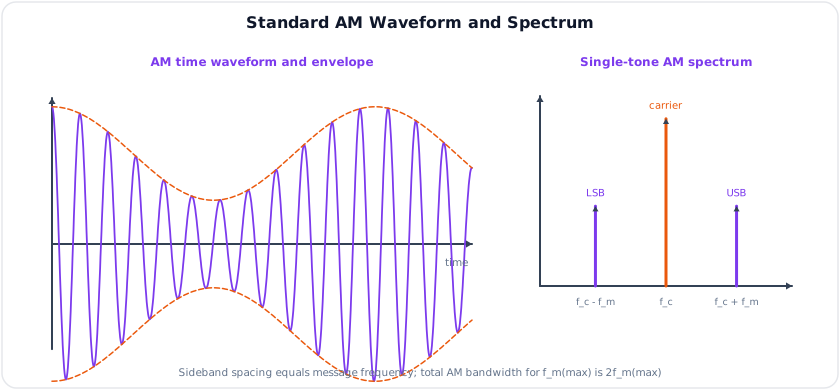
Thus standard AM contains:
- Carrier at \(f_c\), amplitude \(A_c\).
- Upper sideband at \(f_c+f_m\), amplitude \(\mu A_c/2\).
- Lower sideband at \(f_c-f_m\), amplitude \(\mu A_c/2\).
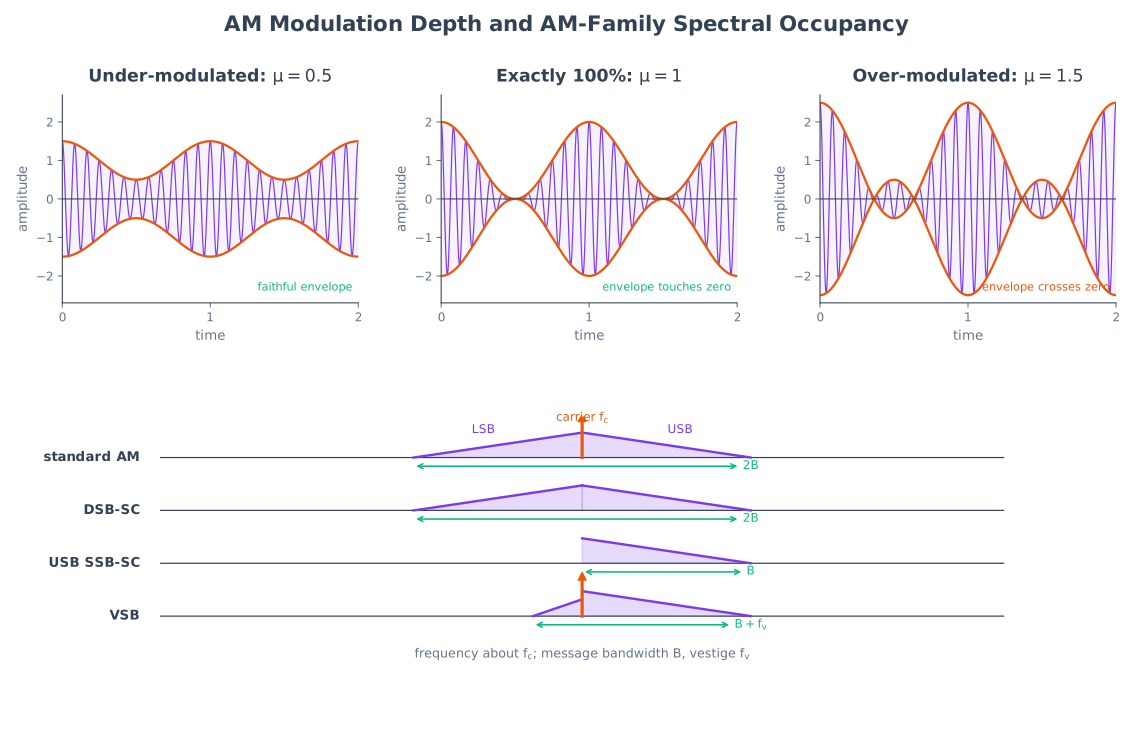
Modulation Index from Envelope
Percentage modulation is \(100\mu\%\).
| Condition | Index | Envelope behavior |
|---|---|---|
| Under-modulation | \(0<\mu<1\) | Faithful nonzero envelope |
| Critical/100% | \(\mu=1\) | Envelope just reaches zero |
| Overmodulation | \(\mu>1\) | Envelope crosses zero; diode detection distorts |
For a general message, the no-overmodulation requirement is \(|k_am(t)|\leq1\).
Bandwidth
If the message occupies \(0\leq f\leq f_{m(max)}\), the translated sidebands extend from \(f_c-f_{m(max)}\) to \(f_c+f_{m(max)}\):
Power Relations
Across load \(R\):
For single-tone modulation:
Transmission efficiency is useful sideband power divided by total power:
At \(\mu=1\):
The carrier consumes most power but carries no unique message information; both sidebands contain duplicate information for a real message.
Worked AM Power Example
Given \(P_c=500\,\text{W}\) and \(\mu=0.8\):
AM Generation and Detection Overview
- Low-level AM: modulate at small power, then use linear RF amplification.
- High-level AM: modulate the final efficient RF power stage.
- Envelope detector: diode-\(RC\) detector for \(\mu\leq1\).
- Synchronous detector: product detector for improved linearity/noise performance.
Circuit implementation is developed in 5.9 Communication Circuits.
3. Double Sideband Suppressed Carrier (DSB-SC)
DSB-SC transmits both sidebands while suppressing the carrier.
For \(m(t)=A_m\cos\omega_mt\):
Properties
- USB and LSB are present.
- Carrier is absent ideally.
- Bandwidth remains \(2f_{m(max)}\).
- All transmitted power is in information-bearing sidebands.
- Requires coherent detection.
Generation
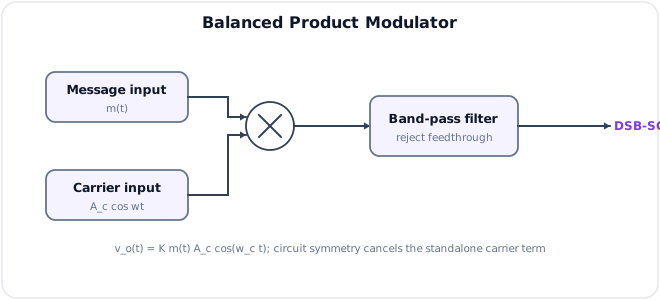
A balanced transistor/diode multiplier or double-balanced ring modulator cancels carrier feedthrough by symmetry.
Coherent Detection
Multiply by a synchronized local carrier and low-pass filter:
An envelope detector fails because the DSB-SC envelope is proportional to \(|m(t)|\) and phase reversals contain the sign of \(m(t)\). Carrier phase error causes a \(\cos\phi\) loss; frequency error causes beating.
4. Single Sideband Suppressed Carrier (SSB-SC)
SSB transmits only one of the two DSB-SC sidebands, usually with the carrier suppressed.
For a real message \(m(t)\) and Hilbert transform \(\hat m(t)\):
Bandwidth and Power Saving
SSB uses half the bandwidth of AM/DSB-SC and removes both the carrier and one redundant sideband. Relative power saving depends on the same message normalization and transmitter comparison; for single-tone 100% AM, standard AM sends \(P_c+2(P_c/4)=1.5P_c\), while one SSB component carries only \(P_c/4\) under the corresponding amplitude convention.
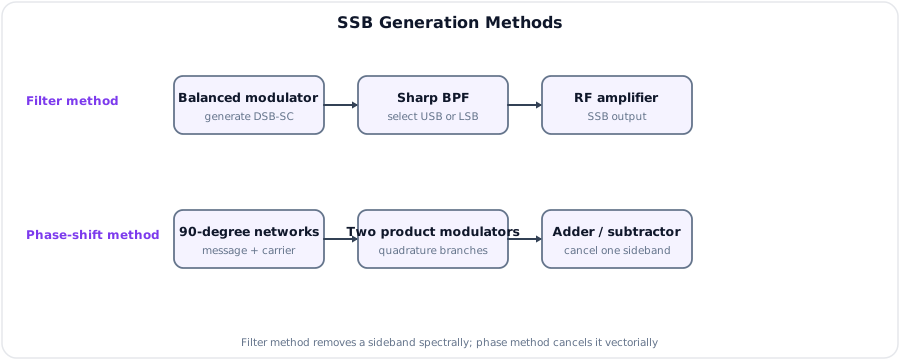
Generation Methods
Filter Method
Generate DSB-SC, then use a sharp bandpass filter to select USB or LSB. Generation at a convenient IF permits crystal/mechanical filtering before final frequency conversion.
Phase-Shift Method
Use \(90^\circ\) phase shifts of message and carrier in two balanced modulators; add/subtract outputs so one sideband cancels.
Weaver Method
Use two quadrature mixing stages and low-pass filters, convenient for DSP/IC implementation.
Detection
Reinsert a carrier using a BFO/PLL and apply a product detector. Carrier-frequency error translates all recovered audio components, causing unnatural speech pitch. A pilot carrier may aid synchronization.
Advantages
- Highest bandwidth and power efficiency in the AM family.
- Narrower receiver bandwidth admits less noise power.
- Effective for long-distance HF voice and aeronautical/marine links.
Limitations
- More complex generation and filtering.
- Accurate frequency reference is required.
- Simple envelope detection is unavailable for suppressed-carrier SSB.
5. Vestigial Sideband (VSB)
VSB transmits one complete sideband and a small vestige of the other, often with a residual/full carrier depending on system design.
It is useful when the message extends near DC and an ideal abrupt SSB filter would be difficult. The vestige permits a practical transition region around the carrier.
Approximate bandwidth:
where \(f_v\) is vestigial width.
Classical application: analog television video, where VSB saves bandwidth compared with DSB while preserving low video frequencies.
6. AM-Family Comparison
| Feature | Standard AM | DSB-SC | SSB-SC | VSB |
|---|---|---|---|---|
| Carrier | Full | Suppressed | Suppressed or pilot | Often residual/full |
| Sidebands | Both | Both | One | One + vestige |
| Bandwidth | \(2f_m\) | \(2f_m\) | \(f_m\) | \(f_m+f_v\) |
| Power efficiency | Low; carrier dominates | Better | Best AM family | Intermediate |
| Detector | Envelope or coherent | Coherent | Coherent/BFO | Envelope/coherent by design |
| Complexity | Lowest | Medium | Highest | Medium/high |
| Application | AM broadcast | Stereo subcarrier, building block | HF voice | Analog TV video |
7. Angle Modulation
In angle modulation, carrier amplitude is constant and information changes instantaneous phase:
Instantaneous angular frequency and frequency are:
Angle modulation includes FM and PM.
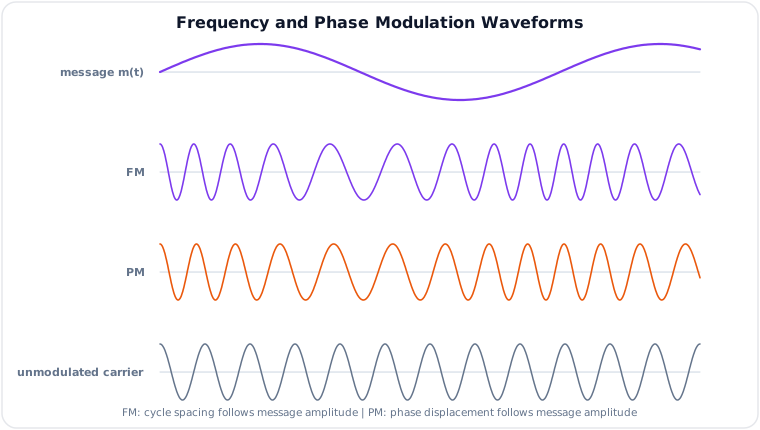
Consequences of Constant Envelope
- Transmitted average power is ideally constant:
- Efficient nonlinear/saturated RF power amplifiers can be used.
- Amplitude limiting can remove much amplitude noise before detection.
- Bandwidth is generally wider than standard AM, especially for large modulation index.
Constant total power does not mean “all FM power is in sidebands.” Single-tone FM power is distributed among a carrier component and multiple sideband pairs according to Bessel functions; the carrier component may even vanish at particular modulation indices.
8. Frequency Modulation (FM)
In FM, instantaneous frequency deviation is proportional to message amplitude:
Instantaneous phase is the integral of frequency:
Therefore:
Single-Tone FM
For \(m(t)=A_m\cos2\pi f_mt\):
Peak frequency deviation:
FM modulation index:
For fixed \(A_m\) and \(k_f\), \(\Delta f\) is independent of \(f_m\), while \(\beta\) decreases as message frequency increases.
Narrowband and Wideband FM
| Type | Index | Spectrum/usage |
|---|---|---|
| NBFM | \(\beta\ll1\) | Carrier plus dominant first sideband pair; bandwidth near \(2f_m\) |
| WBFM | \(\beta>1\) | Many significant sideband pairs; broadcast/high-fidelity use |
The boundary is descriptive, not a sharp physical transition.
FM Spectrum
Using the Bessel expansion:
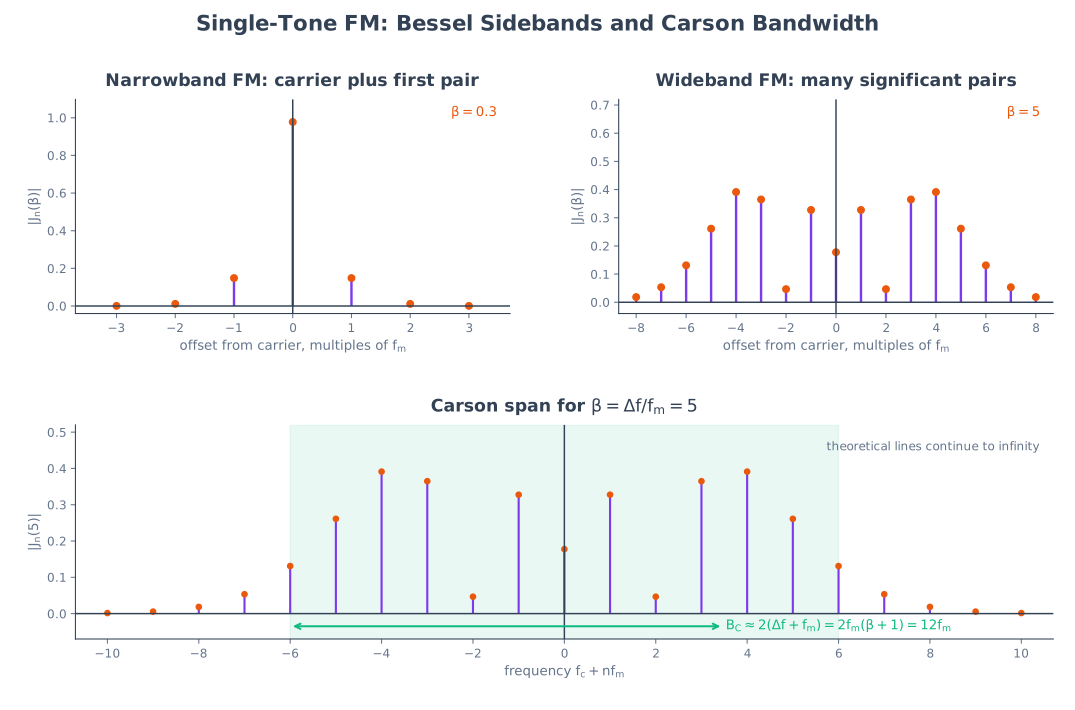
- Lines occur at \(f_c\pm nf_m\), \(n=0,1,2,\ldots\).
- Carrier amplitude is \(A_cJ_0(\beta)\).
- The \(n\)th sideband amplitudes are related to \(A_cJ_n(\beta)\).
- There are infinitely many theoretical sidebands, but high-order terms become negligible.
- Bessel identity \(\sum_{n=-\infty}^{\infty}J_n^2(\beta)=1\) confirms constant total power.
FM Bandwidth and Carson's Rule
An engineering bandwidth containing roughly 98% of single-tone FM power is:
For a single tone:
Carson's rule is an approximation; exact occupied bandwidth depends on the message spectrum, deviation and specified power criterion.
Worked FM Example
For \(\Delta f=75\,\text{kHz}\) and \(f_{m(max)}=15\,\text{kHz}\):
FM Generation
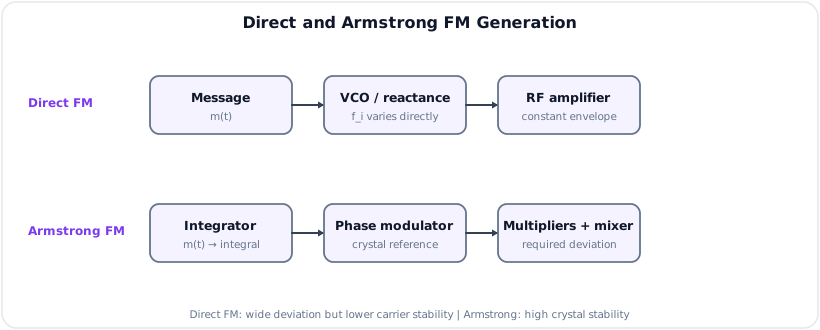
- Direct FM: message controls a VCO, varactor or reactance modulator; simple and supports large deviation.
- Armstrong indirect FM: integrate message -> phase modulate a crystal-controlled carrier -> frequency multiply/mix; excellent center-frequency stability.
FM Detection
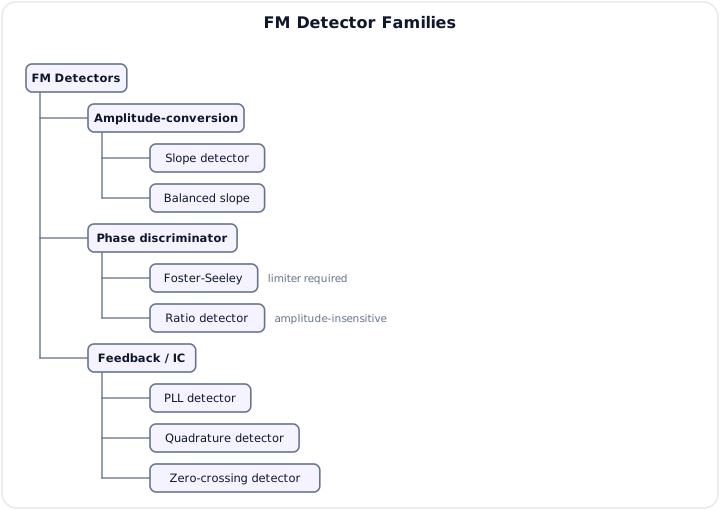
All detectors convert frequency deviation to voltage:
- Slope detector: tuned slope converts FM to AM; simplest, poor linearity, limiter required.
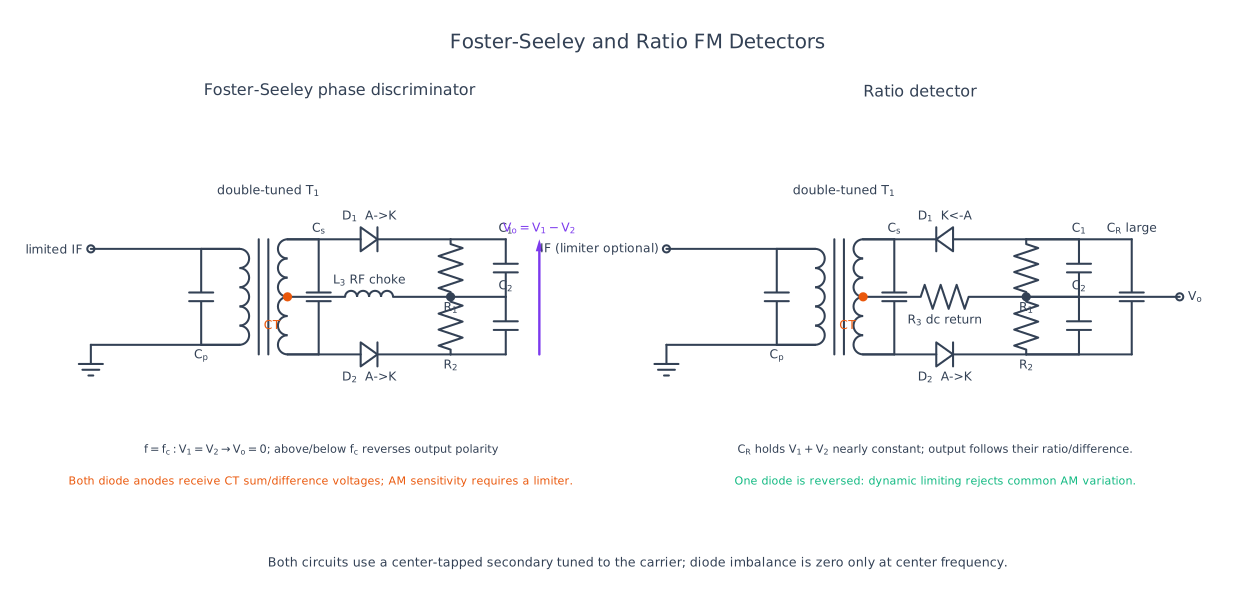
- Foster-Seeley: transformer phase discriminator; very good linearity, limiter required.
- Ratio detector: diode-voltage ratio gives inherent AM rejection; generally no separate limiter.
- PLL detector: VCO control voltage tracks instantaneous frequency; excellent IC method.
- Quadrature detector: frequency-dependent phase shift followed by phase detection.
Detailed circuits are in 5.9 Communication Circuits.
FM Noise Improvement
FM permits amplitude limiting and can provide improved output SNR above threshold. High-frequency demodulated noise rises strongly, so broadcast FM uses:
- Pre-emphasis: boost high message frequencies before transmission.
- De-emphasis: complementary receiver attenuation to restore response and reduce high-frequency noise.
FM also exhibits:
- Capture effect: stronger co-channel signal suppresses a weaker one.
- Threshold effect: below a critical input carrier-to-noise ratio, output SNR deteriorates abruptly.
9. Phase Modulation (PM)
In PM, instantaneous phase deviation is proportional directly to message amplitude:
For \(m(t)=A_m\cos2\pi f_mt\):
where:
Instantaneous frequency is:
For a single-tone message:
Thus PM frequency deviation increases with message frequency for fixed message amplitude.
PM Bandwidth
Applying Carson's approximation to a single tone:
For a general message, \(\Delta f\) depends on the maximum derivative, not merely maximum amplitude.
FM-PM Relationship
- FM using a PM modulator: integrate \(m(t)\) before phase modulation.
- PM using an FM modulator: differentiate \(m(t)\) before frequency modulation.
PM Detection
Use a coherent phase detector, PLL or Costas loop. Alternatively, an FM discriminator produces a signal proportional to \(d\phi/dt\); integrating that output recovers the PM message.
10. Comparisons
FM vs PM
| Feature | FM | PM |
|---|---|---|
| Controlled quantity | Instantaneous frequency | Instantaneous phase |
| Phase term | Proportional to \(\int m(t)dt\) | Proportional to \(m(t)\) |
| Single-tone index | \(\beta=\Delta f/f_m\) | \(\beta_p=k_pA_m\) |
| For fixed message amplitude | \(\Delta f\) independent of \(f_m\) | \(\Delta f=\beta_pf_m\) |
| Generation relation | Integrator + PM | Differentiator + FM |
| Detector | Discriminator or PLL | Phase detector/PLL, or discriminator + integrator |
AM vs FM
| Feature | AM | FM |
|---|---|---|
| Varied parameter | Amplitude | Frequency |
| Envelope | Carries information; varies | Ideally constant |
| Bandwidth | \(2f_{m(max)}\) | Carson: \(2(\Delta f+f_{m(max)})\) |
| Noise immunity | Lower; amplitude noise is detected | Better above threshold with limiting |
| Transmitted power | Changes with \(\mu\); carrier wastes power | Constant total power, Bessel-distributed components |
| RF power amplifier | Must preserve envelope for standard AM | Efficient nonlinear PA possible |
| Receiver | Envelope detector can be simple | Limiter + discriminator/PLL is more complex |
| Special effects | Overmodulation | Capture and threshold effects |
| Typical use | MF broadcast, aviation AM voice | VHF high-fidelity broadcast, telemetry |
11. Analog Receiver Link
AM/FM receiver architecture, TRF, superheterodyne conversion, IF/image frequency, AGC, AFC, sensitivity, selectivity and fidelity are covered in 5.3 Analog Receivers.
12. Key Exam Points
Key Exam Points - Analog Modulation
- Standard AM: \(A_c(1+\mu\cos\omega_mt)\cos\omega_ct\); bandwidth \(2f_m\).
- AM powers: each sideband \(=\mu^2P_c/4\), total \(=P_c(1+\mu^2/2)\), maximum efficiency \(33.33\%\).
- DSB-SC suppresses carrier but retains both sidebands; coherent detection is required.
- SSB transmits one sideband, uses bandwidth \(f_m\) and requires accurate carrier reinsertion.
- VSB sends one sideband plus a vestige and is a practical compromise near DC.
- FM index: \(\beta=\Delta f/f_m\); PM index: \(\beta_p=k_pA_m\).
- FM has infinitely many Bessel sidebands and constant total power; it may still have a carrier component.
- Carson's rule: \(B\approx2(\Delta f+f_{m(max)})\).
- Foster-Seeley needs a limiter; ratio and PLL detectors reject amplitude variation more inherently.
- FM from PM uses an integrator; PM from FM uses a differentiator.
Model Answer - Need for Modulation [5 marks]
Exam-ready answer
Modulation is the process by which a baseband message controls a parameter of a high-frequency carrier \(c(t)=A_c\cos(2\pi f_ct+\phi_c)\). AM varies \(A_c\), FM varies instantaneous frequency and PM varies phase. The operation translates the message spectrum from near zero frequency to a selected passband while ideally preserving its information.
Modulation is necessary for: practical antennas, because \(\lambda=c/f\) and resonant dimensions are fractions of wavelength; efficient radiation and channel matching, because antennas, microwave links and other bandpass media work in assigned bands; frequency allocation and selective tuning, so a receiver can select one station; multiplexing, so independent messages occupy different carriers; and noise/interference planning, because carrier placement permits practical filtering and a modulation appropriate to the link.
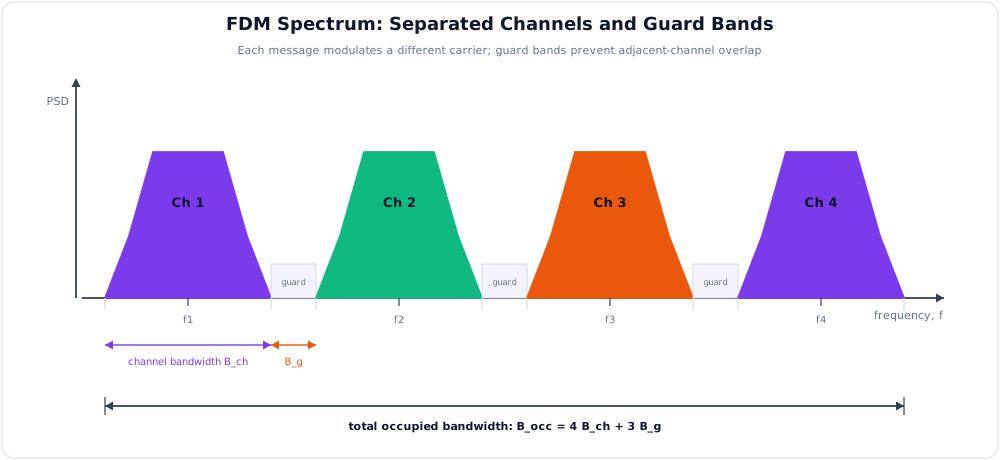
For a \(3\,\text{kHz}\) message, \(\lambda=3\times10^8/(3\times10^3)=100\,\text{km}\), giving an impractical quarter-wave antenna of \(25\,\text{km}\). At a \(100\,\text{MHz}\) carrier, \(\lambda=3\,\text{m}\) and a quarter-wave is \(0.75\,\text{m}\). Separate carriers also form the nonoverlapping FDM channels shown; guard bands accommodate filters and prevent adjacent overlap.
Modulation does not by itself remove noise or guarantee greater range. It consumes bandwidth and circuit resources, and the best carrier depends on spectrum regulation, propagation, antenna gain, available power and receiver sensitivity. Applications include broadcast AM/FM, aeronautical radio, microwave/satellite links and cellular systems.
Practice target: 7-8 minutes; define modulation, calculate antenna size, and explain at least five independent reasons.
Model Answer - Standard AM Derivation, Spectrum and Power [10 marks]
Exam-ready answer
In standard full-carrier amplitude modulation, the carrier amplitude varies linearly with the instantaneous message while carrier frequency and phase remain fixed. Let
With amplitude sensitivity \(k_a\), the modulation index is \(\mu=k_aA_m\) and
Using \(\cos A\cos B=\tfrac12[\cos(A+B)+\cos(A-B)]\),
Thus the spectrum contains a carrier at \(f_c\), upper sideband at \(f_c+f_m\) and lower sideband at \(f_c-f_m\). For a message limited to \(f_{m(max)}\) hertz, each sideband is a translated copy of the message and
From an oscilloscope envelope,
For \(0<\mu<1\) the envelope is faithful; at \(\mu=1\) it just reaches zero; for \(\mu>1\) it reverses/crosses zero and an envelope detector produces severe overmodulation distortion.
Across load \(R\) ohms, carrier power is \(P_c=A_c^2/(2R)\). Each sideband has amplitude \(\mu A_c/2\), hence
At the largest distortion-free single-tone value \(\mu=1\), \(P_T=1.5P_c\) and \(\eta_{max}=1/3=33.33\%\). The carrier consumes power but contains no unique message information, while USB and LSB carry duplicate information for a real message; this motivates DSB-SC and SSB. A low-level AM transmitter modulates before linear RF amplification, whereas high-level AM varies the final power stage. A diode-\(RC\) envelope detector is simple when \(\mu\leq1\); coherent detection is more linear but needs carrier synchronization.
As a check, if \(P_c=100\,\text{W}\) and \(\mu=0.6\), each sideband is \(9\,\text{W}\), total power is \(118\,\text{W}\) and efficiency is \(18/118=15.25\%\). Spectrally, a \(5\,\text{kHz}\) tone on \(1\,\text{MHz}\) produces lines at \(995\), \(1000\) and \(1005\,\text{kHz}\) with \(10\,\text{kHz}\) null span between sidebands.
Practice target: 16-18 minutes; derive the three spectral terms, draw the envelope/spectrum, and derive all four power relations.
Model Answer - AM Sideband Power and Efficiency Numerical [5 marks]
Exam-ready answer
For single-tone standard AM, the carrier power is \(P_c\), each sideband power is \(\mu^2P_c/4\), total sideband power is \(\mu^2P_c/2\), and total transmitted power is
Given \(P_c=500\,\text{W}\) and \(\mu=0.8\), the upper-sideband power is
By spectral symmetry, the lower sideband contains the same power:
Therefore \(P_{SB}=80+80=160\,\text{W}\) and
Transmission efficiency is the information-bearing sideband power divided by total transmitted power:
The same result follows directly from \(\eta=\mu^2/(2+\mu^2)=0.64/2.64\). The power balance \(500+80+80=660\,\text{W}\) is the numerical check. Since \(\mu=0.8<1\), the signal is under-modulated and its envelope does not cross zero, so ideal envelope detection is possible. The carrier alone consumes \(500/660=75.76\%\) of total power without carrying unique message information, illustrating standard AM's low power efficiency. At \(\mu=1\), the theoretical maximum efficiency would still be only \(33.33\%\); increasing \(\mu\) above unity is not a valid efficiency remedy because it causes overmodulation and envelope-detector distortion.
Practice target: 7-8 minutes; state the formulas, show units at every result, and verify that carrier plus both sidebands equals total power.
Model Answer - Standard AM, DSB-SC, SSB-SC and VSB [10 marks]
Exam-ready answer
All four schemes translate a baseband message to a band around \(f_c\), but differ in retained carrier/sidebands, bandwidth, power and detector complexity.
Standard AM is \(s(t)=A_c[1+k_am(t)]\cos\omega_ct\). It transmits the full carrier and both sidebands, occupies \(2B_m\) hertz for message bandwidth \(B_m\), and permits a simple envelope detector if \(|k_am(t)|\leq1\). For a single tone, \(P_T=P_c(1+\mu^2/2)\) and maximum useful-sideband efficiency is only \(33.33\%\). Its simplicity suits MF broadcast and some aviation voice.
DSB-SC is \(s(t)=A_cm(t)\cos\omega_ct\). It suppresses the carrier but keeps both translated sidebands, so bandwidth remains \(2B_m\). All ideal transmitted power is information-bearing, but a product detector with a phase/frequency-synchronized carrier is compulsory. It is used as a modulation building block, in stereo subcarriers and in I/Q systems.
SSB-SC retains only USB or LSB. With Hilbert transform \(\hat m(t)\),
Its bandwidth is \(B_m\) and it removes carrier plus the redundant sideband, giving the best AM-family bandwidth/power economy. It is generated by DSB-SC plus a sharp filter, quadrature phase cancellation or Weaver processing. Product detection with a BFO/PLL is required; frequency error shifts recovered audio pitch. It is preferred for HF, marine and aeronautical long-distance voice.
VSB transmits one full sideband and a small vestige \(B_v\) of the other, usually with a residual/full carrier according to system design. Its approximate bandwidth is \(B_m+B_v\), between SSB and DSB. The vestige allows a realizable transition near the carrier when the message extends to DC; classical analog television video is the standard application.
| Scheme | Transmitted components | Bandwidth | Detector | Main limitation |
|---|---|---|---|---|
| AM | Carrier + USB + LSB | \(2B_m\) | Envelope/coherent | Poor power efficiency; overmodulation |
| DSB-SC | USB + LSB | \(2B_m\) | Coherent | Carrier synchronization |
| SSB-SC | One sideband | \(B_m\) | Coherent/BFO | Accurate filtering and tuning |
| VSB | One sideband + vestige | \(B_m+B_v\) | Design-dependent | Residual-sideband/equalization complexity |
For \(f_c=1\,\text{MHz}\) and \(B_m=5\,\text{kHz}\), AM and DSB-SC occupy \(995\)-\(1005\,\text{kHz}\), SSB occupies either \(1000\)-\(1005\,\text{kHz}\) or \(995\)-\(1000\,\text{kHz}\), and VSB is only slightly wider than \(5\,\text{kHz}\). An envelope detector fails on ordinary DSB-SC/SSB because their envelope does not preserve the signed message. Thus standard AM trades efficiency for simplicity, SSB maximizes economy, and VSB is a practical filtering compromise.
Practice target: 16-18 minutes; draw aligned spectra, then compare components, bandwidth, power, detection, applications and limitations.
Model Answer - DSB-SC Generation and Coherent Detection [5 marks]
Exam-ready answer
In double-sideband suppressed-carrier (DSB-SC) modulation, an ideal product modulator multiplies the message by the carrier:
For \(m(t)=A_m\cos\omega_mt\),
Only USB and LSB appear; no standalone term at \(f_c\) exists, and bandwidth is \(2f_{m(max)}\).
A balanced transistor multiplier or four-diode ring generates DSB-SC. Symmetry makes equal carrier-feedthrough terms cancel while cross-products add. Mismatch and transformer imbalance leave a practical residual carrier, so an output bandpass filter removes switching harmonics and unwanted products.
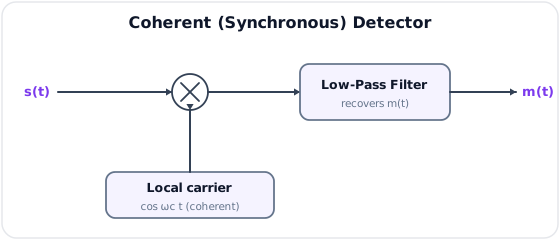
At the receiver, multiplication by \(2\cos(\omega_ct+\phi)\) gives
The LPF rejects the \(2f_c\) component and produces \(v_o(t)=A_cm(t)\cos\phi\). Thus phase error scales the output; at \(\phi=90^\circ\) it vanishes. A frequency error \(\Delta\omega\) produces \(m(t)\cos(\Delta\omega t+\phi)\), causing beats/fading, so a pilot, squaring loop or Costas loop restores carrier synchronization.
An envelope detector fails because the visible DSB-SC envelope is proportional to \(|m(t)|\), not signed \(m(t)\); each negative message excursion causes a \(180^\circ\) carrier-phase reversal that the envelope discards. Coherent detection preserves that sign and phase. DSB-SC saves carrier power but not bandwidth and is used as an SSB/IQ building block.
Practice target: 7-8 minutes; derive the two sidebands and the LPF output, then state phase/frequency-error effects and why envelope detection fails.
Model Answer - SSB-SC Generation, Detection and Performance [10 marks]
Exam-ready answer
Single-sideband suppressed-carrier (SSB-SC) transmits only the upper or lower sideband of a DSB-SC signal and ideally suppresses the carrier. For real message \(m(t)\) and its Hilbert transform \(\hat m(t)\),
The quadrature terms cancel one translated sideband and reinforce the other. If message bandwidth is \(B_m=f_{m(max)}\) hertz, then \(B_{SSB}=B_m\), half the bandwidth of AM/DSB-SC. Removing the carrier and one redundant sideband also gives the best power economy in the AM family.
Filter method: a balanced modulator first creates DSB-SC; a sharp crystal/mechanical bandpass filter passes USB or LSB. Generation is often at a fixed IF where narrow transition filters are practical, followed by mixing to the assigned RF. It becomes difficult when very low message frequencies make the two sidebands closely spaced.
Phase-shift method: one branch uses \(m(t)\cos\omega_ct\) and the other uses \(\hat m(t)\sin\omega_ct\). Accurate \(90^\circ\) message/carrier phase shifts and equal amplitudes allow addition/subtraction to cancel one sideband. Broadband phase/amplitude accuracy is its limitation. The Weaver method instead uses two quadrature mixing stages and low-pass filters and is convenient in DSP/IC systems.
Detection uses a product detector and reinserted carrier from a BFO, PLL or pilot. Mixing the selected sideband with \(2\cos[(\omega_c+\Delta\omega)t+\phi]\) translates it to baseband. Phase error changes recovered amplitude/phase, while carrier-frequency error \(\Delta f\) shifts every recovered audio component by that amount; speech then sounds unnaturally pitched. An ordinary envelope detector cannot recover suppressed-carrier SSB faithfully.
Advantages are half AM bandwidth, lower transmitter power, less received noise because of narrower filtering, and reduced selective-fading distortion. Limitations are generation/filter complexity, need for linear amplification, accurate tuning/carrier reinsertion and poor fidelity when the BFO is offset. SSB is used for HF long-distance, aeronautical, marine and amateur voice. For a \(300\)-\(3000\,\text{Hz}\) voice band on \(10\,\text{MHz}\) USB, the occupied RF is \(10.0003\)-\(10.0030\,\text{MHz}\), only \(2.7\,\text{kHz}\); DSB would require twice that span. This numerical placement also shows why a receiver-frequency error of even tens of hertz is audible.
Practice target: 16-18 minutes; write the Hilbert expressions, draw both generation methods, and cover detection error, advantages, limitations and applications.
Model Answer - Frequency and Phase Modulation [10 marks]
Exam-ready answer
In angle modulation, carrier amplitude is constant and information changes instantaneous angle:
In frequency modulation (FM), instantaneous frequency deviation is proportional to the message:
where \(k_f\) is in hertz per message unit. Integrating angular frequency gives
For \(m(t)=A_m\cos2\pi f_mt\), peak deviation is \(\Delta f=k_fA_m\) hertz and
In phase modulation (PM), phase deviation is directly proportional to the message:
where \(k_p\) is radians per message unit. For the same sinusoid, \(\beta_p=k_pA_m=\Delta\phi_{max}\) radians and
The waveform shows constant envelope in both cases. In FM, cycles compress or spread according to message amplitude; in PM, greatest instantaneous frequency departure occurs where message slope is greatest. For fixed \(A_m\), FM peak deviation is independent of \(f_m\) while \(\beta\) decreases as \(f_m\) rises. PM phase index is independent of \(f_m\), but its frequency deviation rises in proportion to \(f_m\). FM can therefore be generated by integrating \(m(t)\) before a PM modulator; PM can be generated by differentiating \(m(t)\) before an FM modulator.
Both allow efficient nonlinear RF power amplification and amplitude limiting, but generally require more bandwidth than AM. Practical FM uses transmitter pre-emphasis to boost high audio frequencies and complementary receiver de-emphasis to restore response while suppressing high-frequency demodulated noise. FM is detected by a discriminator or PLL; PM uses a phase detector/PLL, or an FM discriminator followed by integration.
For FM with \(\Delta f=50\,\text{kHz}\) and \(f_m=10\,\text{kHz}\), \(\beta=5\). For PM with \(\beta_p=2\) radians at the same \(f_m\), \(\Delta f=20\,\text{kHz}\). Total ideal angle-modulated power is constant, \(P_T=A_c^2/(2R)\), but it is distributed among carrier and many Bessel sidebands. Capture and threshold effects limit weak-signal FM, and oscillator/phase noise limits both schemes.
Practice target: 16-18 minutes; derive both expressions from instantaneous angle, define indices with units, then compare deviation behavior and generation/detection.
Model Answer - Narrowband/Wideband FM, Spectrum and Carson's Rule [10 marks]
Exam-ready answer
For a sinusoidal message, an FM signal is
where \(\Delta f\) is peak frequency deviation in hertz and \(f_m\) is modulating frequency in hertz. Narrowband FM (NBFM) has \(\beta\ll1\); using the small-angle approximation, only the carrier and first sideband pair are important and bandwidth is roughly \(2f_m\). Wideband FM (WBFM) has \(\beta>1\) and several significant sideband pairs, giving better potential noise performance at the cost of bandwidth. These are engineering descriptions rather than an abrupt physical boundary.
The exact single-tone Bessel expansion is
Therefore spectral lines occur at \(f_c\pm nf_m\) for \(n=0,1,2,\ldots\); carrier amplitude is \(A_cJ_0(\beta)\) and each \(n\)th sideband amplitude follows \(A_cJ_n(\beta)\) with sign representing phase. The theoretical spectrum is infinite, but high-order terms become negligible. At zeros of \(J_0\), the spectral carrier component vanishes even though the transmitted waveform still has constant amplitude. The identity \(\sum_{n=-\infty}^{\infty}J_n^2(\beta)=1\) proves that total power remains \(A_c^2/(2R)\) while being redistributed among lines.
An engineering estimate containing about \(98\%\) of power is Carson's rule:
for a single highest-frequency tone. It is approximate; exact occupied bandwidth depends on message spectrum and the specified power mask. For broadcast values \(\Delta f=75\,\text{kHz}\) and \(f_{m(max)}=15\,\text{kHz}\), \(\beta_{max}=5\) and
A nominal \(200\,\text{kHz}\) channel therefore leaves allowance for filters/guarding. By comparison, an AM signal carrying \(15\,\text{kHz}\) audio needs only \(30\,\text{kHz}\). WBFM uses this extra spectrum to gain noise immunity above threshold; a limiter removes amplitude noise, and pre-emphasis/de-emphasis improves high-frequency audio SNR. Below the FM threshold, however, output noise rises abruptly, and the capture effect favors the stronger co-channel signal. These limitations mean wider bandwidth is not a free improvement and must be supported by channel allocation and adequate input carrier-to-noise ratio.
Practice target: 16-18 minutes; define both FM classes, label Bessel lines and amplitudes, prove constant power, and complete one Carson calculation.
Model Answer - FM Generation and Detector Comparison [10 marks]
Exam-ready answer
An FM generator must produce \(f_i(t)=f_c+k_fm(t)\), and an FM detector must convert deviation \(f_i-f_c\) back to a proportional voltage.
Direct FM: the message controls a VCO, varactor-tuned LC oscillator or reactance modulator, directly changing resonant frequency. It is simple and can provide large deviation, but modulating the oscillator can impair center-frequency stability. A slow PLL may stabilize the average carrier while allowing message-rate deviation.
Armstrong indirect FM: a crystal oscillator supplies a stable carrier; the message is integrated and applied to a phase modulator to create narrowband FM. Frequency multipliers increase both carrier frequency and deviation, and mixers place the result in the assigned band without changing deviation. Its frequency stability is excellent, but it needs more stages and careful multiplication/mixing.
Every detector has an S-shaped transfer near \(f_c\), with zero output at center and opposite polarities above/below it.
- A slope detector places \(f_c\) on a tuned-circuit slope so FM becomes AM, then envelope-detects it. It is simple but nonlinear, narrow-range and amplitude-noise sensitive; a limiter is required. A balanced pair improves symmetry.
- A Foster-Seeley discriminator uses a double-tuned transformer to convert frequency deviation into phase/diode-voltage imbalance. It has high output and very good linearity but responds to amplitude, so a preceding limiter is essential.
- A ratio detector uses related transformer/diode connections and a large capacitor to hold the diode-voltage sum approximately constant. The output ratio rejects AM variation inherently, usually avoiding a separate limiter, though output and linearity may be lower than a well-aligned Foster-Seeley circuit.
- A PLL detector makes its VCO follow the incoming FM. Within lock and loop bandwidth, control voltage is
where \(K_{VCO}\) is in hertz per volt. It offers excellent linearity, amplitude immunity and IC integration without a precision transformer.
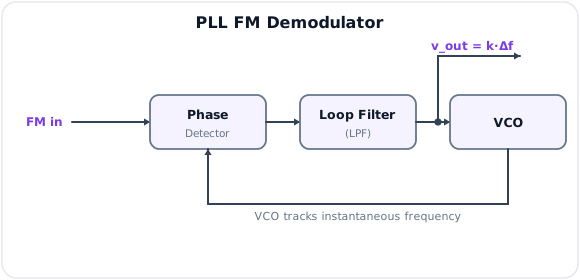
The detector must cover peak deviation without leaving its linear/lock range, and its bandwidth must pass the highest message frequency while rejecting noise. A de-emphasis network follows detection in broadcast FM. If \(K_{VCO}=100\,\text{kHz/V}\) and input deviation is \(75\,\text{kHz}\), the PLL control deviation is about \(0.75\,\text{V}\), verifying the proportional conversion. Slope and Foster-Seeley circuits need limiting; ratio and PLL methods provide more inherent AM rejection. Direct generation favors simplicity/large deviation, whereas Armstrong favors carrier accuracy.
Practice target: 17-19 minutes; draw both generators, sketch an S-curve, and compare the four detectors by principle, limiter need, linearity and limitation.
Model Answer - AM and FM Comparison [5 marks]
Exam-ready answer
In AM, carrier amplitude follows the message:
whereas in FM, instantaneous frequency follows it:
| Feature | AM | FM |
|---|---|---|
| Information parameter | Amplitude | Instantaneous frequency |
| Envelope/power | Varies; \(P_T=P_c(1+\mu^2/2)\) | Constant ideal envelope; \(P_T=A_c^2/(2R)\) |
| Bandwidth | \(2f_{m(max)}\) | Carson: \(2(\Delta f+f_{m(max)})\) |
| Noise performance | Amplitude noise is detected | Better above threshold after limiting |
| RF power amplifier | Must preserve envelope | Efficient saturated/nonlinear PA possible |
| Receiver | Simple envelope detector possible | Limiter plus discriminator/PLL |
| Distinct effects | Overmodulation for \(\mu>1\) | Capture and threshold effects |
| Applications | MF broadcast, aviation voice | VHF broadcast, telemetry, two-way radio |
For \(f_{m(max)}=15\,\text{kHz}\), AM needs \(30\,\text{kHz}\). Broadcast FM with \(\Delta f=75\,\text{kHz}\) needs about \(180\,\text{kHz}\) by Carson's rule, so FM trades spectrum and circuit complexity for better noise immunity/fidelity. AM is power-inefficient because its carrier contains no unique information, but reception is inexpensive. FM uses constant transmitter power and supports amplitude limiting and pre/de-emphasis, yet below its threshold quality collapses rapidly. Neither is universally superior: AM suits bandwidth- and cost-limited links, while FM suits links where bandwidth is available and noise performance is more important.
Practice target: 7-8 minutes; state both defining equations and compare at least seven features including bandwidth and special distortions.